Another Poll ... This time mainsail type

What kind of reefing do you have on your own boat, or which do you look for when chartering?

  • In-mast reefing

    Votes: 12 13.5%
  • In-boom reefing

    Votes: 3 3.4%
  • Standard slab reefing (no lazyjacks)

    Votes: 13 14.6%
  • Slab reefing with lazyjacks

    Votes: 60 67.4%
  • Something else (e.g. Topper wrap round mast, Topcat Catamaran without any reefing etc.)

    Votes: 1 1.1%

  • Total voters
    89
I've heard the XOD described as a 'wooden washing machine'. I've got toe straps on my little boat, a Flying Fifteen. In a big blow and full of water from going down the mine, I've managed to turtle it and wave the keel in the air.

Star boats, serious spaghetti factor! Nothing else points so well, 6 meters excepted.
Your impressions of the X are correct. On the plus side, the ballast ratio is nearly 50% and they are very hard to drive the bow under, the kite is small. The current fleet champions have a combined mass of 360kg though, and whilst they are indeed very good, weight helps a lot. XODs used to reef, many years ago, but it’s long been an arms race of pie eating and baggy sails. It always blows hard for Cowes Week.
 
The one time I did Cowes week around half the races were cancelled on account there being no wind and the sea breeze didn’t make it to the central Solent.

Back to the OP, I think my boat is one of two on the pontoon with a traditional mainsail cover rather than either in mast or a stack pack.
 
Last edited:
You left out roller reefing.

"Something else" of course covers it, but (at least for the "Once upon a time" applicable to OLD boats) it might merit its own category.,
 
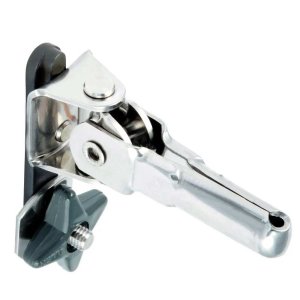
I had an Enterprise when I was a kid. You could reef that in light airs by rolling the main around the boom. The goose neck had a square end which slotted in to the boom to stop it rotating.

Of course in a decent bit of wind the gooseneck fitting would compress and the sail would un-ravel.
As I said, it worked well for light winds.

allen-sliding-gooseneck-a4114-2a.jpg

As much use as a chocolate tea pot.
 
11.5m Catamaran, 45m^2 main, three reefs, the third reef (which I specified) reduced the sail to 15m^2 - which we used a lot. We could do all the reefing from the cockpit and all the reefing lines and main halyard were to starboard.

Jonathan
 
Fully battened slab-reefed main with separate luff and leech reefing pennants led to the cockpit, the easiest and safest system I have come across. Makes reefing possible on almost all points of sail. It came with the boat and I’m very happy with the first owner’s choice.
 
Last edited:
I’ve got both slab (removeable lazy jacks) and in-mast as I have 2 boats. The slab is far nicer - it sails better, but is a bit more work and riskier (involves going to the mast and leaving the cockpit). If I bought new I’d have slab reefing. I have a high risk tolerance, it needs saying. Not for everyone I understand.
 
I had an Enterprise when I was a kid. You could reef that in light airs by rolling the main around the boom. The goose neck had a square end which slotted in to the boom to stop it rotating.

Of course in a decent bit of wind the gooseneck fitting would compress and the sail would un-ravel.
As I said, it worked well for light winds.

View attachment 208245

As much use as a chocolate tea pot.
That wasn't designed for reefing. Enterprises originally had smaller cruising sails for strong winds.
Then we fitted 16:1 or 32:1 kicking straps and just went for it with full sail.
I think we had about 80kg total crew weight when I raced Enterprises - very fast in light winds but needed very hard work and board half up to go upwind beyond F3.
Cruising sails or reefing would have been permanent disgrace, so just left swimming periodically.
 
Last edited:
Top