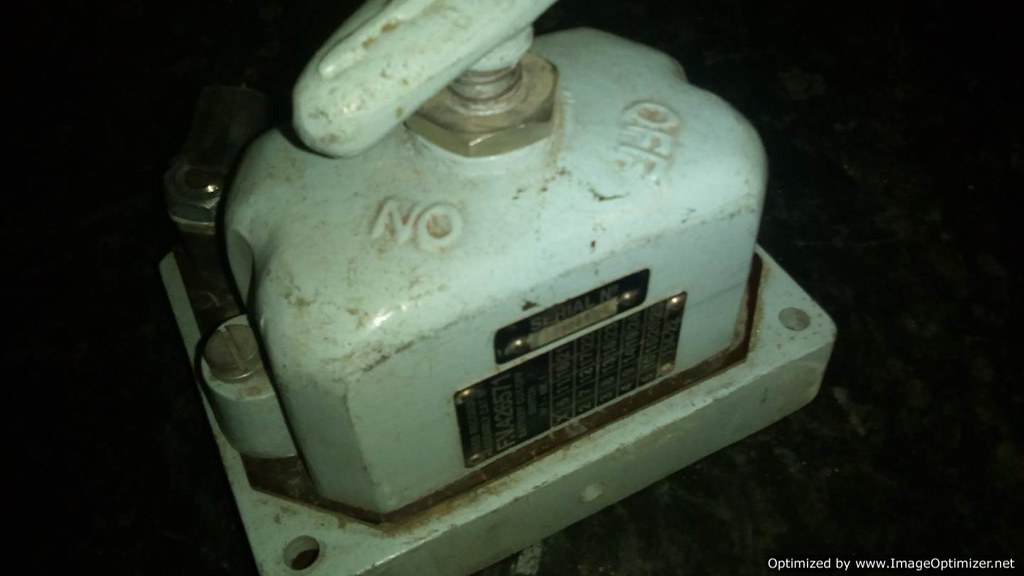
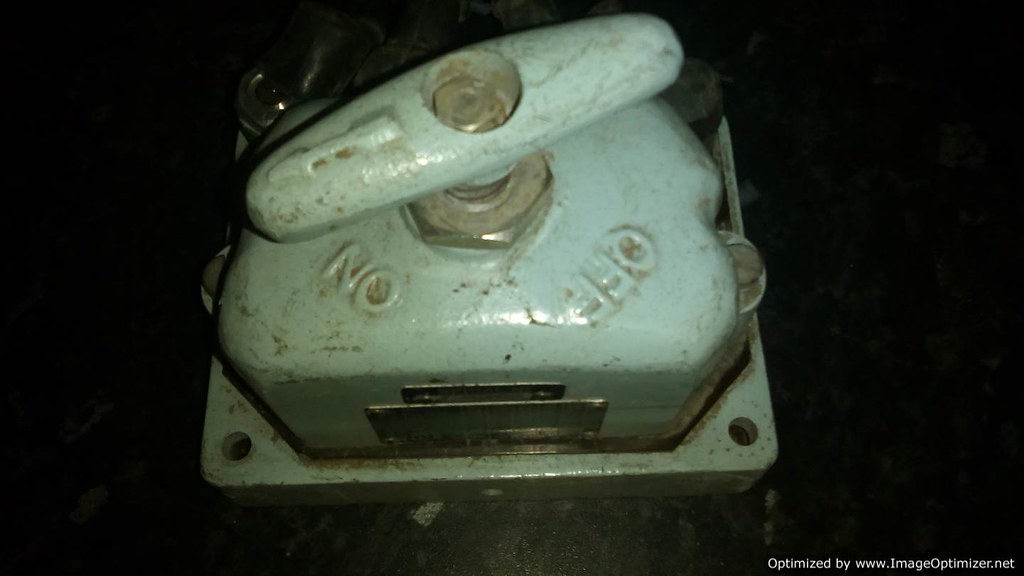
Another one bites the dust

Ok, the set up with 3 switches. Turn engine switch on, to me that is the same as turning my 12b to 1. Turn domestic on and turn 1 off is the same as me turning my 12b to 2. ( which I can't do without a break as it's make before break as long as I go through both and not through off) If you turn your emergency on that to me is the same as me turning my 12b to both.
I can charge either battery independently or together and can isolate either bank.
What am I missing?

OK, so James boat has three batteries, two are connected in parallel and the 3rd is on its own. So turn the engine switch to on, that is not the same as 1 on your switch, as only the engine circuits are live. Turn the domestics on, no need to turn the engine switch off, now the domestic circuits are live, along with the engine. Both circuits are separate though, unlike the 12B where they are just a big bank of three batteries.

How do you charge all batteries, whilst still keeping the engine battery separate from the domestic circuits, for instance ?

What happens when you anchor and forget to take the switch off of "Both" ?

What happens when you're underway and using the both setting and a battery fails, flattening all batteries ?
 
I have separate banks - a pair of really chunky lead acids running everything domestic (used to be AGMs when I could afford them) and a deep-cycle engine starter. Separate circuits, splitter and intelligent charger.

For that rare occasion after some years when the engine battery gives up the ghost after some time unattended and off charge (happened a year ago, requiring just a replacement 110Ah deep cycle engine battery), is my backup plan of a pair of heavy-duty jump leads OK, to run between the battery banks for the time it takes to crank the starter motor? That’s my emergency ‘Both’ switch. Of course, I could always disconnect the engine battery or the domestic load with a spanner before using the leads to bridge from domestic bank to starter lead - but the simplest plan is just to jump-start in situ as we do with cars. If the experts agree...?
 
I have separate banks - a pair of really chunky lead acids running everything domestic (used to be AGMs when I could afford them) and a deep-cycle engine starter. Separate circuits, splitter and intelligent charger.

Why would you spend money on a deep-cycle battery to use for engine starting?:confused:
 
Why would you spend money on a deep-cycle battery to use for engine starting?:confused:

although not "technically correct" a deep cycle battery that is a fair amount more than big enough to crank the engine will theoretically last longer than an SLI . The potential downfall is the occasion you may need to be cranking over for a prolonged period
 
I have separate banks - a pair of really chunky lead acids running everything domestic (used to be AGMs when I could afford them) and a deep-cycle engine starter. Separate circuits, splitter and intelligent charger.

For that rare occasion after some years when the engine battery gives up the ghost after some time unattended and off charge (happened a year ago, requiring just a replacement 110Ah deep cycle engine battery), is my backup plan of a pair of heavy-duty jump leads OK, to run between the battery banks for the time it takes to crank the starter motor? That’s my emergency ‘Both’ switch. Of course, I could always disconnect the engine battery or the domestic load with a spanner before using the leads to bridge from domestic bank to starter lead - but the simplest plan is just to jump-start in situ as we do with cars. If the experts agree...?

Jump leads should work fine. You will probably only need the red one :-)

But like with cars, the trouble with having jump leads aboard is that you get drawn into other people's cock-ups.
 
Thanks.

In my case I'll carry on with too much worrying then. Double check everything is looking good inside once or twice a year. At least you can get into the Vetus for look - just looked at a Seaworld on/off stashed in a box, can't even get in there for a look!, big black mark IMHO. Are they known as a good brand?

Looks like this -
https://www.sheridanmarine.com/product/battery-master-switch-key

No problem at all with those switches. I have one on my Jenson and we fitted them to rally cars as a main isolator in case of rollover. I also fitted one to my single outboard motor boat.

That type has been around for years in the motor sport world.
 
I removed the 1-2-B switch from my boat because my (sometimes reluctant) crew needed to have a simple solution that involved very little instruction.
Given that a couple of friends use the boat too - I needed to be sure that switching on was just on/off so I fitted a Blue Sea combined version.
 
I have separate banks - a pair of really chunky lead acids running everything domestic (used to be AGMs when I could afford them) and a deep-cycle engine starter. Separate circuits, splitter and intelligent charger.

For that rare occasion after some years when the engine battery gives up the ghost after some time unattended and off charge (happened a year ago, requiring just a replacement 110Ah deep cycle engine battery), is my backup plan of a pair of heavy-duty jump leads OK, to run between the battery banks for the time it takes to crank the starter motor? That’s my emergency ‘Both’ switch. Of course, I could always disconnect the engine battery or the domestic load with a spanner before using the leads to bridge from domestic bank to starter lead - but the simplest plan is just to jump-start in situ as we do with cars. If the experts agree...?

Jump leads will work and would be a better solution than messing around disconnecting leads. If you keep all of the negatives permanently connected together you would only need the red lead for the positives.

The setup in my OP uses a third switch in place of your red jump lead. It would be preferable to a jump lead if the engine battery had failed, as you can turn the engine switch off and the emergency switch on, starting and continuing to run the engine from the domestic bank. Same method can be used if the domestics fail (more unlikely) to run them from the engine battery. It is also quicker and easier than jump leads of course. A typical time to want to start the engine is when you drop the sails as you come into port, that might not be the best time to be looking for the jump leads.
 
Paul R - I think I've installed a similar system in my boat, in that I have two batteries with individual on/off switches and charged through a VSR which I fitted last year , replacing the 12B switch. The VSR has a low power relay over-ride function; will this do the same as your central switch or is it more akin to the 'both' function on a 12B switch?
 
Paul R - I think I've installed a similar system in my boat, in that I have two batteries with individual on/off switches and charged through a VSR which I fitted last year , replacing the 12B switch. The VSR has a low power relay over-ride function; will this do the same as your central switch or is it more akin to the 'both' function on a 12B switch?

The Victron VSR that i use has the same function, it basically overrides the voltage sensing circuitry and manually closes the relay. This means the bank are now in parallel, the same as my "emergency" switch, which is also the same as the "both" setting in the 12B switch.

You are limited though by the max rating of the VSR, 120a for the Victron and 14a for the BEP, for instance. To get those ratings you also have to fit suitable cables, 16mm² for the Victron and 20mm² for the BEP. I think those cable sizes are a bit heavy for normal charging, the function has limited use and there is still now way to isolate one battery and run everything from the other, for an extended time, if a battery fails.

So i prefer to limit the VSRs use to charging, connecting it with lighter cable and fusing according to those cables, then fitting the third switch to cover the other backup functions.
 
No problem at all with those switches. I have one on my Jenson and we fitted them to rally cars as a main isolator in case of rollover. I also fitted one to my single outboard motor boat.

That type has been around for years in the motor sport world.


Sorry Roger, but i disagree. Fitting them to cars is not the same as fitting them to boats.

Yes, the "type" has been around for years, but there are many versions of the "type". Quality is variable, as with everything, but more important current rating is also very variable. The Seaworld switch that GHA refers to is a low amperage device IIRC, about 100a max @12v, maybe 75a continuous ? Perhaps GHA could confirm this ?

As i said, on a cruising boat (such as GHAs) i would't want to fit them. Connecting such a low amperage switch to the domestic circuits of a boat that may well have a windlass or bow thruster is asking for trouble, so is fitting one to something with a reasonably sizable inboard, bleeding the fuel system would be an interesting test for the switch.
 
The Seaworld switch that GHA refers to is a low amperage device IIRC, about 100a max @12v, maybe 75a continuous ? Perhaps GHA could confirm this ?.

No markings on it - the link from google looks like the same says 100A continuous 500A peak.

Regardless of that, I'm that not keen on anything I can't take apart and have a good look at so these might find some low power non critical use but won't be wearing the "big boys pants" :)
 
The Victron VSR that i use has the same function, it basically overrides the voltage sensing circuitry and manually closes the relay. This means the bank are now in parallel, the same as my "emergency" switch, which is also the same as the "both" setting in the 12B switch.

You are limited though by the max rating of the VSR, 120a for the Victron and 14a for the BEP, for instance. To get those ratings you also have to fit suitable cables, 16mm² for the Victron and 20mm² for the BEP. I think those cable sizes are a bit heavy for normal charging, the function has limited use and there is still now way to isolate one battery and run everything from the other, for an extended time, if a battery fails.

So i prefer to limit the VSRs use to charging, connecting it with lighter cable and fusing according to those cables, then fitting the third switch to cover the other backup functions.
Thanks very much for that. Sorry for the digression
 
Top