Another one bites the dust

This is probably what prompted the new owner of the boat to get the electrics looked at :)

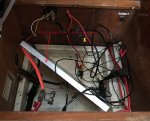
Battery box before :

Electrics05.jpg

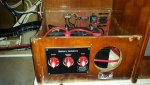
After :

20180119_151430.jpg

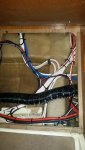
Panel beneath the chart table, look closely in the middle and you can see the lovely choc blocks, the block of six is connecting a fragile pair of NMEA data wires for the GPS to VHF/DSC, before ;
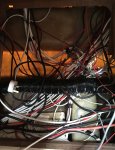
Electrics06.jpg

After :

20180119_151442.jpg

Don't think the decision to do something was "panicked" :D
 
What's the mode of failure please?

Bad contacts, probably made worse by switching from bank to bank under load, would be the most common. Sometimes the switch needs to be turned back and forth to get it to turn on, sometimes they just don't work. It's fair to say that some are old switches, but some are newer, the newer ones are definitely not as robust as those old Vetus switches were.

For me though, a key factor is the singe point of failure issues, if we are just talking about the reliability of switches.
 
.... The number of RNLI "rescues" of boats which can't start the engine would reduce dramatically if everyone changed to a foolproof system.

I suspect a significant number of engines which won't start are on small craft with a single battery, but I might be wrong on that.
Also a few reports I've seen seem to involve yachts a bit too modern for a 1B2 switch to be normal equipment?
I suspect the data might get a bit skewed because people with older yachts are perhaps more likely to sail to the pub than call the RNLI if the motor won't start?
Also how many non-starting motors are due to the cranking battery being flat? It's happened to me on shore and on the mooring, never at sea. There are many other things which can stop an engine.

I suspect the biggest danger is fools who think their system is foolproof.
 
What's complex about turning a switch on or off ? Arrive at boat, turn domestics on. Time for the engine, turn it on.

Or in my case: Arrive at boat, turn one switch through 90o to turn on everything. Four weeks later, turn off an go home. An engine which needs isolated whenever it's not running sounds very dodgy.
 
Why the change ?

I have limited space for batteries, so decided to connect the two I had together as one house bank with an extra one (an old 063 from my Herald, which has an 038 again as God intended) tucked away as a start. Since that gave me a very unbalanced storage, it seemed to make sense to separate the two circuits at the same time; before that I just chose 1 or 2 and ran on that, reserving the other as spare.

Given that I had two circuits, I took a fairly standard engineering approach to the switching - make the things which need to be done often the easiest to do. Hence a BlueSea dual+combine switch and rather less accessible breakers for each bank if I need to do a medium term configuration.

Nice and easy. Works for me.
 
Bad contacts, probably made worse by switching from bank to bank under load, would be the most common. Sometimes the switch needs to be turned back and forth to get it to turn on, sometimes they just don't work. It's fair to say that some are old switches, but some are newer, the newer ones are definitely not as robust as those old Vetus switches were.

For me though, a key factor is the singe point of failure issues, if we are just talking about the reliability of switches.

Thanks.

In my case I'll carry on with too much worrying then. Double check everything is looking good inside once or twice a year. At least you can get into the Vetus for look - just looked at a Seaworld on/off stashed in a box, can't even get in there for a look!, big black mark IMHO. Are they known as a good brand?

Looks like this -
https://www.sheridanmarine.com/product/battery-master-switch-key
 
An engine which needs isolated whenever it's not running sounds very dodgy.

Where did that idea come from? Nobody has said that apart from you. The engine battery just has its own isolator. No reason why you cannot leave it on all the time you are on the boat, although no need if you are only using the domestic circuits.

Look at my description in post#59 on the other electrics thread. What could be more simple than that? There are 3 banks fulfilling 3 different purposes and you switch on each as and when you need them. Charging is done automatically when the engine is running ensuring the start battery is always charged and can never run flat by being used for other purposes.
 
Last edited:
Or in my case: Arrive at boat, turn one switch through 90o to turn on everything. Four weeks later, turn off an go home. An engine which needs isolated whenever it's not running sounds very dodgy.

I agree. When i'm just on the boat in the marina i only turn the domestic switch on. I turn the engine switch on when i need to use the engine, but it doesn't get turned off until i leave the boat.

I have limited space for batteries, so decided to connect the two I had together as one house bank with an extra one (an old 063 from my Herald, which has an 038 again as God intended) tucked away as a start. Since that gave me a very unbalanced storage, it seemed to make sense to separate the two circuits at the same time; before that I just chose 1 or 2 and ran on that, reserving the other as spare.

Given that I had two circuits, I took a fairly standard engineering approach to the switching - make the things which need to be done often the easiest to do. Hence a BlueSea dual+combine switch and rather less accessible breakers for each bank if I need to do a medium term configuration.

Nice and easy. Works for me.

Ah yes, i remember you saying you had the BlueSea switch. I had one of those on my last boat, nicely made and typical BlueSea quality. In everyday use it's pretty much the same as having the 3 switches i use now. It certainly has all of the everyday simplicity and keeps both circuits separate. It doesn't allow a faulty battery to be isolated without getting a spanner out, but you know that :encouragement: Other than that minor issue (and you might never even need to isolate a battery) it offers all of the advantages of dual circuits. Good stuff.
 
Thanks.

In my case I'll carry on with too much worrying then. Double check everything is looking good inside once or twice a year. At least you can get into the Vetus for look - just looked at a Seaworld on/off stashed in a box, can't even get in there for a look!, big black mark IMHO. Are they known as a good brand?

Looks like this -
https://www.sheridanmarine.com/product/battery-master-switch-key

I'd be very reluctant to fit those. If you need a backup for the Vetus i have the one i took off of my boat when i changed to dual circuits. Yours for the cost of postage.
 
Why the heck do we need isolator switches? Thousands, nay, millions of vehicles are circulating this planet without the need of isolators and of course they are all spontaneously bursting into flames! These threads regarding 12b etc are verging on meglomania. Get over it, get a life and realise despite your personal views some people regard them as acceptable solution.
 
Last edited:
I'd be very reluctant to fit those. If you need a backup for the Vetus i have the one i took off of my boat when i changed to dual circuits. Yours for the cost of postage.

Think they're be resigned for non critical use. Ta for the very kind offer - but postage ain't so easy when you don't have an address ;) There is another vetus still attached to a bulkhead which will hopefully clean up OK.
 
Why the heck do we need isolator switches? Thousands, nay, millions of vehicles are circulating this planet without the need of isolators and of course they are all spontaneously bursting into flames! These threads regarding 12b etc are verging on megalomania. Get over it, get a life and realise despite your personal views some people regard them as acceptable solution.

Who said it was anything to do with stopping a boat bursting into flames? It is about managing your battery banks simply - or don't you bother to read what is being written?

Just because, according to you, some people regard them as acceptable does not mean that there is not a better solution available.
 
Who said it was anything to do with stopping a boat bursting into flames? It is about managing your battery banks simply - or don't you bother to read what is being written?

Just because, according to you, some people regard them as acceptable does not mean that there is not a better solution available.

Touchy.
 
Why the heck do we need isolator switches? Thousands, nay, millions of vehicles are circulating this planet without the need of isolators and of course they are all spontaneously bursting into flames! .....

This is true, but in my experience, cruiser-racers are more likely to get filled with salt water than the average Mondeo. And if you should manage to have an electrical fire with a car or motorbike, it's relatively easy to stop and walk away.
A lot of vehicles do have battery isolators, e.g. race cars.
 
That's silly, what i fitted is nothing like a 12B switch and requires no manual intervention, other than turning the switches on when you arrive and off when you leave.
Ok, the set up with 3 switches. Turn engine switch on, to me that is the same as turning my 12b to 1. Turn domestic on and turn 1 off is the same as me turning my 12b to 2. ( which I can't do without a break as it's make before break as long as I go through both and not through off) If you turn your emergency on that to me is the same as me turning my 12b to both.
I can charge either battery independently or together and can isolate either bank.
What am I missing?
 
Last edited:
Our boat from new was fitted with a 3-way diode splitter for 3 possible battery banks. A previous owner had the three diode outputs crimped together and fed to a 1-2-B in such a way that on each position all charging and domestic services were linked to the selected batterie(s). I was paranoid about open circuiting the alternator with a dodgy 1-2-B contact so always left it on "both", making sure things didn't discharge too much.

Needless to say I have revised the system with a Smartguage system (similar to a VSR) and now have a functional three bank system that now uses the original fit battery selector for domestic services. Starter and windlass are directly connected to their own batteries. All banks have isolators.

Anyone want a 1-2-B switch?
 
A system designed to rely on humans is a bad system prone to failure
Can I suggest then that you never take your boat out !

A system made overly complex with a complicated electrical relay device, yet still requiring three switches is also a bad system prone to failure (IMHO). I note that Paul even mentions 'if the VSR fails'.

My own current boat has twin engines / alternators / batteries so has effectively two completely separate electrical systems with a cross connect relay, but if or when I do go back to a single engine set up I would likely remove any VSR in favour of a O - 1 - B - 2 - O. That said I was taught from the off that the battery switch is changed whenever the engine is started or stopped. A bit like the tiller is held, when the lines are cast off.
 
Can I suggest then that you never take your boat out !

A system made overly complex with a complicated electrical relay device, yet still requiring three switches is also a bad system prone to failure (IMHO). I note that Paul even mentions 'if the VSR fails'.

Blimey, it's a relay, not really complicated. I do of course mention possible failure, everything can fail. If the VSR were to fail the engine battery carries on charging regardless, the domestics can still be charged using the emergency switch. That's the "failsafe" and "backup" i keep talking about (or just one of them). On a single engine boat with a 12B switch there is no failsafe or backup when the switch fails, for instance.
 
Top