Another astronomical question

William_H

Well-Known Member
Joined
28 Jul 2003
Messages
14,429
Location
West Australia
Visit site
Inspired by the question on longitude. We were setting up a new season yacht club sailing calender. Our night race series have been a flop in participation due to difficult Yachting Australia regs requiring cat 5 compliance. So we came up with a series of 6 races around the summer solstice where we could finish before dark on a Friday night. We don't have summer time clock shift so went to https://www.timeanddate.com/sun/australia/perth?month=12&year=2018 to get official nautical twilight as a definite last time to finish before dark.
Ok so from this chart it seems that sun set is later in January where I assumed latest sunset time would be 23 Dec. Why?
Now Perth is situated right on the western edge of the time zone (longitude) but Ican't see how that changes anything.
Anyone got any ideas. ol'will
 
It's all done by mirrors!


Basically your astronomical noon varies a bit around the clock noon (which is an average of the astronomical noon) due to variations in Earth's orbit round the sun (it's not circular or at a constant speed). As a result sunrise starts getting later, enough to start shortening the day, while sunset is still getting later, but less so. earliest sunrise and latest sunset don't fall on the longest day.

It's interesting once you've noticed it.

Someone will come along shortly tell you about annalemna.
 
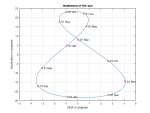
Me! The analemma is traditionally plotted on old globes, around the middle of the Pacific as there's little else there to plot and is a sort of lop-sided figure of eight. See below:

analemma.png

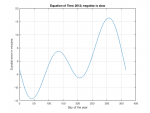
Another way to view it is as a sundial error, see:

sundial_error.png
 
Last edited:
The problem arises because of the way we normally define "day". If "one day" was defined as the time it takes for one complete rotation of the Earth then all days would last the same length (the Sidereal Day). But we define "a day" as the time between one noon and the next (the Solar Day). This has two components - the rotation of the Earth on its axis, which takes about 23 hours and 56 minutes, and the apparent motion of the Sun as the Earth orbits it, which accounts for the rest. Because the Earth's orbit is elliptical and not circular the Earth's orbital speed varies, depending on where in its orbit it is (see Kepler's Laws of Planetary Motion), so the orbital component of the day length also varies. Because it would be inconvenient (to say the least) if the units of time which are subdivisions of a day were not constant, the value we use for the "day" is an average over the year. This means that the actual noon-to-noon time on any particular calendar day and the next will sometimes be greater than and sometimes less than the length of our average, standard "day". This means that for any place astronomical noon will vary with respect to clock noon even when corrected for longitude. Daylight length is symmetrical about astronomical noon, not clock noon, which accounts for the phenomenon the OP describes and is responsible for the horizontal (left-to-right) variation of the Sun's position on the analemma. The vertical (up-and-down) analemma variation is due to the angle of the Earth's axis to the plane of its orbit (the "obliquity of the ecliptic") which accounts for the Seasons, including variation in daylight hours.
 
Last edited:
Top