Anode and outdrive advice

jon and michie

Well-Known Member
Joined
28 Dec 2014
Messages
1,784
Visit site
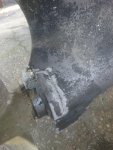
Hi - After having my boat lifted out the other week I managed to get to see her last weekend and was a little shocked to say the least at how one of the outdrive anodes has disintegrated after only been in the water for 3 months.
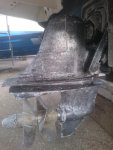
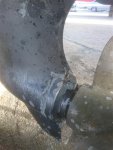
DSC_0211 (Medium).jpg DSC_0204 (Medium).JPG DSC_0205 (Medium).jpg

Long story short when previous owner had her the leg casing was in a really bad way corrosion wise and new casing was sourced while the props was off, I spoke to the broker to put new bellows on and a new ring anode - so basically a new ready to go leg.

I took some advice from a neighbouring boater who suggested adding extra anode to the leg which I am definitely contemplating can anyone shed any light on how this has gone so quickly ?
many thanks in advance
Jon
 
Do you leave your shorepower connected when you're away from the boat? Have you got a hull anode as well? Doesn't the dpg have other anodes - what state are they in?
 
Hi Jimmy - yes I have left shore power connected I don't have a hull anode the dpg has a bar anode at the hull side where the leg attaches (don't know the name for that bit yet) which never got replaced and was about 50 % used - I am thinking it has something to do with the marina power though

Jon
 
Hi Jimmy - yes I have left shore power connected I don't have a hull anode the dpg has a bar anode at the hull side where the leg attaches (don't know the name for that bit yet) which never got replaced and was about 50 % used - I am thinking it has something to do with the marina power though

Jon

Have you got a galvanic isolator fitted? If not I'd fit one regardless - but first I'd stick an ammeter in the shorepower earth circuit and see if there's any current flowing. I'm surprised there isn't another hull anode though, how are your seacocks etc bonded? (What's the boat?)
 
From memory there are 3 , the ring prop (as in the pic ) ,the bar on the transome housing as you say about the size of yorkie bar ,and a third triangular one may be 3cm arch side s ,also attached to the steering ? Thing tucked away behind the leg .
How ever the prop anodes should last 12/12 -mine did .
So next Q --- dare I ask are they genuine VP or pattern parts from the likes of "key part " et al ?
 
There was an original galvanic isolator fitted as standard but as I wasn't sure if it was working or not I bought one with warning lights on i.e ac or dc leakage just to put my mind at rest and I did this within 2 weeks of ownership.
The boat is a sea ray 315 sundancer the only anodes I can remember seeing are 1 bar anode and 1 ring anode on the leg and the trim tab anodes with foam like backing pads on

Jon
 
.....and the trim tab anodes with foam like backing pads on

Jon

There shouldn't be any foam backing pads underneath your trim tab anodes, as these are isolating the anode from protecting the trim tab. Therefore, the zinc anode must make direct contact with the stainless steel tab.
 
Are those stainless props?

If you have stainless prop's, no ICCP system (MerCathode/Volvo equivalent) and a big tidal flow then three months will be about right for anode lifetime.

I overcame this by fitting additional anodes on the transom (bonded to engine/drive) and fixing my MerCathode.
 
Many thanks for the replies - Portofino - I don't know what make the anodes are/were I will look at the bar anode in the morning as it is in my garage and is only 50-60% worn out I don't recall seeing any triangular anodes on the transom area
The Ors - is the MerCathode a mercruiser type galvanic isolator ? - I have a brand new galvanic isolator fitted - Yes they are stainless props

I am also thinking maybe the wrong type of ring anode could of been fitted - will find out when whats left of the old has been removed.

jon
 
The Ors - is the MerCathode a mercruiser type galvanic isolator ?

No. Galvanic isolator is to do with shore power. MerCathode is an ICCP or 'Impressed Current Cathodic Protection' system. It uses your battery to drive a current through the water in the reverse 'direction' to that of the 'galvanic' current, slowing the corrosion.

The MerCruiser version is called 'MerCathode'. I don't know what the VP version is called. MerCathode has two versions and can be either built-in to the drive or transom mounted.
 
Here is where it should be
null_zpsqymqpb4p.jpg


Not suggesting this or lack of this is the cause of the main ring premature degregation
In the 1st instance since we think galvanic isolation is covered --try some genuine Vp anodes all round and go from there ?
 
Based on my own experience.

Fit an impressed current protection system .

Use aluminium anodes, assuming salt water use..

Mare sure there is very good electrical connection between the anodes and all components of the outdrive ( there are stainless bonding cables). I expect to find significantly less than 1 ohm resistance between any component.

Ignore comments regarding stainless steel props making it worse. DPS stainless props and probably most other drives with them have an insulating plastic bush, so the outdrive metal is electrochemically unaware they are there
 
Last edited:
Are those stainless props?

If you have stainless prop's, no ICCP system (MerCathode/Volvo equivalent) and a big tidal flow then three months will be about right for anode lifetime.

I overcame this by fitting additional anodes on the transom (bonded to engine/drive) and fixing my MerCathode.

Yep, given that the OP already has a galvanic isolator fitted, then I'd also be adding a big (150mm) button anode on the transom and bonding everything to that. Check that all parts of the drive have a good electrical path back to the new anode.
 
Many thanks once again for the replies - Portofino - if the triangular anode on the transom housing is facing outwards then I definitely don't have one fitted on either corner.
Can anyone recommend a impressed current protection system.

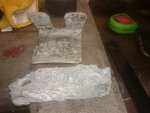
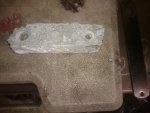
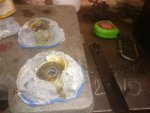
The bar anode and trim tab anodes didn't get replaced when I got the boat so I don't know how long they have been on her but they haven't corroded much in the last 3 months (see pics)

DSC_0224 (Medium).jpg DSC_0226 (Medium).jpg DSC_0229 (Medium).jpg

Having had a good think of what has gone on whilst I was on the water I am coming to the conclusion of the following.

Possible wrong type of ring anode fitted - as the others weren't as badly corroded even the piece of aluminium that the bar anode bolts to isn't corroded.

Faulty or bad Marina electric - The marina electrics at the berth we had was next to a pontoon pile and on the berth itself was a rusting piece of steel flat bar which was bolted to the metal part of the pontoon but the other end dangling in the water - also a neighbour had mentioned that the electricity point was faulty.
A neighbouring boat was nearly lost as he told me that his hull anode had degraded that much it was letting in water through the bolt hole.

Steel boats/barges are/where berthed so they could of been eating my anode as well.

I do plan to put an extra anode/s on the leg near to the rear of the casing above the cone and getting some stainless steel wire to earth them together.

Please chime in on any opinions - I don't fancy lifting my boat out every 3 months just to replace an anode.

Jon
 
Last edited:
I have DPG drives myself. I am in the water for 6 month every year (salt) and the ring anode is always 80% gone once I get her out of the water. The bar on the transom or the triangle on the steering last for 2-3 years. If you google you will see that the DPG drive (and the DPE drive as well) actually loose the ring anode easily. It is a known problem. In fact in the first versions of the drives VP did not fit the triangle anode ... this was applied on later versions but really did not help much. This is the reason that some of the zincs kit you find available have the triangle anode ... others do not. One thing I have found though is that zincs are truely not the same .... stick to either OEM VP or Osculati (I have found them very good ... or better than VP). Do never buy zincs on price.
 
Top