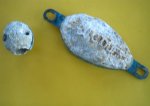
Annodes - AGAIN!

Robert Wilson

Well-Known Member
Joined
23 May 2012
Messages
8,053
Location
Second Coast, Ross-shire, overlooking Gruinard Bay
Visit site
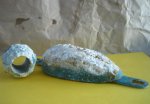
Is there any life left in these?
Hull/lozenge was on for 10 months. Shaft annode was on for about8 months.
Boat's hull not badly affected by growth/barnacles after 12 months in the water (Loch Ewe:sea-loch)
Both have been replaced, but I'm wondering are these worth keeping for another short season?
And/or is there any scrap value in them?
IMG_7784a.jpgIMG_7783a.jpg
 
Last edited:
Those anodes appear to be in almost as new condition! The hull anode hasn't even rusted yet... The anode material gets eaten away mostly from the surface facing the part being protected. Just scrub off the white deposits before you refit them and they will easily do another season, maybe two in the case of the hull anode (more meat - lasts longer). The real give away is that you can still read the raised lettering "MG DUFF".

Rob.
 
I would not use that type of shaft anode & would certainly never remove & think of refitting it.
anodes do not rust but are eroded by a higher / more noble metal

Those anodes appear to be in almost as new condition! The hull anode hasn't even rusted yet... The anode material gets eaten away mostly from the surface facing the part being protected. Just scrub off the white deposits before you refit them and they will easily do another season, maybe two in the case of the hull anode (more meat - lasts longer). The real give away is that you can still read the raised lettering "MG DUFF".

Rob.
 
I would not use that type of shaft anode & would certainly never remove & think of refitting it.

Why not? They look just like the ones I have used successfully for the past 25 years

anodes do not rust but are eroded by a higher / more noble metal

Not correct. True, 'Rust' is a form of corrosion really only applicable to steel so the word could have been chosen better. But erosion is a mechanical process that has nothing to do with anodes.
 
Plenty of life left in them, but i would not refit a partly used shaft anode. It might be difficult to refit it securely.

The hull anode could easily be refitted and I'd think would be good for several more years of service.

However the very low level of zinc loss from the hull anode would prompt be to check the bonding to what ever it is fitted to protect.


EDIT
In support of Vyv.
Erosion is a mechanical process so is not the correct term for the normal loss of material from an anode. It is an electrochemical process identical with what we normally refer to as galvanic corrosion. Corrosion is therefore a more accurate term but in this context I try to avoid using that as well!
 
Last edited:
The cylindrical MG Duff ( as opposed to the spherical ones ) shaft anodes have more zinc mass + with the steel insert do not come loose & last longer due to their mass

Why not? They look just like the ones I have used successfully for the past 25 years


Not correct. True, 'Rust' is a form of corrosion really only applicable to steel so the word could have been chosen better. But erosion is a mechanical process that has nothing to do with anodes.
 
This conversation made me think of a questions I've been wanting to ask some old salts for a long time:

Has anyone tried painting their rudders and other metal parts to prevent corrosion and reduce consumption of their zincs?

Obviously, you'd still want a good electrical connection between the zinc and the metal parts, but the rest of the surface area on your metal parts could be painted. This should create a dielectric barrier that would reduce the galvanic corrosion, which is why zincs are used.

I have a lot more experience with electricity than I do with boats. I've never noticed anyone painting their metal thru-hull parts, and I always wondered why.
 
Has anyone tried painting their rudders and other metal parts to prevent corrosion and reduce consumption of their zincs?

Kind of.

The mud where we kept our old boat is highly corrosive - there's a scrapyard on the opposite bank which has spent decades leaching god knows what metallic substances into the riverbed. A stainless steel keel strap / rudder hinge was substantially corroded in one season, so we got a copy made up in bronze by Classic Marine. This too started corroding during one season - the maker was amazed, said he'd never seen anything like it. The metalwork is not connected to anything else on the boat, and there is no power on the pontoons to be causing stray currents. It's purely down to the evil stuff in the mud. Our solution was to thoroughly paint the part with two coats of epoxy (not epoxy paint, just standard West resin) to isolate it from the mud and water. So far this seems to have done the trick.

Pete
 
Of course metals may be painted. Usually no reason on shaft and prop, but also may be, there are even special antifoulings made for them. Om my boat underwater bronzes are painted - prop included - some kind of primer or paint for metal and antifouling over, prop with this hard kind.
 
That hull anode is not working! check your bonding wires. Either that or the boat has been out of the water for long long time.

I have replaced my anodes each year since 2010 (usually in the conditions as posted). I have made an inspection of my "wires" each year over winter and all seems to be connected/in order - but I have been doubting what was done (and how) to the boat before I bought her.
She came out the first two years, but was re-launched in March last year and has stayed in over this winter.
I'd be interested to hear views/advice on what actually needs to be bonded on a GRP boat - engine, metal thru-hulls,?? anything else? I have the book "The 12 volt Bible for Boats" but I haven't found anything relevant to the above (unless I've missed it!!)
 
T
I'd be interested to hear views/advice on what actually needs to be bonded on a GRP boat - engine, metal thru-hulls,?? anything else? I have the book "The 12 volt Bible for Boats" but I haven't found anything relevant to the above (unless I've missed it!!)

There are several views on this question. The 12 volt Bible is a US publication I think, where their views on bonding are very different from European ones.
Thinking here is that bronze or DZR fittings, and maybe even brass ones, need no bonding and can look after their own corrosion protection.
An engine can never be given corrosion protection by an external anode.
Galvanic couples, such as the prop on its shaft, need an anode for protection.
Folding and feathering props may contain different materials and need an anode for protection.
P-brackets may benefit from an anode, as they are usually manganese bronze (=brass) but coating with an impervious paint or epoxy is an easier solution.

So my boat, for example, has a shaft and a prop anode, nothing else. I have owned it for more than 15 years with no corrosion problems.
 
I'd be interested to hear views/advice on what actually needs to be bonded on a GRP boat - engine, metal thru-hulls,?? anything else? I have the book "The 12 volt Bible for Boats" but I haven't found anything relevant to the above (unless I've missed it!!)
This depend on boat, and engine/shaft arrangement, should be designer's job to decide. Normally engine block, shaft/prop/sterntube (may be connected through engine or separately), rudder fittings. Sometime even keel. But for iron keel and steel rudder plate better to put separate anodes right onto them.

Seacocks/thru-hulls should not be connected - made of corrosion resistant material and left alone - so they will not be affected by electrolysis should something go wrong. There were systems where they had an anode - but separate one, only for them. No connection to engine or any of electrics.
 
I have made an inspection of my "wires" each year over winter and all seems to be connected/in order - but I have been doubting what was done (and how) to the boat before I bought her.

Inspection alone may not be enough, you should check the continuity from the anode to whatever is being protected with a multimeter, obviously there should be connectivity.
 
Top