Anchoring/tides

There are two linked but separate questions here.

1. Does the place you're anchoring in have enough depth of water to prevent grounding? That's answered by noting the depth on arrival and by making allowances for your draught and for the fall of tide. In the OP's example about 5m would be enough (draught 1.8m + fall 1.9m + 1m margin of error, rounded up to the nearest whole metre - don't muck about with fractions of a metre unless it's really necessary).

2. 'Anchor in 4-6m refers to the charted depths'. It's saying that there's a suitable place to anchor at that location. The actual depth of water when you arrive there will of course be 4-6m plus the rise of tide, i.e. you'd be looking for 7-9m on the depth sounder at 1400 0n 9 November if you want to park in the location suggested by the cruising guide.

And don't forget to do a few circles first, before dropping the hook, to check that when you swing on the anchor your boat won't be able to move onto an excessively shallow spot.
 
Questions:
What does the guide mean “suitable depth” and how do I find it.
What is the relationship between the depth shown on the charts and the height shown in the tables.
I presume I need to motor around until I find the ‘suitable depth’, but what would that be in my example.
What is the easiest way of doing it?
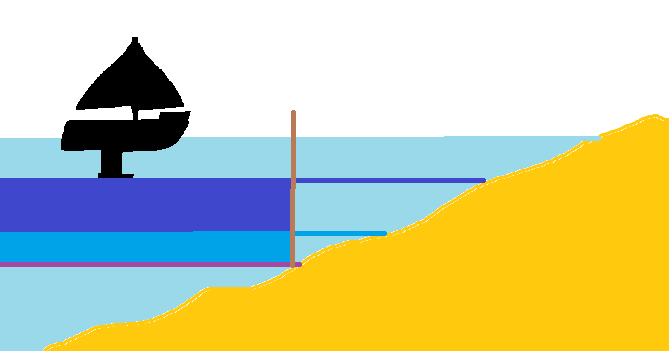
Here's a little picture to help.
The very dark blue is todays tidal range (i.e. the high water value) if working out scope, or the current tide height (using rule of twelfths) when actually anchoring.
The lighter blue underneath is your safety margin - this is personal, some use 0.5m some use 3m. You'll get more confident after watching the depth over a full tide while at anchor so start big and see what happens.
The stuff below those is just spare water, motor forwards until you hit the line where this is gone and you're left with the safety and the remaining tide.
The brown line is the length to use for scope which includes up to the roller.
I may regret saying this but if you're still nervous and have something like a CQR then replace it with a more modern design. This is a real confidence booster because you know it'll set and reset every time.
anchor.png
 
If you're confused about this, you really should go on a Dayskipper theory course. Depth for anchoring always comes up in the exam and is fully covered in the course. If you can't manage a course, get the RYA course book or one of Tom Cunliffe's excellent books.
 
If you're confused about this, you really should go on a Dayskipper theory course. Depth for anchoring always comes up in the exam and is fully covered in the course. If you can't manage a course, get the RYA course book or one of Tom Cunliffe's excellent books.

Tom Cunliffe repeatedly says it's not that difficult and has even failed people for doing too much maths (recent YM article) in practical tests when anchoring.
 
Our anchor is a 15kg Rocna (original spec. we're told) on 50m of 8mm chain
Just checked our spec. sheet

Hard to get that bit wrong then. Pick a nice day and sit watching the depth while reading or chatting with a cuppa and you'll soon be more confident about the depth bits.
 
just do like the rest of us and mess it up once or twice - quickest way to learn :-)

(and will calibrate the echo sounder perfectly...)
 
I don't subscribe to that school of thought. I prefer what seems to me to be the simpler approach although I appreciate that others think differently.

If you mean you don't like the depth to read below the keel neither do I but the OP said that's how theirs was set so I was trying to make it easy for their setup :)
 
Are you any wiser castoffandgone? problem with asking a question like yours on ybw is that you will get lots of different explanations using lots of different terms and a few of them will be outright wrong anyway.

You dont say in what respect you arent " the sharpest knife" but my guess from teaching the shorebased courses would be that you are a bit uncomfortable with numbers. Hope that doesnt sound patronising but it is the usual issue. And if that is the case then suggestions that you go off and buy a book wont really help you - your eyes will still glaze over. Best answer is to get on one of the RYA's shorebased courses.

Hopefully I wont add to your confusion with the following:

1/ first thing about chosing a spot to anchor is to make sure you have enough water under your boat when the tide is at its lowest. Usually you want the draught of your boat plus a safety margin of ( say ) 1 metre to avoid your keel touching the bottom in waves or wash.. My boat draws 1.8 metres so the minimum depth of water I want at low tide where I place my boat is 2.8 metres

2/ likely you wont be looking for your anchoring spot at low tide but at some other time of day. So you need to work out how much the tide will fall from the time when you are looking until low water. There are a number of ways of doing this:

a/ look at your plotter which will usually tell you both how high the tide now is and how high it will be in your location at low water. To construct anb example it might say that the tide is currently 6.2 metres and it will drop to 2.2 metres at low water. So the tide is going to fall by the difference - 4 metres.

b/ You can calculate the current height of tide by using your almanac and the tidal curves. far too complicated to explain here but you will get the same number 4 metres.

3/ To use the example of my boat, I have already said that I need a minimum depth of 2.8 metres at low tide for me to be safe. If the tide is going to fall by 4 then at the time I am anchoring I need a spot where the current depth is 4 + 2.8 metres which is 6.8 metres.

4/ So you stooge around under engine looking for a well sheltered spot with at least 6.8 metres of depth of water. Look at your depth sounder. When you have found a spot put the anchor over the side

5/ Its often quoted that you let out chain equivalent to 3 times the depth of water. Its a bit more complicated than that - you really need to let out a bit more if the water is shallow and you need to add in the height of your bow roller from the water surface. If you have room and there is no one else to bump into, let out lots of chain , more than the 3 times for sure.
 
Back to the exam question you set

Work out the range for the day/night. (The difference between HW and LW)

In this case it's a bit under 2 metres. Let's call it 2.

Now you need to know how far the tide will drop after you've arrived.

You are planning to arrive at HW, so it will drop by 2m.

All you now need to decide is how much water you want under your keel at LW. Let's say 1 metre.

So you want to anchor in 3m of water, plus the distance between the bottom of your keel and where your sounder reads zero.

In your case your sounder is set at keel depth, so no further calculation is needed.

So when you go into the anchorage, you are looking for a spot where your sounder reads 3m or more.

Anchor. Let the anchor out until it touches bottom and then roughly twice as much more.

If it holds that's good enough for a while.

Next you need to work out how much chain to let out for the next HW. (If you've actually anchored at HW, that'll be good for the next 11 hrs or so)

What's the actual depth shown by your sounder now? Let's say all the shallowest spots were taken and you ended up anchoring where the sounder shows 4.5m.

But you did anchor at about, or just after the time of HW as planned.

I can't remember your draft, but say it is 1.5m.

So you anchored in 6m of water.

The next calculation depends on where you measure your scope from. I measure it where it enters the water, and have the chain marked every 5m.

So to have 3x the depth, you need 18m of chain out, measured where it enters the water. Since I mark my chain every 5m, I would let out 20m.

Now check the next range ie from the next LW to HW. If it's more than 2m, you might want a little more chain out. But you've got plenty of time to check how things are going.

The key calculations in each instance are how far will the depth drop to LW after anchoring, and what you expect the depth to be at HW.

You don't need to use the chart at all for depth calculations except to determine the general area you want to anchor in. Generally better to anchor in shallower water than deeper, particularly if you don't have a windlass and are leaving near HW - greater depth=more chain=more weight to pull up.
 
Sorry I have been 'off the air' for a while and I now have to get off to bed as I have a very early alarm call in the morning. I will have a good review of all your replies when I am a bit fresher tomorrow.
So thanks for now
Goodnight
 
Good morning.
Having had a careful read through all the posts this morning, I feel I should be able to find a method that fits my brain! Watayottie did suggest, and there was no offence taken, that I might be less than confident with the maths of it all. Well, although not a dyscalculia sufferer, he might not be far off with his assumption.

Over simplifying the calculations for a moment:

If I arrived at a CCC recommended anchorage and motored around until I was reasonably satisfied that the depth around my estimated swinging circle was fairly even at say 5m (as read from my echo sounder offset to the bottom of the keel). Then noted from my tide times that the maximum rise and fall of the tide in this area during my stay would be, say 2m. Could I then, without working out the actual state of the tide on my arrival, assume the deepest the water could rise to would be 7m and the shallowest it could fall to, only be 3m. By allowing for the deepest i.e. 7m. Calculated at say 4 times the depth, 28m of chain should be deployed.

What would be the problems/dangers of simply doing it this way?
 
Whilst not maybe what you are asking for most places in the west coast of Scotland do have a very good tide gauge in the form of he shore line seaweed excetra there are few places that you will not be able to gauge the state of the tide and if it not raining whether the tide is rising or falling Bering in mind that you will not travel that far that you will not know the tide on a daily basis so add about an hour each day except through crinan canal
May be worth working in either fathoms or metres rather than mixing them!
 
Good morning.
Having had a careful read through all the posts this morning, I feel I should be able to find a method that fits my brain! Watayottie did suggest, and there was no offence taken, that I might be less than confident with the maths of it all. Well, although not a dyscalculia sufferer, he might not be far off with his assumption.

Over simplifying the calculations for a moment:

If I arrived at a CCC recommended anchorage and motored around until I was reasonably satisfied that the depth around my estimated swinging circle was fairly even at say 5m (as read from my echo sounder offset to the bottom of the keel). Then noted from my tide times that the maximum rise and fall of the tide in this area during my stay would be, say 2m. Could I then, without working out the actual state of the tide on my arrival, assume the deepest the water could rise to would be 7m and the shallowest it could fall to, only be 3m. By allowing for the deepest i.e. 7m. Calculated at say 4 times the depth, 28m of chain should be deployed.

What would be the problems/dangers of simply doing it this way?
Yes that would work with one huge caveat. You said your boat reads below the 1.8m keel, so when you read 5m it's actually 6.8m so you need 8m of chain because the bow roller is 1m above the surface. Make this simpler for yourself and just add 3 to the depth reading :)

Your maths was spot on though and is the easiest way to do it. Add to this Tom Cunliffe's suggestion of marking the chain every 3 meters and you have no further maths at all, just count the same number of marks as your depth guage plus 3 :D
 
In an area of modest tides and with a modest draught.

Just anchor in 20ft+ and have done with the lot. Finis.


I have a similarly easy method of dealing with secondary ports.

For God's sake don't go on a course.
 
Last edited:
Good morning.
What would be the problems/dangers of simply doing it this way?

With just a 2m rise and fall I can't think of any particularly serious issues. The difference in scope required between a LW arrival and a HW arrival is 8m, using your 4 to 1 ratio, so at worst you'd swing a bit less than a boat's length wider than you needed to.

I'm not familiar with your area so don't know to what extent your anchorages get crowded. If your anchorage of the day is likely to be busy, you might find yourself with the choice of going closer to the shore than you originally intended, or further out. In which case it would be worth knowing more accurately what the rise and fall you expect from the time you anchor.

The other factor to bear in mind in more crowded anchorages is how close you are likely to swing towards nearby boats (and vice versa). Ideally you pick an area where all the boats are similar and react similarly to tide and wind so all swing in the same direction at any particular time. But the boats also need to be on similar scopes; or there can be trouble when the tide turns.

In general I think your approach would be fine. I'd still want to work out the optimum scope after I put the hook down. Easy enough to shorten your scope later if you wanted to. And you'd have a clear picture in your head to adjust your plan from if you needed to. Eg, you've assumed a maximum fall of tide of 2m. But your best spot now looks to be a metre shallower than you intended. So if it's not actually HW, how far will the tide fall? And you can do a simple approximation in your head for that, eg if its halfway between HW and LW, it'll drop half of the range ie only 1m. So you'd be OK.

You'd want a more sophisticated approach in Brittany though, where there can be 10m tidal range, and you want to ensure you've got enough chain.
 
Top