Anchoring - Tandem vs V

I would support @thinwater post. There are lots of permutations possible, all you need to do is carry the gear and practice. During almost 50 years of yacht ownership I have used all the techniques suggested above, including a few times when the wind speed instrument stayed hard against the stop at 60 knots for hours.

Having cruised the west coast of Norway for a few seasons my favourite heavy weather anchoring technique includes a shore line secured to windward. I have found suitable locations for shore lines elsewhere. My rule of thumb is two anchors if F8 plus is expected, if the one you are lying to drags the other will check it. On recovery I have, at times, found both rodes leading to windward, but then I always have much more out on the rope/chain second rode so the anchors can not interfere.

As a yoga teacher once pointed out, "an ounce of practice is worth a ton of theory".
 
Nomenclature can be a problem for unusual things.

A tricycle is a bike with three wheels. But is there one in front or two in front? In the US, at least, the latter is referred to as a tadpole, and is far more common for adult tricycles.

I struggled with nomenclature for a number of articles and ended up making up my own, for use within the article. If others find this nomenclature useful, good, if not, maybe someday we will settle on something.

Tandem. Obviously two anchors, but there are some variations. Two wheels obviously have to be in a straight line (two point define a straight line) and common usage referrers to things that are one in front of the other, but not all usages. For example, tandem Raycor filters are side by side and are plumbed in parallel. Tandem anchors in climbing are often in a V-configuration. and they are never on a common in-line sling for reasons of load distribution. Twin would be another possible nomenclature, but that clearly implies they are identical, which the anchors will not be. If you have a good suggestion for the generic use of two anchors, in any configuration, fire away.
  • In-line Tandem. The secondary anchor is attached to the tandem eye via. a secondary rode, typically 20-40 feet long, but deeper than the water if possible or you are going to play hell recovering either anchor. It is NOT attached to the tripping eye, because that will trip the forward anchor the moment the wind shifts even 5 degrees, which it does constantly. Try it. It MUST be at the back of the fluke or you are just fooling yourself. Of course, very few anchors have a hole in the proper location.
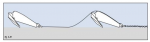
  • V-tandem. The secondary anchor rode is sometimes shackled to the primary anchor shackle instead of the tripping eye. But this is no longer an in-line tandem (what most people think of as a tandem). Vryhof and Bruce refer to this as piggy-back anchoring. If the wind shifts even a little bit, they now form a V. The first anchor also no longer holds 100% of the up-lift force, which turn out to be a very big deal. Completely differnt in holding characteristics from a conventional in-line tandem; it handles wind shifts better and works on shorter scope (the secondary anchor is not lifting the first anchor), but is very prone to snagging. It is one of the preffered methods for setting platform anchors (no wind shift, a single bigger anchor cannot bury due to underlying rock).
1672342793569.png(piggy-back, by Vryhof)
  • A better V-tandem has the secondary rode (20-40 feet) attached to the main rode ~ 30-60 feet from the primary anchor (the distances could be greater in deep water). Now the anchors are free to form a large asymmetrical V. The angle is best set at 45-120 degrees. This is the most stable and snag resistant variation. Because the sub-rodes are different lengths the anchors will not foul if they drag. There are additional subtleties, advantages, and tricks, but that that would take a chapter to describe... or at least several long articles. Lots of testing.
  • Bahamian Moor. Also two anchors, but the legs are equal length, both rodes come all the way to the boat, and the angle is 120-160 degrees (180 is nearly impossible and the forces approach infinity, making it undesirable). It could be considered a special case of a V-tandem, but separate rodes come back to the boat, so there are not two anchors on the rode, it is two separate ground tackle strings. There are some advantages and some shortcomings. It holds the boat in a very small swing and the anchors do not have to reset. However, if the wind is from the side the holding of the anchors is greatly diminished. If the boat does a 360 with the tide the rodes can be hell to untangle. The rode also wants to foul the keel, even with all-chain. For this last reason I never us this method; I would either set a V-tandem with a wide angle. and accept more swing, or anchor fore-aft (only in a very sheltered setting).
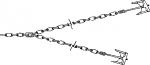
On the challenges with the nomenclature is that there is no commonly accepted name for rigging two anchors off the same rode in a V-configuration. Side-by-side staggered is one name I have seen. Kind of awkward. It's not a piggy-back. I've seen platform anchor hardware developed for this purpose, but there was no special name for the side-by-side configuration.


1672342040266.png(side-by-side staggered ... or V-tandem)

So for the purpose of the articles I defined this as a V-tandem. Once you make sense of the difference between tandem (two anchors on one rode) vs. single, and in-line vs. V, it is very systematic. A tandem is any rig with two anchors on the same rode, whether set in-line, piggy-back, or in a V. All other rigs are either single or multiple-rode rigs.

Suggest something more clear.

---

And to be clear, I'm not in favor of using two anchors routinely, and certainly not in crowded harbors. These methods are for very special situations. For me, either pudding mud that is like thick water (V), or flat rock (in-line) or shingle where nothing can dig.
 
I've long been intrigued by the Swedish technique of using rock-pitons driven into steep-to rock, with an anchor out behind in deep water, or taking lines ashore to tie around convenient trees in the islands. It is apparently commonplace to carry the needed gear. I've done exactly that when chartering in the Greek Islands; on one occasion sending Milady to swim ashore with a rope-rode. Unfortunately, she forgot how to tie a bowline - or anything else - so had to wind the end 3 times round a stout tree, then hold it until I'd got the stern anchor sorted!

Then there's Skip Novak's technique of using a long wire strop around a big boulder on a stony Patagonian beach, with his rope rode tied to that. There are places where that idea might just work if a big blow was forecast. Here's a pic showing, for example, an isolated rock in Baltimore Harbour, with room to east and south, around which a cable strop could be affixed. I presume that would be unlikely to drag.....

52594148741_6c998e2409_w.jpg


Here's a pic showing, for example, a rock on the west side of The Cove, St Agnes, which might serve in a westerly blow.

52594190241_9ed297e36f_w.jpg
 
Last edited:
I have made extensive use of the Bahamian Moor, while leaving boats unattended for several weeks at a time, in Shetland and in the Outer Hebrides. I deliberately did not bring both rodes aboard, because doing so guarantees that the two rodes become tangled together. Because I was doing this regularly, I made up a device resembling an upsidedown saucer. This was made in two halves, and bolted onto the chain. A large bow shackle, fitted round the chain and rested on the saucer. The second, normally rope, rode was made fast to the bow shackle, and then enough chain was lowered, so that the joining point would always be below keel level. The scope of both rodes would be in the region of 8:1. Obviously a lot more than normal anchoring, but better safe than sorry.
It's not a system which would meet with approval in a recognised anchorage, as a boat thus anchored, behaves very differently from one conventionally anchored. I did this every year for several years, without any problems. This was in places where winds of 60 to 70 knots are not unusual, but well sheltered from any sea.
The reason for mentioning the Bahamian Moor is partly because thinwater referred to it, and also because it's related to anchoring in a Vee.
 
I've long been intrigued by the Swedish technique of using rock-pitons driven into steep-to rock, with an anchor out behind in deep water, or taking lines ashore to tie around convenient trees in the islands.
I carry a couple of climbers pitons for that, but never had to use them in Norway. I would anchor first then dinghy ashore with the shoreline flaked down plus a long tail to reach back to the boat on the anchor scope. A length of heavy fishing boat mooring rope was used to secure around a suitable rock or tree, (close to the roots so as not to lever it out), and protect the nylon shoreline from chafe. Row back to boat paying out the shoreline then haul boat up towards shore so anchor leads aft. Often on W coast of Norway there are mooring bollards set into the rocks.
The Scandinavian way is to use a stern anchor and shore line but in a wild anchorage I used my heavy bow anchor and chain so the boat could swing head to the wind. In crowded harbours it would be the stern anchor and motor up to the pier to fix a pair of shore lines.
 
I carry a couple of climbers pitons for that, but never had to use them in Norway. I would anchor first then dinghy ashore with the shoreline flaked down plus a long tail to reach back to the boat on the anchor scope. A length of heavy fishing boat mooring rope was used to secure around a suitable rock or tree, (close to the roots so as not to lever it out), and protect the nylon shoreline from chafe. Row back to boat paying out the shoreline then haul boat up towards shore so anchor leads aft. Often on W coast of Norway there are mooring bollards set into the rocks.
The Scandinavian way is to use a stern anchor and shore line but in a wild anchorage I used my heavy bow anchor and chain so the boat could swing head to the wind. In crowded harbours it would be the stern anchor and motor up to the pier to fix a pair of shore lines.

As part of the shore line kit:

Scavenged 20mm (approx) rope off beaches with an eye then spliced on each end makes it easier to tie to trees, strop round tree, shackle or carabiner for line to yacht. Similarly short lengths, or various lengths, of chain are useful to attach shore lines to rocks. When a rode is retired there are sometimes good lengths of chain that can be cut out for such purposes. Pitons or simply short lengths of concrete reinforcing bar hammered into crevices can make good anchoring points (and are found, ready secured in some locations in the Baltic and Tasmania - there are very few original ideas).

Having a long enough rope for shore lines and/or extra anchors is really unusual (many do not even carry a spare :( ). For extra anchors and deployment from a dinghy then a Fortress, assuming no weed or pebbles on the seabed, are really very sensible, light, dismountable and reliable if set correctly. Other lightweight anchors are the aluminium Spade or Excel and the high tensile steel based Viking (all of which are also demountable). Retired halyards can make decent shorelines.

Jonathan
 
Top