Anchoring scope YM article

There is a LOT of research on scope vs holding capacity and the affect of catenary on snatching. Google will find some of it, particularly as relates to ships and platforms. However, most of that relating to yachts is in magazines and books. Try:

  • Practical Sailor
  • MySailing
  • Books on anchoring (not general sailing books)
  • and lots of others....

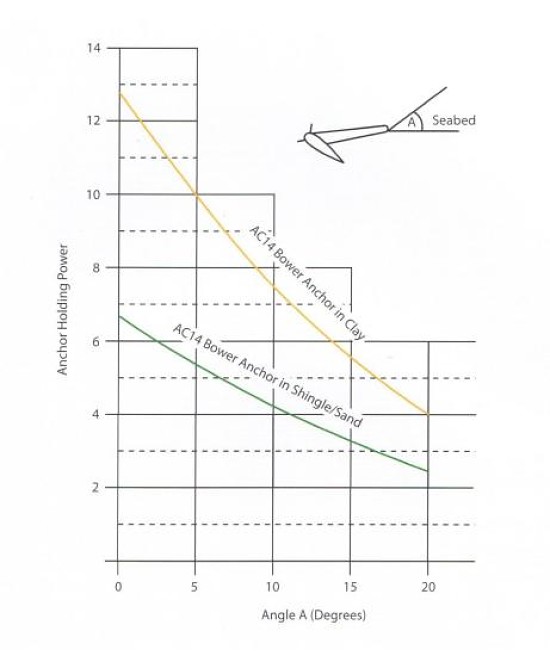
Anchor-holding-power-relation-with-scope.jpg

AC14? On a yacht?
 
... If the seabed slopes steeply and the steep slope will commonly caused by tide scouring the seabed there are other issues, one the tide will be strong and will reverse and secondly if the seabed is being scoured the seabed that remains will be hard. If there is loose sand - it will be very loose and not a secure location for anchoring....

Yes, in my local experience, steep slopes are also very hard.

Why anchor there? Some of the best fishing!
 
1. It sometimes happens that the only available spot is on the edge of a dredged or other deeper channel. The only solution is a short scope or one may get set into the channel one way or aground the other. So 3:1 scope, but this is a case when a good weight slid down the cable will help, but you need to have the right equipment.

2. The chap who uses 7:1 when all around are using 3:1 is never going to be popular.

3. If anchoring in a fjord keep in mind that the nice thick clay that you have anchored on may leave your anchor, no matter how sexy it is, skittering over its surface and worse, may drop sharply to unfathomable depths.

4. Give me a nice big diameter grooved roller at the bow.

5. You need to have at least one anchor that you can let go in a hurry.

Don’t ask me how I know these things.
 
Last edited:
Kukri

I'd value some elaboration on what you mean by a 'nice big' roller (big in relation to what?) - I actually like 2 slotted (?) rollers set at 45 degrees to each other (not being overly big), one higher than the other - and even better if 'seesawed'

I might comment that anchor rollers and bow rollers in which they are housed appear to be getting smaller and smaller - maybe when everyone has been scared witless by the complexity of anchoring, implied in some posts, yacht builders can dispense with them completely.

Most people are going to be using their primary so if they need to 'leave' it they then rely on their second anchor (which is commonly the one they retired as being inadequate when they bought their new anchor :( ). They may have another anchor (a Fortress) but it might be very small. Carrying a second anchor on which they can rely might not be common practice.

Jonathan
 
Johnathan- I’m not sure that we are disagreeing - the point is really that the chain should be turned through an arc of quite large diameter and through an obtuse angle if possible (the more obtuse the better) and so I agree with your two rollers, but the bigger the better.

The groove does two things; first, it automatically keeps the chain un-twisted so no need for a swivel. Second it offers a nice big bearing surface for the links. I’m not clear in my mind about how this reduces friction but it certainly seems to do so.

Andrew
 
Re the depth of water that you anchor in and scope on a shelving bottom, I think that the depth is taken as being that where your hook lands.
If that is say 5 mtrs and it is 10 mtrs from a 100 mtr drop off and the chain I let out puts the boat over the drop off, I still have my anchor in 5 mtrs.
The same applies if an onshore wind put the boat in 3 mtrs, I'm still anchored where the hook is in 5 mtrs.
 
Re the depth of water that you anchor in and scope on a shelving bottom, I think that the depth is taken as being that where your hook lands.
If that is say 5 mtrs and it is 10 mtrs from a 100 mtr drop off and the chain I let out puts the boat over the drop off, I still have my anchor in 5 mtrs.
The same applies if an onshore wind put the boat in 3 mtrs, I'm still anchored where the hook is in 5 mtrs.

This is correct.

Scope is defined as the ratio between the depth of water where the anchor is lying plus the bow roller height (plus the tide rise and fall if you want to calculate the scope at different times) versus the length of rode. There is no provision to take into account a sloping seabed.

Thus the scope does not vary when anchoring on sloping ground.

However, as far as the anchor is concerned, the ultimate holding power is influenced not by scope but by the angle of pull relative to the seabed. Scope is a simplified version of measuring this angle but it does not take into account the angle of the seabed.

As most sailors are familiar with the concept of scope, the use of the “effective scope ratio” is a useful concept.
 
Re the depth of water that you anchor in and scope on a shelving bottom, I think that the depth is taken as being that where your hook lands.
If that is say 5 mtrs and it is 10 mtrs from a 100 mtr drop off and the chain I let out puts the boat over the drop off, I still have my anchor in 5 mtrs.
The same applies if an onshore wind put the boat in 3 mtrs, I'm still anchored where the hook is in 5 mtrs.

I thought that too for years until I saw the diagram above and realised what was actually happening. Yes the angle of your boat to the anchor you dropped at 5m is exactly the same whether the boat is now at 10m or 3m upslope or downslope.

But the interesting bit (assuming chain stretched so negligible catenary) is that the angle of the chain to the anchor (and scope is solely there to reduce that angle) is much better if the boat is in shallower water than the anchor and much worse if it is in deeper water. Nothing to do with the different depths but simply that a 10 degree slope makes the scope angle 10 degrees better one way and 10.degrees worse the other.

In practice slopes are usually only a few degrees of course so we’d never notice, but every now and again...
 
Top