Anchoring scope YM article

Of course other anchorages are effectively flat which makes life easier, but if faced with one of these steeper slopes, factor this into scope calculations rather than solely relying on the simpler formula.

I just use the depth where I dropped the anchor. No need to fiddle with calculations.
 
Agreed. I liked the geometry. Though I’ve never been concerned myself about a sloping seabed, since any drag would usually mean we’re going out to sea and my anchor alarm would wake me.

However, when I was with Bob Shepton last time he mentioned how he has to anchor with a scope of 2:1 in Greenland as the shore slopes so steeply at the shore. But still on 2:1 it held in strong winds because of the geometry mentioned.

I think, in some circumstances it can be good to know when 2:1 might be sufficient.
 
Noelex,

You have often referred to the issue of a sloping seabed - and we would have to accept we are not world cruisers and do not have your depth of 'geography'. But I have noticed that others, few, none, have ever suggested they have your fears. In fact no-one has ever really underlined, except you, that a sloping seabed is a big issue.

I have to wonder if your fears over the sloping seabed (and it must be a big issues for you considering how often you mention it) might be due to some other factor. People who use Deltas, CQRs, Bruce, Rocna, Spade etc etc do not seem to have your issues - I wonder if perhaps its not the seabed that causes you to mention the issue so ofen - but maybe....

your anchor?

I know you have considerable difficulty accepting that a 16 degree fluke to seabed angle is unique - but maybe it is the root cause of your issues.

Maybe you can define why your anchor overcomes these issues - whereas a Rocna might not?

Jonathan

Sloped seabed is a big deal some places. I know a few places around here that are nearly impossible to anchor at any scope for that reason, and yes, I've used NG anchors. Mantus or Manson, no difference. You just can't anchor on a steep slope.

Just one of many localized factors.
 
This topic always cracks me up. I guess it is just because I have tested so much of it.

  • Catanary can't be ignored OR assumed to solve all problems. It's all about the maths and there are a continuum of true answers. In deep water, if you drop a few hundred feet of chain, it's nearly impossible to lift that before the anchor is well-buried, and once well-buried, most can handle some limited up-lift. Obviously we wouldn't want to bet too much on that in really strong conditions (over 60 knots), but hurricanes and strong thunderstorms are rare in most areas. I hear people speak of "a day in 35 knots," which frankly, isn't that much. In shallow water (less than 5 feet) catenary doesn't do spit. If I anchor at 5:1, sometimes that would be only 30 feet of chain (including bow height), and that will lift in 10 knots. 3:1 would be 18 feet of chain; I might as well attached the anchor to the bridle... which I have actually done at lunch stops, just for laughs. It works. But it would be silly to trust it.
  • Very few anchors can set well or hold well at short scope, period. Try them with NO CHAIN so that catenary does not influence the result and you will see that few are better than 50% at 3:1 scope and some are less than 30%. Some won't set at all. BUT if we use chain in deeper water, the initial setting is NOT at short scope. In fact, initial engagement is nearly always at infinite scope, since the chain is on the bottom at first, until the power really comes on. Same if we let the rising wind set the anchor.
Follow the maths, and everybody's observations are correct. But they're not all using the same starting point. The math is the math.

Neeves theory (as I understand it) is that once an anchor is set, shortening scope to match the rode angle at the anchor is harmless. True enough, but there are two caveats that make me nervous:
  • The scope had to be longer during setting or the anchor would never have reached that depth. The anchor would have leveled out more shallow, such as we see with the Mantus, for example. This can be done by setting at longer scope or by using catenary in deeper water. But it has to be one of the other.
  • If the anchor is unset by yawing or a wind shift, it will not be able to reset quickly at short scope. If there is enough chain, this may create the required scope, but the anchor will have to move closer to the boat's new position, dragging a good distance, to get there. In shallower water, you'll just drag.
The thing about short scope is that need enough chain down to create pseudo long scope conditions at he bottom. This is a dynamic situation. As a multihull guy, I think deep water starts at 7 feet. I suspect 20 feet or more is what most people consider deep, and the math is different then. It's largely about how long and how heavy the chain is. The maths.
---
If I'm in a crowded harbor, I anchor as short as practical. If there is room, I use lots. Why not.
 
I'm with JD.

I had always thought most people would realise that the seabed sloped. The seabed is at 0 depth at the waters edge, (call it a beach), its 5m deep where you are located and it was 10m deep a bit further out - thus the seabed slopes. It appears this is now a remarkable revelation to some - bizarre. Some seabeds are at the bottom of vertical cliffs - and very deep, some seabeds are very flat - but as you have little idea from your perch near the bow roller then taking JDs simplistic idea of basing scope on depth, + the height of the bow roller over the water line - seems so easy and has worked so well for us, and most people, for decades.

No wonder people become scared of anchoring - they now need to use basic trigonometry and work out the angle of seabed slope before they can define the scope they are going to use.

Jonathan
 
This topic always cracks me up. I guess it is just because I have tested so much of it.

  • Catanary can't be ignored OR assumed to solve all problems. It's all about the maths and there are a continuum of true answers. In deep water, if you drop a few hundred feet of chain, it's nearly impossible to lift that before the anchor is well-buried, and once well-buried, most can handle some limited up-lift. Obviously we wouldn't want to bet too much on that in really strong conditions (over 60 knots), but hurricanes and strong thunderstorms are rare in most areas. I hear people speak of "a day in 35 knots," which frankly, isn't that much. In shallow water (less than 5 feet) catenary doesn't do spit. If I anchor at 5:1, sometimes that would be only 30 feet of chain (including bow height), and that will lift in 10 knots. 3:1 would be 18 feet of chain; I might as well attached the anchor to the bridle... which I have actually done at lunch stops, just for laughs. It works. But it would be silly to trust it.
  • Very few anchors can set well or hold well at short scope, period. Try them with NO CHAIN so that catenary does not influence the result and you will see that few are better than 50% at 3:1 scope and some are less than 30%. Some won't set at all. BUT if we use chain in deeper water, the initial setting is NOT at short scope. In fact, initial engagement is nearly always at infinite scope, since the chain is on the bottom at first, until the power really comes on. Same if we let the rising wind set the anchor.
Follow the maths, and everybody's observations are correct. But they're not all using the same starting point. The math is the math.

Neeves theory (as I understand it) is that once an anchor is set, shortening scope to match the rode angle at the anchor is harmless. True enough, but there are two caveats that make me nervous:
  • The scope had to be longer during setting or the anchor would never have reached that depth. The anchor would have leveled out more shallow, such as we see with the Mantus, for example. This can be done by setting at longer scope or by using catenary in deeper water. But it has to be one of the other.
  • If the anchor is unset by yawing or a wind shift, it will not be able to reset quickly at short scope. If there is enough chain, this may create the required scope, but the anchor will have to move closer to the boat's new position, dragging a good distance, to get there. In shallower water, you'll just drag.
The thing about short scope is that need enough chain down to create pseudo long scope conditions at he bottom. This is a dynamic situation. As a multihull guy, I think deep water starts at 7 feet. I suspect 20 feet or more is what most people consider deep, and the math is different then. It's largely about how long and how heavy the chain is. The maths.
---
If I'm in a crowded harbor, I anchor as short as practical. If there is room, I use lots. Why not.


Thin,

I'm not suggesting ignoring scope and catenary - I'm suggesting that the idea that scope defines the angle of the tension on some anchors lacks validity - what an owner does with the information is up to them - its simply food for thought. But I am suggesting some anchors demonstrably offer security even though the tension angle can be quite high - and possibly prioritising anchors that set deeply is a good idea, or one worth considering.

Like you I would not change practice as the catenary and scope are needed when you set the anchor and might be needed again if the anchor trips and needs to reset, by itself. I think if your yacht has a propensity to yaw, or the anchorage has unstable wind, then having chain on the seabed might be useful (the friction of the chain being dragged sideways).

What is important is having an anchor on which you can rely - for that seabed - and I note that your tests show low scope rations result in low hold, for any anchor (hitting on the head any idea that anchor size allows you to anchor at short scope. I also note you, refreshingly suggest anchors that set shallow might have a lower hold than a similarly sized one that sets deeply - that should raise a few hackles.

Jonathan
 
With regard to a sloping sea bed, the way I have always regarded it is if I drop the anchor in 5m of water and use 20m of chain then that is 4:1scope. If the boat swings around and is now in 30m then in 2m the angle between the water and chain doesn't change, the depth at the anchor doesn't change and so long as the anchor has buried itself nothing much changes there. I would allow extra chain just in case the anchor moved a bit when swinging but not based on the boat now being in 20m of water 4x20 =80m chain whilst the anchor is only in 5m of water!
 
It's always going to be more difficult to drag an anchor uphill than downhill. Slope of the bottom, if any, is just another of the miriad factors that are consciously or unconsciously taken into account when anchoring. It's never going to be an exact science.
 
Through reading this thread, it occurs to me that the most important piece of information needed to define minimum scope is the angle between the rode and the anchor needed to allow the anchor to set. In other words, there is an angle at which the rode ceases to allow an anchor to set and starts to break it out so the scope should be set to ensure the angle is less than this critical angle (by some margin appropriate to slope, seabed etc). In fact presumably there is an optimum angle which the scope should be set for. Once the anchor is set, the scope should be reset to make sure the rode provides the necessary spring effect to prevent/minimise risk of snatch loads from causing failure of any part of the system or the skipper from sh!tting themselves. It should also be not less than the appropriate angle to ensure the anchor might reset following a wind/tide change. All you then need to do is choose a rode that suits you, your boat, seabed and anchorage.

So who fancies researching anchor/rode angles. Interesting project as it will depend on seabed soils but I imagine that the angle changes little for most seabed that sailors are likely to use

edited to add that I’ve assumed scope angles are as a result of the rode being pulled straight
 
Last edited:
Many years ago I found that slope of the bottom does matter, when kedging off some mud. It's easy to drag the anchor down the far side of the channel...
I suspect anywhere with a significant slope on a sand or mud bottom is unlikely to be a great anchorage in weather, because the bottom will have got like that through the action of lots of waves or current?
 
[...]
Anchoring is all about compromises and there are commonly many correct answers.
[...]

That's it.

Indeed, lots going on, as mentioned more than once before by guys with masses of experience and empirical knowledge. (y)

Big part of it as well in many areas is guessing who is going to drag first and staying upwind of them.

, rather than using a fixed formula it is more important to take into account all the variables,
Just one of many localized factors.
 
...So who fancies researching anchor/rode angles. Interesting project as it will depend on seabed soils but I imagine that the angle changes little for most seabed that sailors are likely to use....

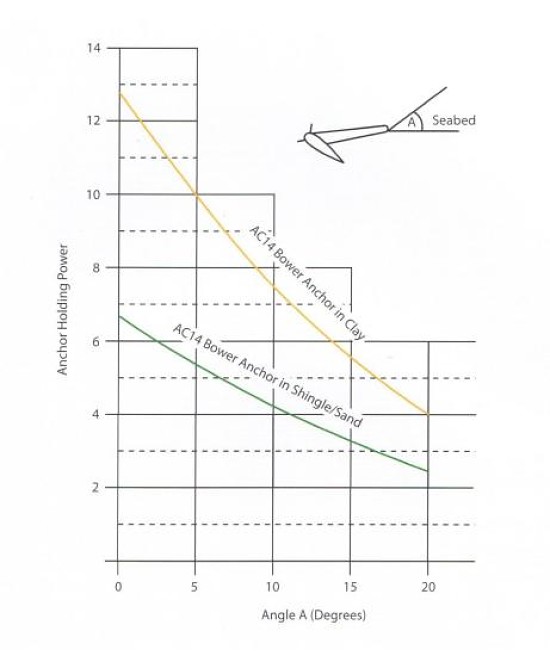
There is a LOT of research on scope vs holding capacity and the affect of catenary on snatching. Google will find some of it, particularly as relates to ships and platforms. However, most of that relating to yachts is in magazines and books. Try:

  • Practical Sailor
  • MySailing
  • Books on anchoring (not general sailing books)
  • and lots of others....

Anchor-holding-power-relation-with-scope.jpg
 
  • Like
Reactions: GHA
Many of the estuaries which are favourite traditional anchorages have 'traps' for the unwary, in having steep underwater banks in places where one might expect to be out of the fairway traffic. A well-set anchor there might ( perhaps not 'might'! ) readily be upset by the change of tide or even the repeated heavy wash from passing commercial vessels/tripper boats/ferries. Anywhere that has a steep-sided gully is prone to such problems.

Consider the illustrated pic of St Just Pool above Falmouth Harbour. Back in the day there might have been well more than 100 sailing vessels, large and small, anchored just out of the deep fairway..... and all of them wanting swinging room. Some would certainly have their hooks down into/onto the steep slopes of the 'drop-off'. Come the change of tide and/or wind, they'll be pulling on their anchor stocks sideways....

49292326523_c778e0b1f4.jpg


That's even more emphasised in nearby very popular yacht anchorages, which get busy even on winter weekends. This example of 'Dandy Hole' is scoured by a fast ebb, and a usually-westerly wind funneled by terrain.

49292816831_2216e05fd5_n.jpg


The problem is even more emphasised up the Truro River, where yachts will anchor out of the fairway/out of the path of the constant tripper boats, just to the north or south of the floating Visitors Pontoon. The ebb runs hard by there, too.

49292816611_10b00974fa.jpg


There is an argument for a Bahamian Moor, but few will try that.

I reckon there are many places where this 'underwater gully drop-off' profile is an issue - including corners of DF's Chesapeake Bay - and what's needed is for those who'd progress beyond RYA Day Skipper to learn to think in 3D instead of planar.
 
Many of the estuaries which are favourite traditional anchorages have 'traps' for the unwary, in having steep underwater banks in places where one might expect to be out of the fairway traffic. A well-set anchor there might ( perhaps not 'might'! ) readily be upset by the change of tide or even the repeated heavy wash from passing commercial vessels/tripper boats/ferries. Anywhere that has a steep-sided gully is prone to such problems.

Consider the illustrated pic of St Just Pool above Falmouth Harbour. Back in the day there might have been well more than 100 sailing vessels, large and small, anchored just out of the deep fairway..... and all of them wanting swinging room. Some would certainly have their hooks down into/onto the steep slopes of the 'drop-off'. Come the change of tide and/or wind, they'll be pulling on their anchor stocks sideways....

49292326523_c778e0b1f4.jpg


That's even more emphasised in nearby very popular yacht anchorages, which get busy even on winter weekends. This example of 'Dandy Hole' is scoured by a fast ebb, and a usually-westerly wind funneled by terrain.

49292816831_2216e05fd5_n.jpg


The problem is even more emphasised up the Truro River, where yachts will anchor out of the fairway/out of the path of the constant tripper boats, just to the north or south of the floating Visitors Pontoon. The ebb runs hard by there, too.

49292816611_10b00974fa.jpg


There is an argument for a Bahamian Moor, but few will try that.

I reckon there are many places where this 'underwater gully drop-off' profile is an issue - including corners of DF's Chesapeake Bay - and what's needed is for those who'd progress beyond RYA Day Skipper to learn to think in 3D instead of planar.
Of those, only the St Just one is really significant.
The others are really quite small slopes. Guessing the chart scales, <5m depth variation over >50m isn't going to make much difference.

In my view, it's a bit of a dead end over-analysing anchoring, as the biggest variable is the nature of the bottom. Even anchoring the same racing mark in the same place (using transits) we find the holding varies. Someimes a silly little anchor will hold the mark and a RIB on a short scope, sometimes it's different. A bit like sometimes our beach is firm and supports a trolley wheel nicely, other times wheels sink in. We get this after rough weather when there's more loose weed mixed in the sand I think.

Got any calibrated mud? :-)
 
This is a simple example showing how the seabed slope can significantly influence the effective scope.
img_1691699_0_0cdf3091c80368ce4971980af634ca45.jpg


This example is for a reasonably steep seabed slope (dropping 10m over a 100m distance) and looking at the most dramatic difference between anchoring up hill or down hill. The marine maps will give you a good guide of the expected slope at any anchorage or you can use your depth sounder. The calculations assume strong wind and negligible catenary.

Nevertheless it shows how a 5:1 scope can become effectively the equivalent of a much shorter 3.4:1 or a much longer 10:1. This type of seabed is steep, but not extraordinary. Of course other anchorages are effectively flat which makes life easier, but if faced with one of these steeper slopes, factor this into scope calculations rather than solely relying on the simpler formula.

Thank you. I finally get why slope matters. It’s always been obvious that the slope of the stretched chain is the same whether the seabed slopes or not so I could never see the problem. Now I can see how the angle of attack varies so mimics longer or shorter scope.
 
I'm with JD.

I had always thought most people would realise that the seabed sloped. The seabed is at 0 depth at the waters edge, (call it a beach), its 5m deep where you are located and it was 10m deep a bit further out - thus the seabed slopes. It appears this is now a remarkable revelation to some - bizarre. Some seabeds are at the bottom of vertical cliffs - and very deep, some seabeds are very flat - but as you have little idea from your perch near the bow roller then taking JDs simplistic idea of basing scope on depth, + the height of the bow roller over the water line - seems so easy and has worked so well for us, and most people, for decades.

No wonder people become scared of anchoring - they now need to use basic trigonometry and work out the angle of seabed slope before they can define the scope they are going to use.

Jonathan

I’m a bit surprised at you wanting to think about many factors even tiny ones like shackle size in an anchor that is already deeply buried but want to dismiss a perfectly legitimate factor of slope affecting apparent scope ( and I admit it took that diagram before I finally got the point).

If you really think that ignoring something that changes apparent scope from 5:1 to 2:1 with a windchange then fine, but that shows none of the spirit of enquiry and discussion which defines you on here.
 
Rupert,

I'm not ignoring it.

We have found over decades and many thousands of nights at anchor that slope of the seabed has never affected the setting or holding of our anchor. What does affect the hold, factorially, is the bottom type - it is far more critical,

Our conclusion is that if you are catering for the bottom type, for example if its weed - go somewhere else where there is no weed, then a cautious use of scope will overcome more commonly sloping seabeds. If the seabed slopes steeply and the steep slope will commonly caused by tide scouring the seabed there are other issues, one the tide will be strong and will reverse and secondly if the seabed is being scoured the seabed that remains will be hard. If there is loose sand - it will be very loose and not a secure location for anchoring. My view is both situations demand that you consider another location, fast reversing tides are not the location to have a relaxed night. Anchoring on the edge of a deep navigable channel would also not be an ideal location as there is always a fear you drift into the channel overnight - and cause an obstruction - so anchor away from deep channels.

My description of the impact of the shackle and, buried, rode developing a reverse catenary was to illustrate that a focus on rode angles is a false premise. Secondly a buried second generation anchor, Rocna, Spade, Supreme, Excel, Ultra - where the tension angle on the anchor is high does not result in horror stories of anchors dragging - in fact no-one mentions that their anchors in my list have a propensity for dragging - this seems to indicate to me that tension on the buried anchor is not quite the nightmare people discuss - and burying your anchor, power setting, is advantageous. You can ensure your anchor sets as deeply as possible by removing the swivel - and if you have the chance - using smaller chain, G70 instead of G30. You need to be cautious - good anchors have been rated, at various times, as Super High Holding Power - some new anchors have not been tested, at all, Mantus and Vulcan (so buyer beware until such time as they have been tested) and Mantus has a unique reputation of setting very shallow (in fact half the depth of the anchors of my list) for the same set distance. Mantus engages as well as any other but sets - very slowly.

Jonathan
 
Top