Anchoring on a windlass?

Thanks for all the info.. My windlass is also Lewmar so maybe others are designed for holding the boat at anchor but according to the manual this one isn't.. I will have a look for one of those hooks next time I am in the chandler and make up a bridle..
 
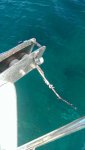
I had a bit of bother trying to find the right size chain hook and so used a camel hitch and one of my standard 14mm 3 braid nylon mooring warps. In the end it worked well enough that I dispenced with searching for a hook. My boat it must be pointed out is significantly smaller than some of those palaces shown above at just 34 ft and ~5 ton.
 
I'm not convinced - not in a blow, at least: the more the boat can move, the more speed she can gain during each swing, hence creating more snatch load at each end of the arc.
Indeed letting down more chain is better in such conditions, but just because the ground tackle holds better, not because the snatch load is lower.
We're not really talking about a 'blow' though. Most of us wouldn't be anchoring in a blow (we'd be attached to a marina!) but we may be anchoring in light to moderate winds and in moderate winds, you're very likely to experience conditions in which the chain is relatively taut between the bow roller and the point at which it is sitting on the seabed. When that part of the chain is taut there is no catenary in it and no ability to absorb any shock loading. If you put out more chain, then the length (and weight) of chain between the bow roller and the seabed increases and so does any catenary effect and hence the ability of the chain to absorb shock loading. Yes I agree that putting out more chain also helps the anchor to hold better because more chain means its more likely that the pulling force on the anchor remains horizontal
 
If you put out more chain, then the length (and weight) of chain between the bow roller and the seabed increases
Mmm... Does it? I can't think of any physical/geometrical reason for that.
Of course, that is true if you reach the point when the chain is taut between the bow roller and the anchor, without ANY length of chain sitting on the seabed.
But that's a bad anchorage - one that needed more chain anyway, to start with...
 
Mmm... Does it? I can't think of any physical/geometrical reason for that.
Of course, that is true if you reach the point when the chain is taut between the bow roller and the anchor, without ANY length of chain sitting on the seabed.
But that's a bad anchorage - one that needed more chain anyway, to start with...

I'm no expert on these things as you know but I look at it this way. Firstly we're not talking about a constant load on the chain but a varying load with sudden shock loads caused by veering of the boat. Those shock loads will tend to lift some of the chain off the seabed and with a relatively short scope of chain it may well momentarily lift all of the chain off the seabed and under those circumstances, the chain is taut and there is no catenary. Obviously then as you let out more chain the possibility of the chain becoming momentarily taut is reduced and the potential for the catenary effect of the chain absorbing some of that shock loading is increased. I do agree that there must come a point at which letting out more chain has no effect in this respect and I guess where that point is depends on the individual circumstances of the boat, wind strength, chain weight etc

There is one other reason why letting out more chain may be useful. When a boat veers at anchor it tends to move from side to side. That movement is partly resisted by the friction between the chain and the seabed and the more chain you have lying on the seabed the less likely it is that that sideways movement is transmitted to the anchor. Of course this is also potentially important if there is a wind shift whilst the boat is at anchor; more chain on the sea bed will mean that the chain realigns itself more gradually and reduces the sideways loading on the anchor as the anchor itself realigns

All IMHO and I expect somebody will be along in a minute to flame me on this:D
 
All IMHO and I expect somebody will be along in a minute to flame me on this:D

Not me, Mike, I'm in learning mode.
Lots of things to experiment with.
It is likely that we will be doing much more anchoring during the next few weeks when we move back to the Baldricks.
The plan at the moment is to do a couple or three weeks in and around Mallorca before heading home to Sant Carles.
Our son is coming out and some yachtie friends are staying on board for about a week so I will have even more information to absorb.
 
It is likely that we will be doing much more anchoring during the next few weeks when we move back to the Baldricks.
Did you find any new anchorages near CF that you haven't posted about on the Sardinia thread?
 
Did you find any new anchorages near CF that you haven't posted about on the Sardinia thread?

No, it has been a bit windy so we have only been to Guidi.
When you are out, it might be worth checking out the ones on the south of Sant Antioco - MapisM has two down there that he recommends.
Out of the two, the one further north did seem to have a beach bar - might be useful if you have the offspring.
Check with MapisM though

Sorry for the thread drift.
I will start posting again on the Sardinia thread - maybe some reports on our trip home.
 
Fwiw I never use a strop or bridle. Critical thing when anchoring isn't staying put ( because that's easy). It's getting out quickly when needed.

Jimmy, scuse pedantry, but the bolts are in tension only not shear. The shear load is taken by friction, created by tension in the bolts. That is true generally of bolted components loaded in shear.
 
Jimmy, scuse pedantry, but the bolts are in tension only not shear. The shear load is taken by friction, created by tension in the bolts. That is true generally of bolted components loaded in shear.
Mmm... I see what you mean, but I would disagree with the "only" bit.
If that would be true, a winch (or a cleat, just to make another example) held in its place by some clamps, creating the same pressure on the mounting surface as the one created by the bolts tension, could withstand the same shear load...?!
Besides, afaik bolts are rated for both tensile and shear strength - there must be a reason, I reckon.
 
Last edited:
with a relatively short scope of chain it may well momentarily lift all of the chain off the seabed and under those circumstances, the chain is taut and there is no catenary.
Agreed, that's in fact the situation I mentioned in my post #24.
 
I always used to, but now I have a heavier boat. If it blows then the windlass will pass its strain point and realise chain ( which is what it is designed to do). ... so now I use the chain lock ( which was supplied!).

Hmmm, i always anchor on the windlass, and so does pretty much everyboat i see. Maybe if it was rough i would rig some kind of shock absorber, or maybe if i was planning on staying at anchor for several days.

Maybe we all shouldnt use the windlass?
 
Agree 100% with Deleted User. Many years of using the windlass for lunch stops has never impacted adversely on any I've owned. Longer term anchoring is a different matter.

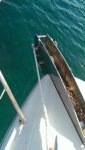
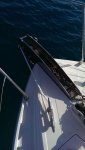
We use something not too dissimilar from this (http://www.defender.com/product.jsp?path=-1|2276108|2276131|2276134&id=950106). on a rope end that allows us to use the remote to transfer load from windless to snubber. If you looked at our bow at anchor is would like we had a tight rope and a floppy anchor chain. (the rope of course is around the cleat on deck.

It is standard practice, I remember anchoring a yacht in the Bahamas'. In the night the wind got up and the swell "because everywhere is 6-9ft deep" was so bad that the bow went down so far in the swell (wind had already pulled the anchor chain taught) that the load was 100% on on the windlass and began to pull it out. This would be a reason to have a snubber.

Anyway I hope you enjoy "free dropping" your anchor like a pro and not pressing the button like a "Sunsail/Moorings amateur and enjoy plenty of happy anchorages.

We have a Lewmar V5 Windlass and replace the gypsy wheel approximately after 300 anchor drops (every 2 years). If you have "twisty chain syndrome, replace ;-)
 
Last edited:
Top