Anchoring in a fast flowing river, tips required.

pcatterall

Well-Known Member
Joined
2 Aug 2004
Messages
5,506
Location
Home East Lancashire boat Spain
Visit site
Have to get my boat down from her up river winter HQ next week.
The trip entails anchoring in one of the deeper areas while waiting for the next tide.
I will need to anchor in about 20 feet of water when the tide is on the ebb, there is up to 6 knots running. I will then have to stay over the next tide (too dark to risk on the river) then resume as the tide floods.
I may be single handed and it is not easy to get on deck from the wheelhouse.
I plan to flake out the required scope and secure the end. get the anchor ready to drop and secure it with a loop line running to the wheelhouse. I would then just stem the tide, release one end of the loop and ease off the power to let the boat ease back.
It seems feasible but could be problematic if anything goes wrong. Also there is the risk of the anchor dragging when the tide turns.
Any thoughts or tips welcome
(32 foot boat, sandy Mersey mud!!)
Regards
 
This could go really really wrong. I probably wouldn't sleep too well with a 6 knot tide on my own anchor...

To ensure maximum chances of success

(1) Wear a Harness and keep the Lanyard Attached to the boat (If you fall overboard once the boat is anchored then you ain't going to get back to the boat)

(2) Prepare, as you suggest

(3) As much chain (or chain+rope) as possible. Normal is 3-5x max depth on chain-only rode. I would recommend up to 10x depth in this situation.

(4) Boat needs to be stopped when you let the anchor go, but more importantly it needs to be moving as slow as possible (almost stationary) when the chain reaches full length and the anchor begins to dig in (go too fast at this moment, and the anchor will just bounce happily along the seabed.)

(5) Regarding tide changing and anchor resetting; providing the tide slows down gradually and builds up gradually in the other direction, it should hold okay. Problem might be if there is a sudden change in direction that the boat is going to fast at the instant the anchor needs to reset. Different anchor designs are better at resetting after direction changes.
 
don't know about anch in the Mersey , but have anchored overnight, single handed many many times where heavy current and tide changes occurred. never been a problem , but think out
1/2 How will I get away from here If conditions are not ideal

1 where you will end up at the other end of the swing

2 allow for cross tide winds for while you are changing ends so to speak

3 sufficient scope for high water

4 that small distance while the anc digs in the opp direction

5 potential for foul ground

6 the need to secure shafts from rotating, as the noise from the gearbox etc might keep you awake at night.


rivers have the great benefit the end change can happen very quickly, so you are soon back in your bunk on the night change, if you feel the need to be awake.


As to the drop

I would be careful to snub the outgoing chain otherwise the boat might be going backwards rather faster than ideal when the tied up bit is reached.


Getting chain up single handed is much more problematical as if a strong current is flowing ,

a it could be hard work getting it up
b you will drift along while stowing for sea etc.


Enjoy !!!


ps edit added

I hope the 6kn is bar room speed, as thinking about things overnights have been

4 kn anc near caudebec on Seine

3.0 in river at Antwerp
3.5 in the elbe
 
I do wonder how the boat was taken up-river?
I have hatched some hare-brained plans in my time, and pushed my luck carrying them through, but I would have thought very long and hard about this one because there seems to be no escape-route if something goes amiss.
A 6-knot stream is about hull-speed for your boat, so the tension on your anchor cable is going to be much the same as in a storm. I hope you have two over-size high-holding-power anchors, lots of cable and a strong, competent crew-man.
Letting go an anchor by remote control is not all that difficult, but for a situation like this it needs to be rehearsed and tested to elimanate any snags before relying on it.
If it all goes wrong, I think any insurer would take a dim view of it, and you could be seriosly out-of-pocket, or much worse.
 
Ditto.

Plus you can never be sure that the anchor will set first time then what can be done with no crew to handle the ground tackle?

It's the last ditch sort of thing you'd do when you'd got yourself into a heck of a pickle (or up the proverbial river? /forums/images/graemlins/wink.gif) and certainly not the sort of thing you'd be planning to do other than as an interesting academic exercise.
 
This sounds decidedly iffy

Where are you starting from? - can you get somewhere with a proper mooring for the night.

Perhaps Fiddlers Ferry?

And then do the trip to deep water in one go.

Is there no-one who will crew for you? If it all goes pear shaped you will have great difficulty sorting things out on your own.

Where do you plan to anchor?

I would have thought the Mersey would be reasonably well lit - would it be better to go for it overnight - don't know, never sailed there, but I have done that sort of thing on the Humber.

Note the lights in a notepad in the order you pass them and note bearing and distance from each to the next and the light pattern. Its much easier ticking off a list than trying to read the chart.

If you do anchor try to find the shallowest water you will stay afloat in - the deeper the water the stronger the tide.

Best of luck if you do go for it.
 
"6 the need to secure shafts from rotating, as the noise from the gearbox etc might keep you awake at night."

If he can sleep under these circumstances he's a better man than I am!
 
You would be advised to push the flood up to spike island and lock in, then leave spike on the next flood and push up past hale lighthouse, so if you ground on a sandbank you will have the rising tide to get you off, try and take someone who knows the river well, as it is very tricky to get up from ff to spike and from spike to a safe depth of water up towards the airport.
will you be carrying on, or locking in at liverpool marina,
or will you be going straight up to conway...
take a visit to west bank sailing club, and speak with them about the locking in at spike island first...

Why dont you leave ff canal when all the other boats leave, and go up the river with the bulk of ff when they all go to anglesey, there are only a couple of tides a year when you can get up the river safely...
 
Eh?

If you're going downstream (Have to get my boat down from her up river winter HQ), you'll want to sail with the ebb (I will need to anchor in about 20 feet of water when the tide is on the ebb, there is up to 6 knots running. I will then have to stay over the next tide (too dark to risk on the river) then resume as the tide floods.) not the flood.

Then why do you have to drop the anchor when there is a 6 kt current? Wait until slack water, drop it and help it dig in by going astern in the direction of the next stream. That'll give your time ot sort out any snarlifurkins, without being swept along.
 
[ QUOTE ]
A 6-knot stream is about hull-speed for your boat, so the tension on your anchor cable is going to be much the same as in a storm.

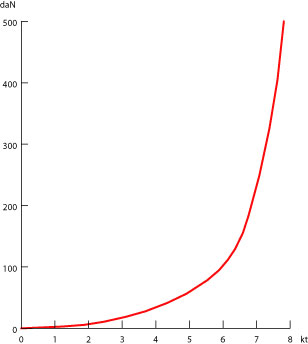
[/ QUOTE ]Not quite - in fact the force from drag tends to always be overestimated. This is a graph from Fraysse's website for a "typical 10m (33') waterline boat":

fig33.jpg


"We can see a 6 kt current... has about the same effect as a 20 kt wind."

Of course the force rapidly increases past hull speed, but 6 knots should be fine.
 
I agree with colvic987, I’ve done this trip a couple of times. I do not fit through the lock inner gates at Spike Island, so have sat in the lock over night, on my way down the river. I have also run amuck at Hale head and had to wait for the next tide. It’s not as much to worry about as all these merchants of doom, who have never sailed in the Mersey would have you believe. You can always ask in Fiddlers Ferry club for someone to crew down the river with you.
 
Bahamian moor - completely agree. It's the only way you'll guarantee the anchor won't trip and not re-set on the tide change. I used it for many years anchoring in the north Brittany rivers, tides and currents only up to 4kts though.

Single handed, going downsteam, drop on the last of the ebb with double the scope you'll need at high water. Dig it in with a dose of astern (lift and re-set if it drags. Yuk! Hard work.) You're then sitting above the drop point for your second hook. Drop it just onto the bottom. As the tide changes, pay out the chain/rope until you have the right scope for high water, x4 to x6 depending on anchor type (Oops! Stand by for anchor debate hijack). Test in astern. Pull in slack on first anchor so they're gently pulling against each other. Lash rodes together. Lower an additional 2x tidal range of chain and swing around your home made mooring as the tide changes.

Swear a bit when the time comes to un-twist the rodes before departure. It is a lot easier if one rode has only 10 - 15 metres of chain, with the rest made up with rope.

6 kts eh? I guess you should be harnessed up all the time . . . no question of going ashore.
 
Many thanks for the responses, all valuable stuff.
yes it is from Fiddlars Ferry.
There are several yachts going down together.
The 6 knots is a guess but the river itself flows quite quickly, following a high tide there is an awfull lot of water suddenly trying to get down to Liverpool so 6 may be realistic.
Doing it in one go is not really an option, coming up is no prob as the tide is one hour later at Fidlars Ferry.
I dont know what the problem is at Spike Island this year, but the 'regulars' say it is not on.
The deep water bit is followed by a shallow crossing down stream which we could not get over in time, hence waiting for the next tide (but one)
Proceeding in the dark is not a good option, no real lights this far up, I do have my upstream route in the computor but the channel has apparently changed.
I can stem the worst of the falling tide, probably just an hour to wait and anchor when there is just the river current to deal with.
I think the big issue is not having crew, if all goes well no probs, if not then it could be fraught!!
Thanks again!!
 
[ QUOTE ]
I think the big issue is not having crew, if all goes well no probs, if not then it could be fraught!!

[/ QUOTE ] Exactly - I wouldn't do that with SWMBO let alone single handed - I would want a good, experienced crew who has sailed on that boat before and is familiar with all the equipment.
 
I once looked at parking at FF.

From memory its about 14 miles from there to Liverpool marina and about 10 miles from there to be clear of the river.

Is it not possible to leave FF at high water and be out of the Mersey by low water? When I was talking to some people there I certainly got that impression.

I would have thought 25 miles with the tide helping would have been quite straightforward. Certainly the lower Mersey is well lit.
 
Yes Bergman it looks easy enough but several crossings nearly dry at low water. At Fiddlars Ferry the tidal period is only 3 hours due to the river effect so possibly about 1.5 hours with enough water to clear the shoal areas. These shoal areas are some miles apart and because the tide is late upstream at Fiddlars ferry the tidal window is even less!!
From Garston to Liverpool to the sea is buoyed and with plenty of water so no probs.
 
Peter
I came down from Fiddlers in April.
Spike Island lock is closed due to low water in marina. Beware!!
The bank off Hempstones Point has shifted out into the river- I unexpectedly spent a night admiring its contours and am not alone -give it a very generous offing.
Not sure what you draw but there is a hole about 1.1m alongside the entrance to Spike Island where you can wait out of the tide alongside a wall, right on the end of the eastern bullnose.
I know others, including Mike from Fiddlers, have anchored off Pickerings Pasture, 2K west of the bridge, where there is plenty of water and a more forgiving tidal stream.
Good Luck.
Andy
 
The river doesn't have a bore, I hope?
We once were forced to anchor in the tidal Great Ouse because we missed the headroom under an old notorious bridge. When the flood came in there was a wave about 3 feet high, preceeded by a vicious eddy that swung us helplessly broadside on. Feeling the boat catch on the bottom, and then roll as the wave hit us broadside, was pretty scary.
 
Thanks PickledPig, the guys are aware of the problem at Hempstones (they did a low water dinghy recce last week) so I just have to follow them!!, how much room is there in the 'hole' at Spike?
The proposed anchor site is somewher in the channel near Hale bank, I guess I could find a shallow bit there to reduce anchor depth and current speed.
Thanks for the info. At least we dont have a bore to contend with!!
Regards
 
Top