
Anchor windlass instructions for dummies

yodave

Well-Known Member
Joined
31 Dec 2010
Messages
400
Location
up North
Visit site
Okay...

So I'm still very new to this, and although we're getting better at making it on and off our fixed mooring etc, etc, there are still a few bits of our boat that remain a mystery to me.

I realise this is very basic stuff. I obviously know what an anchor is for, but having poked around with the old manual windlass, I'm still a little unsure how it works and whether there are bits missing or something needs oiled. Trial and error is an option, but I don't want to try it and then find that I haven't got all the bits I need to retrieve the anchor.

It looks to me as though I need some sort of handle, which I can't find anywhere in the darkest recesses of the boat; and although I might not actually need to use the anchor any time soon ...it seems as though I might need to use it in an emergency, and so I should understand how it works, and replace anything that's missing.

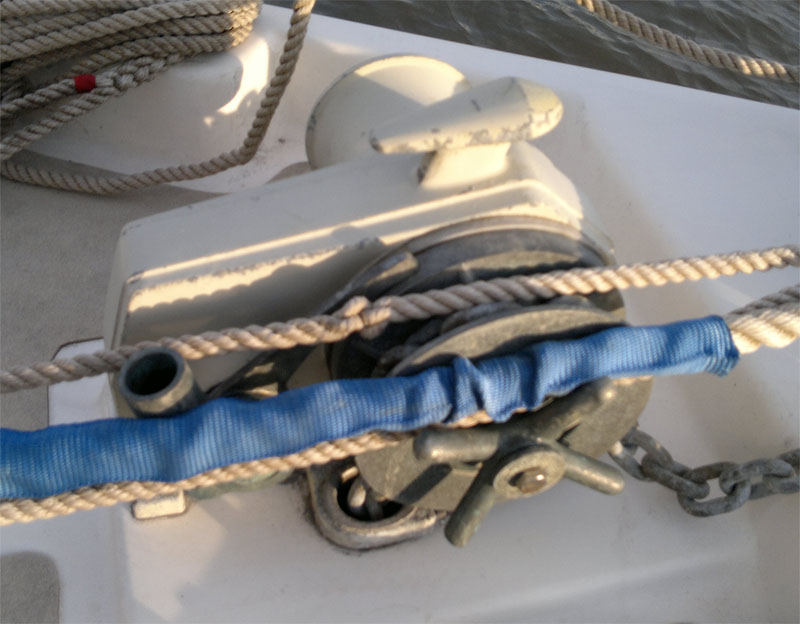
Here's a photo:
anchorwindlass01.jpg


Please ignore the ropes in the photos, as these are either our mooring strop or link-lines.

Any pointers/insight/help would be very much appreciated.

Thanks
 
Yes, the socket at the rear is for a handle - usually about 2'6" long which you crank backwards and forwards to turn the gypsy and so raise the anchor. Slow but good exercise. The star shaped wheel is the clutch and if you undo this it acts as a brake so that you can pay the chain out under the weight of the anchor.

Obviously not as good as an electric windlass but can be useful for breaking out a well dug in anchor. Drum the other side will take a rope which can be useful for tasks such as hauling somebody up the mast.
 
The four pronged jobbie at the bottom of the pic is the clutch. Undo it a bit and the gypsy will run, letting out chain. Screw it up a bit and it will hold, allowing you to winch the hook back up. At the l.h. side of the pic between the ropes is a socket. This takes a lever. Rocking the lever to and fro/back and forth/forward and aft winches in the chain. Therefore, you need a lever. A bilge pump handle would probably fit, but a longer one that lets you stand up over the winch would be less tiring and better for your back. If there's not one a board, a suitable length of stainless tube with a bike handlebar grip at the human interface would do the trick.

Does it need maintenance? Try it and see how well it works. In any case, a light dose of light grease on the innards wouldn't do much harm and might even be of benefit.
 
you have two moving pieces on your winch

1 the clutch (the star shaped thing nearest to camera)

2 the lever (metal piece with hole, left)


Any piece of bar that fits inside the hole will do, though the stronger and better fit, the better.

The bar oscillates to and fro, engaging the pawl into the ratchet mechanism.

The clutch grips the axle, transferring the movement of the bar to the gypsy, (where the chain sits) and also to the drum on the far side.


You need to ensure that all moving parts are oiled/greased properly (not excessively) apart from the clutch face ;) and that the whole winch turns and 'clicks' easily.

Beware of carelessly releasing any item under tension as the lever can exert a very strong pull. Chain hauled in should fall steadily down the hawse-hole; sometimes it piles up in the chain locker - you need to distribute the cone so that the chain does not block the pipe.


Nice piece of kit. If you don't want it, I'll make you an offer :)
 
8ugger typing too slow again !

Yes - you need a handle to go in that round socket that is clearly seen facing upwards. Without it you will struggle to operate the windlass.

Firstly, you need to find the handle (prob about 2' long alluminium tube with small black knob on the end) or a replacement.

Second, make sure that the winged nut with 4 wings is tight clockwise as this is the clutch release. It can be loosened off to allow the anchor chain to run freely when dropping the anchor so dont forget to tighten it before the next stage.

Third, lower the anchor over the bow with a bit of slack chain. Keep some of the chain in the windlass Gypsy (the gnarled drum) though to stop it all dropping over the front

Fourth gently release the clutch and the anchor & chain should start to descend. Nip it up when you've run about 10' out.

Fifth - use your new found handle to pull it all back up.

Repeat 1-5 as many times as necessary

Six - buy an electric windlass ;)
 
Last edited:
The handle will be stainless tube, about 1 metre long. The tube's outside diameter will fit in the back socket, for 'pumping' the chain in; the tube's inside will fit on one of the clutch 'prongs' for letting chain out.

Make sure your chain is marked so that you know how much you have let out - and check that the end is secure!
 
Before trying to use it in earnest, tie the chain so it can't run out and unscrew the clutch to make sure it is free. the threaded spindle should be greased. If not maintained it will seize up and you are stuffed!
 
Thank you

Fantastic!

Tranona, Twister_Ken, Sarabande, Affinite, Greenalien, Snowleopard.

Thanks to all of you. I'll be printing out your instuctions/advice/tips and taking them with me on my next visit to the boat for use as my handy windlass operating guide. You've given me a really good pool of fundamental knowledge [and handy hints] to ensure that when I start to tinker, try, and test the windlass I don't end up with a dead weight on the sea floor and no way of retrieving it.

I'll have one more search for the handle, and if I can't find it I'll source some sort of replacement.

Thank you all very much once again for taking the time to help me out.

Dave : )
 
Thanks Twister_Ken

I'll have a good look in the anchor locker [which is only accessible through the forecabin].

It makes sense that it would be in there.

Fingers crossed!
 
Chances are if it has seen little action for sometime, the gypsy/clutch affair will be bonded together. I pulled mine off with a three legged puller. A quick clean up of the shaft and clutch faces and it was as good as new.

Most were built as double acting. That is, both the forward and aft strokes of the (missing) handle would cause the chain to raise. It is not unusual for one of the chains to break leaving you with a single acting winch. Most of the internal parts are standard bicycle chains and freewheels - easily obtainable should a repair be necessary.
 
Alpha22: I think you could well be right. When I initially had a look at the windlass, I wasn't wholly convinced that [what I now know is the clutch] actually moved, as it didn't budge. Although I don't [currently] own a three legged puller, I now know that I need to free the clutch off.

Not sure that I personally want to be opening up the windlass internals, but it's good to know that the bits and bobs in there are going to be replaceable if required.

Thank you very much for your additional information : )

I'll be out on deck armed with all the advice as soon as the rain stops ...which at this rate could be September.
 
Top