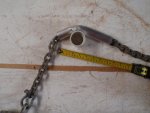
Anchor Swivel

I looked into making a bent link . . . I was going to use round stainless bar and bend it with hydraulics. Would not have been hard or expensive. I thought bending round bar was better than cutting flat plate because it would be smoother on the roller.

But I concluded that the swivel feature might actually be important here. When the bent link hits the bow roller, it is going to put a sudden 180 degree twist in the chain. And that twist is going to be in the relatively short distance between the bent link and the gypsy. I thought that might well cause gypsy/chain problem.

The system can only work if there is sufficient distance between the bow roller and the gypsy to accommodate the length of the shank of the anchor PLUS the length of any bent link and its associated shackles, links etc. I have never found any problem with the possible half twist in the chain, over this length, without the need for a swivel.
 
There was an error in my post on dimensions, thanks Andrew, the length is 180mm - I've corrected the post.

If you have a short distance between windlass and anchor shackle when the anchor is secured then a bent link simply will not fit. Mine is 180mm long plus at least one extra shackle - which is, in total, about 220mm. If you do not have that 'space' then my bent link would not fit - though I would not give up, a shorter bent link might work. I an not suggesting my dimensions are the 'only' answer, just ones that worked for me. NormanS, you might have posted earlier - what are the dimensions of yours?

Hi Jonathon,
Mine is made out of 1/2" (12.5mm) material. The angle is about 140º - 150º. The effective length is about 180mm. My chain is 10mm. As you say, the sizes are not critical. I work on the principle, that "if it looks right, it is right".
 
Hi Jonathon,
Mine is made out of 1/2" (12.5mm) material. The angle is about 140º - 150º. The effective length is about 180mm. My chain is 10mm. As you say, the sizes are not critical. I work on the principle, that "if it looks right, it is right".

Thanks Norman, I suspect mine is well over engineered (a common problem of amateurs - but not a big issue in this case). Being over engineered mine could probably have been 'less beefy' and maybe shorter but it looks right, it works - so it must be right (at least for me).

To quote you, again! what's not to like?

Have a great weekend

Jonathan
 
I don't have any need for a regular swivel (in fact I had one of the expensive shinny ones break on me in Hurricane Lenny) but that looks useful. Where does one buy it (I am in the USA, but happy to get it shipped internationally if the store will do it)? Osculati's on-line store is for wholesale customers only.

EDIT: ordered one from Piplers of Poole

Someone should distribute these in the US - way less expensive than that Ultra swivel.

But this long twist swivel will be very weak with a side load even though it will nicely orientate the anchor. In marginal conditions it would be dangerous, imagine the situation with a 180 degree windshift and the anchor only turns through 90. The side load would be huge.
 
^^ actually, no. This unit is specifically designed to be installed with the "forks" on the chain, and the "loop" to a shackle in the anchor (the reverse of most swivels). So it will articulate on the shackle and not be a lever arm.
 
^^ actually, no. This unit is specifically designed to be installed with the "forks" on the chain, and the "loop" to a shackle in the anchor (the reverse of most swivels). So it will articulate on the shackle and not be a lever arm.

Thats very interesting and would be great for me, I just don't like the look of it much with that skinny swivel joint.

However, I like the idea of quickly orientating my anchor... I wonder if I could put a longer bit of dyneema around it to work as a backup should the unthinkable occur. The shackle before it and the chain link after it. This could be replaced regularly and I guess you could assume that in normal circumstances, it only has to be long enough to absorb say 3 x 360 degrees of twist.

You would probably find that you never pulled it up fully wound around the swivel.
So if that skinny part ever failed, chances might be good that you pulled up your anchor with it still attached by a nice length of dyneema.
Nothing like having a backup....
any comments .?? It seems like a reasonable idea to me.

(Just had a thought, that joint is not designed for swivelling long term, it has a very small surface area so it would probably wear quite fast in stressed conditions... as opposed to a Wasi Powerball that is very high quality and very strong, 6000kg mbl I think)
 
Last edited:
I looked into making a bent link . . . I was going to use round stainless bar and bend it with hydraulics. Would not have been hard or expensive. I thought bending round bar was better than cutting flat plate because it would be smoother on the roller.

But I concluded that the swivel feature might actually be important here. When the bent link hits the bow roller, it is going to put a sudden 180 degree twist in the chain. And that twist is going to be in the relatively short distance between the bent link and the gypsy. I thought that might well cause gypsy/chain problem.

I guess I should read all the posts before posting.

Actually, That bent link together with a big Kong or Wasi powerball might be a good solution as well.

(Starting to get a bit complicated though....I still like the idea of a length of dyneema as backup for these swivels)
 
Fuss,

Going back to an earlier part of the thread - why would you want to spend so much money (beautiful, even sexy though they might be) on a swivel? Can you describe the issues that make buying one so important (and how have you managed in the past without one).

Jonathan
 
Whilst Jonathan and Fuss have their conversation I'd like to add one comment to the OP's question.
For an all chain rode I would advocate a swivel (even just a strong, non-sexy galvanised one) on the bitter end (secured by a finger tight shackle which is then tied to the short length of rope attached to the boat by a round turn and two half hitches – able to be undone under pressure). This is so you can relieve any twists in the chain that develop over time. When my rode was all chain I used to infrequently pay it all out to remove any twists. Without a swivel, as it got to the bitter end, it would untwist violently and shred any rope attached. The swivel prevented this. (Now I have 50m of rope spliced on it is not that easy). Andrew
 
Whilst Jonathan and Fuss have their conversation I'd like to add one comment to the OP's question.
For an all chain rode I would advocate a swivel (even just a strong, non-sexy galvanised one) on the bitter end (secured by a finger tight shackle which is then tied to the short length of rope attached to the boat by a round turn and two half hitches – able to be undone under pressure). This is so you can relieve any twists in the chain that develop over time. When my rode was all chain I used to infrequently pay it all out to remove any twists. Without a swivel, as it got to the bitter end, it would untwist violently and shred any rope attached. The swivel prevented this. (Now I have 50m of rope spliced on it is not that easy). Andrew

I think that is a good idea. I've certainly had twists at the bitter end, although not quite as extreme as you describe.
 
I think that is a good idea. I've certainly had twists at the bitter end, although not quite as extreme as you describe.

Yes, I like that one. Twisting of our chain inside the locker has been a horrendous problem once, preventing me from lowering the amount I wanted, and a lesser problem a couple of other times. Could be a good application for one of the cheap types , a double-ring with a bolt between them.
 
Fuss,

Going back to an earlier part of the thread - why would you want to spend so much money (beautiful, even sexy though they might be) on a swivel? Can you describe the issues that make buying one so important (and how have you managed in the past without one).

Jonathan

Just quickly as I have no big preference as long as the attachment is stronger than the chain either is ok, its up to the individual user. Everyone should know the WLL and BLL of their connectors. When you buy something out of the local chandlery, chances are, you are getting something of unknown strength.

In my situation a swivel runs smoother over the roller and allows me to orientate the anchor easier as the anchor is 60kg. If I used a bow shackle then it would catch slightly on the chain channel which would require some fiddling but it still would work. Also when I lean over to orientate the anchor, it is much more difficult as it will not stay in the newly orientated position when I let it go. this then makes the anchor retrieval a 2 man job as opposed to a 1 man job.

I suppose that if I fiddled around some more, I could make a bow shackle work. I have some green pin lockable ones on board in case I need them (you just can't rely on getting this quality at the local chandlery)
 
Just quickly as I have no big preference as long as the attachment is stronger than the chain either is ok, its up to the individual user. Everyone should know the WLL and BLL of their connectors. When you buy something out of the local chandlery, chances are, you are getting something of unknown strength.

In my situation a swivel runs smoother over the roller and allows me to orientate the anchor easier as the anchor is 60kg. If I used a bow shackle then it would catch slightly on the chain channel which would require some fiddling but it still would work. Also when I lean over to orientate the anchor, it is much more difficult as it will not stay in the newly orientated position when I let it go. this then makes the anchor retrieval a 2 man job as opposed to a 1 man job.

I suppose that if I fiddled around some more, I could make a bow shackle work. I have some green pin lockable ones on board in case I need them (you just can't rely on getting this quality at the local chandlery)

Is there a reason why a "bent link" won't reorientate your anchor without a swivel?
 
Is there a reason why a "bent link" won't reorientate your anchor without a swivel?

I'm not sure, actually, thinking about it. This might be an improvement. I guess I have to try it out.
Was it decided what was the best bent link design?
 
I'm not sure, actually, thinking about it. This might be an improvement. I guess I have to try it out.
Was it decided what was the best bent link design?

Decided by whom? If you look back in this thread, you will see that two of us have made our own, and while using different methods of construction, the finished articles are very similar.
 
Decided by whom? If you look back in this thread, you will see that two of us have made our own, and while using different methods of construction, the finished articles are very similar.
Yes, thanks for that, I have looked back and seen both of your designs. They look good and strong. I am going to make one sometime to try it out.

I don't like "the twister " design as it has a built in swivel which is too light. It has too smaller swivel surface area and will wear in marginal conditions. It might be a safe design when purchased but it would become weak if used often.
 
Bent Tube

And here is a third "design". The attached pic is only a mock-up - the concept is to bend a tube by 40-odd deg so that one's own chain passes through it. For my 8mm chain this requires a 29mm ID within the tube after being bent. The only shackle is from the end of the chain to the anchor. A pin in the tube passes through a link to secure the tube to the chain a few links away from the anchor. What's not to like? Andrew
Bent Tube.jpg
 
And here is a third "design". The attached pic is only a mock-up - the concept is to bend a tube by 40-odd deg so that one's own chain passes through it. For my 8mm chain this requires a 29mm ID within the tube after being bent. The only shackle is from the end of the chain to the anchor. A pin in the tube passes through a link to secure the tube to the chain a few links away from the anchor. What's not to like? Andrew

I like the concept. It has the added advantage in that you could experiment with its position on the chain. Boats with straight stems might want to fit it far enough from the anchor, so that the re-orientating took place while the anchor was clear under the bow.
Depending on your ability to bend suitable pipe without distortion, it might be easier taking a standard 135º pipe bend, and welding short tails onto it.
 
"Depending on your ability to bend suitable pipe without distortion, it might be easier taking a standard 135º pipe bend, and welding short tails onto it." Now there is an idea! It does deserve some thought, and experimentation.

A friend and I have been comparing notes re this thread - it seems to us that many/most users of swivels do so NOT primarily because they are swivels but because:
1) they provide a narrow connection that passes through roller cheeks etc, and/or
2) they enable you to manually right the anchor if it comes up the wrong way up.
If so it might be better to focus on those needs ( hence the bent tube ) rather than a sexy/shiny swivel??

Andrew
 
Last edited:
Top