Anchor snubber to a rope rode

Little Dorrit

Well-Known Member
Joined
27 Jan 2010
Messages
1,295
Location
South Coast
Visit site
Just a simple question In attaching a snubber with dual lines to a rope rode what would be the best technique? Having just been at anchor in 12m of water in F6 I let out the maximum 50m of chain but decided it would be prudent to let out anoher 10m of rope octoplate. I then noticed yawing was causing the rope to rub and possibly chafe severely on the bow roller. What is the best technique to attach a dual snubber by that I mean a snubber coming through each of the fairleads to a rope rode?
 
With 10 metres of octoplait out (nylon, presumably) I do not think you need a snubber but if you do, let out more octoplait. What you seem to be describing is a potentially sacrificial line to take the strain off the octoplait rode at the bow roller. I think chafe is likely to be at least as much of a problem at a fairlead, and doubling-up the line as a bridle won't do much for the yawing. I would suggest trying to pad the bow roller where the octoplait comes through to minimise chafe, and if that does not work attach a substantial line with a rolling hitch to your octoplait, let out a little more rode so the rolling hitch is a couple of metres outboard of the bow roller, then make that line fast and pay out more octoplait. That way your new line will be the one subject to chafe (and you should try to minimise it), but if it gets worn you can cut the damaged part off in due course, and if it chafes through you will still be held by the octoplait once again taking the strain.
 
A bridle is a good idea. It will reduce veering, which is one reason multihulls use bridles, as also 2 anchors in a 'V' will reduce veering.

I'd start your bridle at the transom and run up the side decks and then take outboard at the bow fairleads. This way you have a deck length bridle and can keep the portion beyond the bow short and have there angle of the bridle wide. This will allow you, if you want to deploy newly all the chain and use a chain hook. You can have 50m of chain deployed and. say 10m down the deck of nylon. You can then use a chain hook. If you want to use a longer snubber then - start the snubber at the bow, run to a turning block (spinnaker blocks are good) and then run back to the bow and the bow fairlead and go outboard. You can if you want go outboard at the amidships cleat, run through a Lowq Friction Ring on a short strop and then to a chain hook (or your knot of choice). If you use my doubles back method you have 2 x deck length of bridle and 50m of chain.

You may still need to watch for abrasion and I'd simply use hose pipe and allow the ropes to run freely through the hose. The alternative is to cover the ropes, hollow nylon tape (tube tape) works well, as does dyneema - but the latter is more expensive.

Coincidentally there is a thread on Cruisers Forum active now - its worth reading for knots for the bridle.

Snubber for rope rode - Cruisers & Sailing Forums

Personally I'd attach each arm to the 'rode' independently using a prussic or rolling hitch (or chain hook if you don't need to deploy all the chain.

I'd also dump the anchor plait as your bridle and use climbing rope - it is much more elastic and makes a much better bridle (or snubber. Climbing gyms need to retire their ropes and most of it goes to land fill. Go to your nearest gym and offer to recycle it. They are not allowed to sell it (or not in Oz) so you get it free - but I offer to supplement the coffee or Xmas party fund. Most walls are only 15m high - so you get the right length of rope.


How to: Dealing with Snatch Loads in an Anchorage

Anchor Snubber Tips

The art of snubbing, in the nicest possible way - MySailing.com.au


I have a development of a bridle that might interest you but only have as pdf - send me a PM with an email address and I'll send you a copy.

We now use a 30m bridle - the more bridle the better.

Jonathan
 
As a quick and easy alternative, what about a bit of this?

RABALDER white, Cable tidy, 5 m - IKEA

rabalder-cable-tidy__0275902_PE414011_S5.JPG

Just slip it over the octoplait where it goes through the bow roller and it'll wear instead of the line
 
A bridle is a good idea. It will reduce veering, which is one reason multihulls use bridles, as also 2 anchors in a 'V' will reduce veering.

I'd start your bridle at the transom and run up the side decks and then take outboard at the bow fairleads. This way you have a deck length bridle and can keep the portion beyond the bow short and have there angle of the bridle wide. This will allow you, if you want to deploy newly all the chain and use a chain hook. You can have 50m of chain deployed and. say 10m down the deck of nylon. You can then use a chain hook. If you want to use a longer snubber then - start the snubber at the bow, run to a turning block (spinnaker blocks are good) and then run back to the bow and the bow fairlead and go outboard. You can if you want go outboard at the amidships cleat, run through a Lowq Friction Ring on a short strop and then to a chain hook (or your knot of choice). If you use my doubles back method you have 2 x deck length of bridle and 50m of chain.

You may still need to watch for abrasion and I'd simply use hose pipe and allow the ropes to run freely through the hose. The alternative is to cover the ropes, hollow nylon tape (tube tape) works well, as does dyneema - but the latter is more expensive.

Coincidentally there is a thread on Cruisers Forum active now - its worth reading for knots for the bridle.

Snubber for rope rode - Cruisers & Sailing Forums

Personally I'd attach each arm to the 'rode' independently using a prussic or rolling hitch (or chain hook if you don't need to deploy all the chain.

I'd also dump the anchor plait as your bridle and use climbing rope - it is much more elastic and makes a much better bridle (or snubber. Climbing gyms need to retire their ropes and most of it goes to land fill. Go to your nearest gym and offer to recycle it. They are not allowed to sell it (or not in Oz) so you get it free - but I offer to supplement the coffee or Xmas party fund. Most walls are only 15m high - so you get the right length of rope.


How to: Dealing with Snatch Loads in an Anchorage

Anchor Snubber Tips

The art of snubbing, in the nicest possible way - MySailing.com.au


I have a development of a bridle that might interest you but only have as pdf - send me a PM with an email address and I'll send you a copy.

We now use a 30m bridle - the more bridle the better.

Jonathan
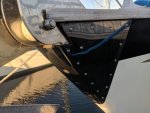
Thanks for the comprehensive reply. That's a lot of information and options to take in but all seems sensible, I will be setting this up soon I think I like the idea of running through the fairleads as the anchor bow roller sides protrude and the rope is likely to chafe severely IMHO (see attached picture). Using two separate knots would be the easiest but I am also considering on continuous line through a soft shackle or low friction eye which I can splice an eye on making a single rolling hitch an option.

Is your pdf a 'new' idea or simply an expansion of the ideas outlined in your reply?IMG_20181117_151515 (Small).jpg
 
The PDF simply describes a further development of the ideas I have outlined.

The restriction I see with your ground tackle is that you are constrained by 50m of chain. This is not a serious impediment.

Chain and nylon snubber are used for self same purpose - to absorb the energy of the moving yacht. The more, nylon, rope you can use the less chain you need to deploy. The common perception is that you need to deploy the snubber beyond the bow, which also means you need to deploy the same amount of chain (which is left in a lazy 'sag').

We use 30m snubbers, though normally only about 20m. But 30m of rope beyond the bow is, daft. If we deploy 30m as in our arrangment we have the bridle sitting less than 10m beyond the bow, or 10m from bow to chain hook.

Running it in some way from the transom - means you don't need lots of chain - because you are using the sidedeck length as part of your rode. Instead of back and forth on the side decks we are running through the attachment point on the chain, we use Low Friction Rings. We have found that if you can secure one end of each bridle arm low down, at the waterline, through the LFR (at the chain) and then back to the bow and then to the transom you produce a normal triangle of the bridle and another triangle between deck and waterline - and this latter reduces the impact of swell or chop. We this have 2 effects one, a conventional and horizontal triangle of the bridle, which reduces veering, and a vertical one which reduces horsing.

If your anchorages are all well sheltered from swell and chop - you would not need the 'vertical 'triangle - but many of our anchorages are 'off' the Tasman Sea (and last week we had 12m swells - which are quelled by the time they reach an anchorage).

If we still have chain available to deploy, in your case say deploying 40m - you still have 10m left - you can extend the bridle (assuming it is long enough) from the transom (which is considerably more comfortable at 2am in the rain, than having to go to the bow).

Much use of snubbers, or a bridle, is determined by the specific design of the yacht and your ability to innovate. However as soon as you accept that the bridle/snubber can 'commence' at the transom you will find other methods that will work as well. One member here starts at the amidship cleats - there are lots of options.

Jonathan
 
One minor point. Never deploy less than about 15 M of rope rode in a combination rode.

The problem is that the rope portion is forced to act as shock snubber, and that requires a certain amount of length. If the length is too short, it can become over worked and fail. When a snubber is securing an all- chain rode, the snubber is disposable and failure is not such a big deal. It can be shorter. But if it the rode and fails, all is lost.

Either anchor on all-chain with a snubber, or let out enough rope so that it has the necessary length to dissipate the shocks. There have been failures related to too little rope (10-30 feet), shallow water, and choppy conditions.
 
Just a simple question In attaching a snubber with dual lines to a rope rode what would be the best technique? Having just been at anchor in 12m of water in F6 I let out the maximum 50m of chain but decided it would be prudent to let out anoher 10m of rope octoplate. I then noticed yawing was causing the rope to rub and possibly chafe severely on the bow roller. What is the best technique to attach a dual snubber by that I mean a snubber coming through each of the fairleads to a rope rode?
 
One minor point. Never deploy less than about 15 M of rope rode in a combination rode.

The problem is that the rope portion is forced to act as shock snubber, and that requires a certain amount of length. If the length is too short, it can become over worked and fail. When a snubber is securing an all- chain rode, the snubber is disposable and failure is not such a big deal. It can be shorter. But if it the rode and fails, all is lost.

Either anchor on all-chain with a snubber, or let out enough rope so that it has the necessary length to dissipate the shocks. There have been failures related to too little rope (10-30 feet), shallow water, and choppy conditions.

That's a very good point and perfectly logical thanks.
 
Most snubbers that I see in Australia, if they are used at all, are too short. Maybe 3m of rope. They take the load off the windlass but do nothing as a snubber. Because they are also oversized, large diameter, they don't (as Thinwater suggests) fail, because they are so strong. Were they to be thinner and offer a vestige of elasticity - they would fail more frequently. This is not restricted to monohulls but is endemic in multihulls where the length of the bridle is dictated not by the bridle's snubbing ability but by the size of the vessel (distance between the hulls). The bridle is both too short and too large a diameter. Again it takes the load off the windlass, it does reduce veering - but does nothing for snubbing. To support what Thinwater said - before we started our development of longer and longer and more and more elastic snubber we did break 2 bridles.

Commonly snubbers are chosen for strength, to be as strong as the chain rode - and this means they are effectively inelastic and the owner is reliant completely on catenary (which largely disappears in the water depth most would anchor in at about 30 knots. A long thin snubber offers elasticity, it actually snubs, and because it is longer it last longer. However it does not replace the chain rode and if the snubber (or bridle fails) the fall back is the chain. In anticipation of failure you should have some form of chain lock to ensure that should failure occur the load is not on the windlass but on a strong point on the vessel. We use the same chain lock, ours is a dyneema strop and hook, which we use to secure the anchor and rode on passage.

For many people none of this is an issue - they don't get caught in stronger winds at anchor. They have stayed at home. Most snubbers I see and certainly bridles on catamarans are supplied at commissioning - and never changed. If you have a long keeled or heavy displacement yacht and oversized chain snubbers will be less critical but most yachts today are relatively light and with decent windage - and a snubber would be advantageous.

Previous generation relied successfully on mixed rodes, because they had less disposable income to invest in chain and, in the absence of a windlass, they deployed and retrieved by hand - but the 'technology' behind their mixed rodes has largely been lost.

I happily admit - we use a mixed rode given that we can deploy 30m of elasticity (and chain to manage chafe and abrasion of the nylon on the seabed) - hopefully we are using 21st Century practices.

Jonathan
 
With 10 metres of octoplait out (nylon, presumably) I do not think you need a snubber but if you do, let out more octoplait. What you seem to be describing is a potentially sacrificial line to take the strain off the octoplait rode at the bow roller. I think chafe is likely to be at least as much of a problem at a fairlead, and doubling-up the line as a bridle won't do much for the yawing. I would suggest trying to pad the bow roller where the octoplait comes through to minimise chafe, and if that does not work attach a substantial line with a rolling hitch to your octoplait, let out a little more rode so the rolling hitch is a couple of metres outboard of the bow roller, then make that line fast and pay out more octoplait. That way your new line will be the one subject to chafe (and you should try to minimise it), but if it gets worn you can cut the damaged part off in due course, and if it chafes through you will still be held by the octoplait once again taking the strain.

I'd offer an alternative view on this.

If its a true mixed rode than the nylon will have the same or similar UTS to the chain, the nylon will be quite beefy and given that it extends 50m of chain will offer very little elasticity at all. Most of the snubbing will be performed by the catenary in the chain. Adding a device specifically sized for snubbing will offer elasticity (because it will be much weaker than the chain and will have a smaller diameter). Because a device designed to snub will be weaker than the rode then the rode itself offers safety - but the windlass will still need to be protected (in case the snubber fails).

Our 6mm chain has a UTS of over 4t, our 30m bridle, each arm has a UTS of about 2t (and I think maybe we have over specified for the snubber - we could accept more elasticity).

Jonathan
 
Just a simple question In attaching a snubber with dual lines to a rope rode what would be the best technique? Having just been at anchor in 12m of water in F6 I let out the maximum 50m of chain but decided it would be prudent to let out anoher 10m of rope octoplate. I then noticed yawing was causing the rope to rub and possibly chafe severely on the bow roller. What is the best technique to attach a dual snubber by that I mean a snubber coming through each of the fairleads to a rope rode?
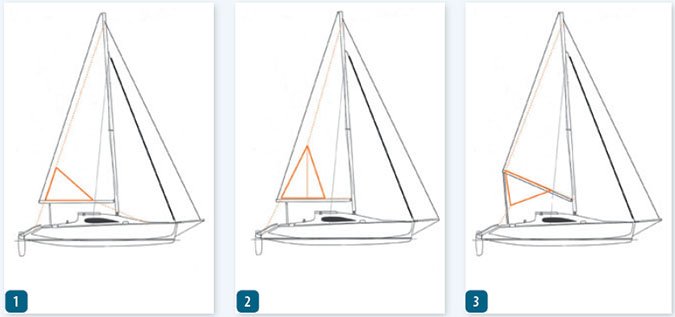
The yawing can be attenuated with the use of a Riding Sail on the backstay. To find out if it's worth going to the expense of getting one made, experiment, by running your storm jib up the backstay and sheeting it forward to some convenient point on one side of the boat, a sheet winch or genoa car for instance. If it's on a split backstay, sheet it to the opposite side.
 
I've been testing riding sails of a number of designs, and I've come to the conclusion that, at least for my trimaran, the least effective and most archaid design, is the traditional triangle-on-the-backstay version.

p1dfr732qg1fks1n3e1ra320j1bfm6.jpg


Banner Bay makes a much better design. But for the DIY, the best answer is a diamond-shaped piece of cloth over an elevated boom. Much stronger and more efficient than the backstay style.

It's funny how long it has taken anchoring to evolve.

2b.%2Bfinished%2Btarp%2Bover-boom%2Bsail%252C%2Bgood%2Bto%2Babout%2B20%2Bknots%2B%2528tested%2Bto%2Bnear%2B30%2Bknots%2529..jpg
 
Thanks for the replies which have been very helpful. I was just wondering if a soft shackle attached as a Prusik knot onto the rope rode with the snubber attached to that with a bowline would be a reasonable solution in addition to the other options?
 
I've been testing riding sails of a number of designs, and I've come to the conclusion that, at least for my trimaran, the least effective and most archaid design, is the traditional triangle-on-the-backstay version.

p1dfr732qg1fks1n3e1ra320j1bfm6.jpg


Banner Bay makes a much better design. But for the DIY, the best answer is a diamond-shaped piece of cloth over an elevated boom. Much stronger and more efficient than the backstay style.

It's funny how long it has taken anchoring to evolve.

2b.%2Bfinished%2Btarp%2Bover-boom%2Bsail%252C%2Bgood%2Bto%2Babout%2B20%2Bknots%2B%2528tested%2Bto%2Bnear%2B30%2Bknots%2529..jpg
How does it perform?
 
Thanks for the replies which have been very helpful. I was just wondering if a soft shackle attached as a Prusik knot onto the rope rode with the snubber attached to that with a bowline would be a reasonable solution in addition to the other options?

I would use a figure 8 instead of a bowline, but yes, that works. Someone will say that a knot weakens the rope, compared to a splice, but (a) the Pruisik or any gripping hitch will slip at about the WLL of the rode, well below breaking strength, and (b) it will break where it chafes o ris edge-loaded over a chock anyway.
 
Commonly snubbers are chosen for strength, to be as strong as the chain rode - and this means they are effectively inelastic and the owner is reliant completely on catenary (which largely disappears in the water depth most would anchor in at about 30 knots.
I think you may be mixing up strength and elasticity. I would expect a 12mm octoplait to be substantially stretchier than 8mm G30 chain, despite having similar strengths.
 
Just a simple question In attaching a snubber with dual lines to a rope rode what would be the best technique? Having just been at anchor in 12m of water in F6 I let out the maximum 50m of chain but decided it would be prudent to let out anoher 10m of rope octoplate. I then noticed yawing was causing the rope to rub and possibly chafe severely on the bow roller. What is the best technique to attach a dual snubber by that I mean a snubber coming through each of the fairleads to a rope rode?
Why not just run the octoplait through one of your fairleads, which a bit of chafe protection if required.?
 
"... Commonly snubbers are chosen for strength, to be as strong as the chain rode - and this means they are effectively inelastic and the owner is reliant completely on catenary (which largely disappears in the water depth most would anchor in at about 30 knots...." (Neeves)

I think you may be mixing up strength and elasticity. I would expect a 12mm octoplait to be substantially stretchier than 8mm G30 chain, despite having similar strengths.

No, I think he was slightly unclear. What he meant was that a rode is typically sized larger than a snubber would be for the same application (for safety sake--it is OK if a snubber fails, but not if the rode fails), and thus the rode will be less stretchy, for any given length, than a thinner snubber would be.

This is unarguably true. This, in part, is why I interjected that if you are going to deploy the rope portion of a mixed rode, a substantial minimum length is required.
 
Top