
Anchor setup question

Assuming that is a stainless bow roller.

To me it looks very much like the whole bow assembly, including the anchor roller, is made from aluminium.
Agree that extending the roller out a bit might be a good idea, but in that case either use aluminium for that also, or, if using stainless steel, make sure to isolate the two materials from each other.
 
To me it looks very much like the whole bow assembly, including the anchor roller, is made from aluminium.
Agree that extending the roller out a bit might be a good idea, but in that case either use aluminium for that also, or, if using stainless steel, make sure to isolate the two materials from each other.
I thought it looked like aluminium but was not sure. I'm not keen on recommending aluminium as you really need to get into anodising and I'm not sure which aluminium to suggest, the obvious being the 5083.

Building a completely new bow roller would be the way to go if the OP was to keep the yacht for some years. Extending the bow roller is a quick fix.

I do agree - if the roller is aluminium and stainless is to be used for the extension than the 2 metals need to be isolated, not difficult - just messy.

In pondering if the existing fitting is aluminium I then wondered how they isolated the stainless bolt that holds the roller itself.


Really the OP needs to consider what is best for him - but as he mentioned agility and dexterity are issues keeping the complete rode, anchor (on bow roller) and rode in the shallow locker seems sensible. Simply deploy by hand standing on the bow and retreive using the sheet winch.

If the OP want to explore the idea of extending the bow roller, to take a shank - then it would be sensible to start a new thread with the bow roller pictures in the thread intro.

Jonathan
 
All good stuff guys and all up for consideration. I like the suggestion to extend the bow roller and can easily do that myself. I have the tools and ability so not a problem if I need to do it. If I can't get an anchor that will stow on the bow roller comfortably then that may be the way to go. It is an aluminium casting so will need to isolate any extension and or fish plates to accommodate it that I may fit.
There is currently no isolation between the forestay fitting bolt and the aluminium casting but equally no signs of corrosion going on and the boat is now 14 yrs old, so probably nothing to worry about.
 
Greeny - I'd check the hole for the fitting of the forestay. We have an aluminium bowsprit that takes a forestay. The forestay is attached to a tang welded to the bowsprit. The forestay enlarged the hole in the tang to an oval shape - rather more rapidly than I would have thought. I complained to the supplier - they replaced or rebuilt the bowsprit and incorporated a stainless sleeve in the hole (there's a word for such a fitting - eludes me). No trouble since. We have lots of custom aluminium components on our cat - all the others are sleeved.

Jonathan
 
There is a positive review on the Epsilon in the current PBO magazine. Its nothing detailed simply a comment on the authors limited use - so far. They make the point the anchor is made with the same requirement for fitting as was the Delta - so if your yacht was designed to accept a Delta, as many production yachts were (or are)- then the Epsilon will also fit.

It merits a look as it will be stocked by many chandlers and looks to be keenly priced.

The Epsilon has not enjoyed detailed testing, I have actually not seen one in the 'flesh'. Lewmar, in common with much industry, has suffered from delayed production and shipment in China.

A few members here have bought one -maybe they can make a comment.

Jonathan
 
Just had a quick read of the online PBO review on the Epsilon. Sounds good as an anchor but no way will it go on the bow roller. Any anchor with a "central" point on it will foul the bow of the boat before it gets onto the roller properly. It looks like I'd need to add at least a 8" extension to get it anywhere near fitting. That's why I started looking at the danforth type designs. I think ideally I'm leaning towards a fortress maybe if I can get one locally at the right price or mail order from Spain/Germany. Portugal is not the best or cheapest place to buy yachting bits by far.
 
The joint of shank to anchor is defined as the crown.

Basically only unballasted anchors have their crown at the heel, Fortress and Danforth are the classic examples. If you were to buy a genuine model they have a long (or wide) stock. Other unballasted anchors are your Bruce and then Bugel, Viking, Knox and SARCA and other then Bruce all have roll bars. You may find Danforth variants, like the one you already have (with no stock). I'd have a look at Knox or SARCA as the shank is at the same level as the top of the roll bar with the fluke way below.

This is a Knox and SARCA side by side. I think SARCA might be available from Jimmy Green (but as it comes from Australia might be expensive) and the Knox is locally made (in Scotland, if it is considered local). I would ring Geof at Knox anchor and ask him about shank length - but it might be on the website www.knoxanchors.com.

Both are excellent anchors of the 2 I would favour the Knox. (Apologies - the SARCA comes with a conventional galvanised finish not the garish personalised colour scheme (I charge extra :) ). The Knox is built to battleship strength and has seriously strong high tensile shank (and excellent galvanising).
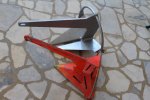
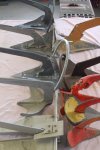
IMG_1341.jpeg

Your demands box you into a corner with - limited options.

For a ballasted anchor, Kobra, Excel, Spade etc they all have their crown in roughly the same location as each other.

This is a rough comparison of ballasted, on the right, and unballasted on the left. Its not a brilliant picture and the anchors are all different weights and sizes

On the left, top to bottom

Viking, Mantus, Viking, Bruce clone, Fortress and on the right Excel, Rocna, CQR, Spade and Kobra.

IMG_4596.jpeg


You either need your 8" extension, move down a size (or two) in anchor or go for a Danforth, Fortress or live with the roll bar of Knox or SARCA - but I suspect the Fortress (and a genuine) Danforth shank will be too long and the stock will be a major hazard (to sheets and removal of the anchor).

If you can fit and live with a Knox or SARCA - they would be a better choice that Fortress or Danforth

Jonathan
 
Boat is small, a Jenneau sun 2000. 20ft trailer sailor.
Currently with a 8kg claw anchor with swivel and 3 mm of chain to 30 m warp.This setup is providing excellent holding but proving problematic for break out and recovery after being set in 15/20 knots wind which is normal here in the afternoon.
Its only used a "day" hook normally on a sandy /muddy seabed with no rock to damage the warp so I'm intending to replace it with 8kg Danforth direct to warp. No chain and no swivel. The chain and swivel setup just make it harder to recover over the roller and around the furling gear. I'm single handed all the time and not as strong or agile as I used to be.
I'll be keeping the old setup for emergency / occasional overnight use.
Will the lack of chain weight really make that much difference to the ability of the anchor to set?
Question for Neeves maybe?

A warp is a line used for warping, not the material line is made from. Thus, your rode is made of chain and rope.

(Sorry, but that and calling the rope portion of a rode "rode" grate on my ears. )

warp

----

As for the amount of chain, I have used less than the water depth + free board for decades on smaller boats. My 34' cruising cat had all-chain, but my current 24-tri has only 6' of chain and it is plenty. This makes break out and retrieval easy.

Cutting and chafe are far less of a problem on smaller boats because the load is less. the boat is lighter, and generarlly we size the rope as much for handling as strength. For example, I use the same 1/4-inch chain and 1/2-inch rope on my 24-foot tri as I did on the cat weighing 5 times more, just because it is easy to handle with no winch and no roller. Of course, if you have a lot of rock and coral, that is different, and you will have to suffer chain. The best answer, without a windlass, is gloves.

I would not go with zero chain except for a kedge or secondary anchor (I have done this--I used a special covered Dyneema length for cut resistance). The chain provides considerable protection right at the anchor when the boat yaws. Even just 2 meters. Also, just a few meters of chain does help hold the shank down during the initial bite, which is very low load.

As for the pulling, find a good place to sit, with your feet braced and with the bow cleat between them. Haul in the lulls and put a single turn on the winch in the gusts or when you simply want to rest. Don't rush. As for breaking out the anchor, once you get right over the anchor, cleat it and let the wayes work it loose. No anchor holds long at 1.5:1 scope!

You will use more scope with less chain, but you are probably also anchoring in shallower water, so that hardly matters.
 
Last edited:
I am leaning towards a 6kg Kobra, elpison 6kg, my current mantus 13lb is up for sale as its too awkward to stow. I have a 6kg delta but on weighing it actually turns out to be over 7kg.

There are a couple of 4kg kobras for sale second hand locally however i think they would be a bit light.
 
An advantage of both the Knox and SARCA - they both have relatively short shanks - and shank length seems to be an issue with greeny. Both would be a devil to stow in a locker.

I had not realised there was so much difficulty in finding an anchor that fits on some small yachts. It appears to be more a fault of the yacht designer/builder not thinking this through. Thinwater has the same issues and a very shallow locker at the bow. He has overcome the issues using a Northhill which is a rather neat folding anchor - but the chance of you finding one in the UK (or anywhere outside America - slim). They were made in America.

Jonathan
 
Top