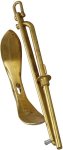
Anchor setup for serious crusing - anchor size for 25 foot, 2 tons (4500 pounds) yachts

Status
Not open for further replies.
Does anyone else think it might be an AI ChatBot, being trialled by The Future Group as a potential cost-saving measure....?

Like Alexa on steroids.... or something?
 
FISHERMANS ANCHOR TEST AND AN OLD PRACTICAL SAILOR TEST THAT INCLUDED THE HERRESHOFF< CQR AND SPADE

First of all, this You tube clip shows how useless a bad version of a fishermans can be if not used in rocks or heavy weed.
60lb. Fisherman. Anchor Test Video # 104 - YouTube

Then a good test of a whole bunch of different anchors that does show the Herreshoff did fairly well in sand for an anchor that is really designed more for rocks and weed. No idea why there is no result for mud, but it's supposed to be fairly good in mud according to previous test. The later PS article covered the mud test where it did well.

Practical_Sailor_Jan_01.pdf (plaisance-pratique.com)

That article is interesting, and the parts I like are the 2 below:
In the December 1999 issue, on which of 17 anchors set and hold best in mud. Tops for setting was the Delta with six anchors tied for second; for holding power, the rank was the Barnacle, CQR and Bulwagga. At the end of those three test sessions, the sand/mud holding power was combined and the top three anchors were the Spade, Bulwagga and CQR.
The CQR might need more scope and take more setting, but what matters most in a storm apart from the anchor not bending or braking, is pure holding power.

The Herreshoff Bronze was a surprise. This very handsome new version of a very traditional anchor set quickly, in 2', and broke out and reset itself in 3'. In sand, its weak point is holding. It dragged at 300 lbs., 100 lbs. short of the 400-lb. requirement. It essentially is a rock anchor.

BUT you get what you pay for, and no other deep water anchor can work fairly well in mud and sand. It's an exception to the rule.
 

Attachments

  • 1790000B_600x600.jpg
    1790000B_600x600.jpg
    22.6 KB · Views: 1
  • 1790000C_600x600.jpg
    1790000C_600x600.jpg
    24.9 KB · Views: 1
Last edited:
FISHERMANS ANCHOR TEST AND AN OLD PRACTICAL SAILOR TEST THAT INCLUDED THE HERRESHOFF< CQR AND SPADE

First of all, this You tube clip shows how useless a bad version of a fishermans can be if not used in rocks or heavy weed.
60lb. Fisherman. Anchor Test Video # 104 - YouTube

Then a good test of a whole bunch of different anchors that does show the Herreshoff did fairly well in sand for an anchor that is really designed more for rocks and weed. No idea why there is no result for mud, but it's supposed to be fairly good in mud according to previous test. The later PS article covered the mud test where it did well.

Practical_Sailor_Jan_01.pdf (plaisance-pratique.com)

That article is interesting, and the parts I like are the 2 below:
• In the December 1999 issue, on which of 17 anchors set and hold best in mud. Tops for setting was the Delta with six anchors tied for second; for holding power, the rank was the Barnacle, CQR and Bulwagga. At the end of those three test sessions, the sand/mud holding power was combined and the top three anchors were the Spade, Bulwagga and CQR.
The Herreshoff Bronze was a surprise. This very handsome new version of a very traditional anchor set quickly, in 2', and broke out and reset itself in 3'. In sand, its weak point is holding. It dragged at 300 lbs., 100 lbs. short of the 400-lb. requirement. It essentially is a rock anchor.

BUT you get what you pay for, and no other deep water anchor can work fairly well in mud and sand. It's an exception to the rule.
Haven’t you noticed that almost anything holds in mud? It’s the bottom of choice for anchoring. Therefore making a claim about how good an anchor is compared to others when anchoring in mud is a waste of time.
Instead of accepting the results of possibly the most independent and far ranging investigation into the holding powers and quality of anchors, you rely on strange one-off results to justify your fixation with the provenly poorer CQR anchor.
 
Last edited:
A Spade anchor is better than a Rocna and a Rocna is better than a Delta. IMHO. So I would spend money on the anchor and know how to attach it to the chain (surprisingly many people do not). 6mm chain sounds fine. Minimum 20m even if you anchor in 2m.
 
With the passion expressed at the inaccuracy of some (or all?) anchor tests by some, or one, I am surprised he has not defined precisely how acceptable test should be conducted and how they are going to be funded.

Its easy to criticise, even easier to criticise without any quantitative data to support the, or an, argument.

So......

If you think anchor testing is wrong - be positive!, please. Start a new thread (and leave this one to die quietly). Think carefully and define in detail how anchors should be tested, how much the anchor testing will cost and, importantly, who is going to pay for it.

If you cannot do this, you have no substance behind you - and are a believer 'the louder you shout the more right you must be'.

Let's see the colour of you money.

We criticise TNLI for his statements - let's see if he is a troll or a knowledgeable anchor expert.

Jonathan
 
Haven’t you noticed that almost anything holds in mud? It’s the bottom of choice for anchoring. Therefore making a claim about how good an anchor is compared to others when anchoring in mud is a waste of time.
Instead of accepting the results of possibly the most independent and far ranging investigation into the holding powers and quality of anchors, you rely on strange one-off results to justify your fixation with the provenly poorer CQR anchor.

You miss the point about cheap fishermans anchors, and that is they are very bad in mud. SV Panope who does film his tests so we can see if there is any cheating was very surprised that a cheap fishermans could not hold in cobblestones, and I suspect it would even be bad in heavy gravel.
The results for tests in sand were similar, the cheap bar fishermans was useless. A heavy Admiralty pattern will do slightly better in both mud and sand, but is still not going to be able to be of real use as part of a serious storm anchor set up with 2 different anchors.

The main reason Lewmar put the CQR back into production and developed a stainless version of similar strength, was because a number of tests including a real good one filmed and posted on You tube under the SV Panope series turned out to be correct, that the genuine steel CQR was a fraction better than the Lewmar Delta, and in terms of use as a main storm anchor, only the UK Spade did betterin the holding in mud, the other anchor mentioned is not in production and too difficult to economically manufacture. The series of tests proved that resulted in the RNLI selecting the Spade for its offshore boats. The CQR is no good with a short scope, so would not have met that part of the requirement. The CQR also takes too long to set which is another point in favour of a Spade. Several other companies like Force 4 found out about the RNLI test results and started making copies of the Lewmar CQR, there is even one company producing a stainless copy.

CQR vs. Delta. Anchor Test Video # 124 - YouTube

One good point mentioned about tests in general in the link I provided, is that the holding in what might look like an even sea bed varies, so doing a test that is not filmed and is supported by the US marine parts companies in only one type of sea bed with no camera or unbiased witnesses results in erratic numbers, so you just select those that show your competitor, (Lewmar), is producing bad anchors. Any test that has not been repeated at least a dozen times to calculate both an average and a very important variance figure, (Accuracy), is pointless. That is why the results of the various privately funded anchor tests are all different !!!

Another bad point about the genuine steel CQR or Lewmar CQR, apart from scope and initial setting requirements, is that it is the only anchor around that when set into soft mud, (Good holding designation in the official guides), heads for the center of the planet if subject to some serious force in a storm. I know that is fact, as I had serious trouble trying to weigh anchor in Colon after some strong trades. I thought I might be getting close to breaking the chain, and when an expert from the USCG design department who was also circumnavigating commented on some of their tests, they did break the chain connector trying to recover a CQR from a serious mud test. That resulted in one company admitting that they were using a cheaper mild steel that the one listed on their web site.

I'm very wary about recommending an amatuer buy or use a CQR for a storm main, unless they understand that it should be used with a good steel Danforth set at a minimum angle of 30 degrees to avoid a potential cross over risk with one anchor dragging into the others chain if the wind does a 360 veer etc. You should always set or lay out, (No need to set, so easy to recover a Danforth), your secondary main in bad conditions anyway, unless you dive on your main to see how it has set. Some folks do that in the Caribbean area when forced to use a short scope due to overcrowding. In many cases the overcrowding is caused by crusing yachts that lack a good deep water short scope capable anchor or a very long rode, and nothing will ever beat the German Herreshoff.
The Germans do know about which anchors to buy for a serious cruise and I had a look at several of their forums, and was stunned to find that most of their more expensive yachts that are or have been circumnavigating, or who are based in areas where poor holding is normal, like Iceland, carry and regularly use bronze Herreshoff.

In do admit to having a fixation over the incredible 3 piece bronze Herreshoff, and suspect that like their top of the range cars and trucks, no one is going to design a better short scope general purpose anchor that works best in rocks, heavy weed, cobblestones and debris or around wrecks, BUT can still produce fairly good holding and very good 180 degree reset figures, (Better than the CQR, Delta and about half of the weak rust prone modern anchors), in mud or sand. The Germans did a test with 2 to 1 all chain and it beat all of the available old and modern anchors that they had available, including the Spade, although it was within the statistical variance figure. It des work almost as well with a 2 to 1 rope rode, BUT I sure would rig a good trip line before you throw.

If you are doing some real research into which 3 anchors and rodes to obtain, you will need to suffer long posts, as it's a complex subject to research. If you don't have time to do that, copy the RNLI or even the TNLI. The current list is as follows:

Herreshoff (Bronze 3 section only) direct from the manufacturer.
Lewmar steel CQR, (No test results available for the stainless version which is a slightly different shape).
Lewmar Delta
Lewmar steel PGX Danforth
The RNLI does use an Admiralty pattern fishermans, but its only of use in rocks, wrecks and heavy weed, so of less use as part of a 3 anchor serious cruising parts list.
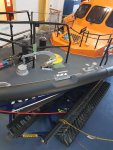
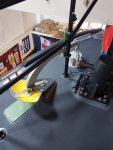
PS: Nothing wrong with buying good used anchors as long as they are genuine versions, BUT please PM me if you spot a used bronze Herreshoff for sale.
 
Last edited:
Herreshoff (Bronze 3 section only) direct from the manufacturer.
Lewmar steel CQR, (No test results available for the stainless version which is a slightly different shape).
Lewmar Delta
Lewmar steel PGX Danforth
The RNLI does an Admiralty pattern fishermans, but its only of use in rocks, wrecks and heavy weed, so of less use as part of a 3 anchor serious cruising parts list.

This is very dated, The RNLI use Spade, designed by a French man, made in Tunisia and bought from a distributor in the Channel Islands. The steel CQR from Lewmar is made in China

J

Whereas TNLI is, apparently trying to promote dated, and now discredited, designs the constant repetition of the brand, or design, Spade and the fact it sits on the foredeck of the latest and most upto date RNLI lifeboat, the Shannon class - simply enhances Spade marketing. It would be impossible, normally, to have so much exposure. Every use of the word 'Spade' and 'anchor' is noted at Google.

IMG-20220607-WA0008.jpeg

Like it or not but the RNLI is highly respected and envied, internationally. Its decisions are noted, its choice of equipment documented and its rejection of historic choices (notably 'British, for decades, and replaced by 'French') not ignored.

IMG-20220606-WA0003.jpg

There is no such thing as bad advertising.

And associating 'Spade' with the RNLI is manna from heaven in the anchor world (of Spade).

Now TNLI - are you a consultant for Spade? If not - you have missed a career route. Historically Spade was a quirky French design (for proof count Spade on bow rollers in UK marinas) - now its common currency on the UK's largest boating Forum.

I use one, Spade - and now I expect to see more of them as it is endorsed by the RNLI (and repetitively mentioned on YBW).

Jonathan
 
Last edited:
With the passion expressed at the inaccuracy of some (or all?) anchor tests by some, or one, I am surprised he has not defined precisely how acceptable test should be conducted and how they are going to be funded.

Its easy to criticise, even easier to criticise without any quantitative data to support the, or an, argument.

So......

If you think anchor testing is wrong - be positive!, please. Start a new thread (and leave this one to die quietly). Think carefully and define in detail how anchors should be tested, how much the anchor testing will cost and, importantly, who is going to pay for it.

If you cannot do this, you have no substance behind you - and are a believer 'the louder you shout the more right you must be'.

Let's see the colour of you money.

We criticise TNLI for his statements - let's see if he is a troll or a knowledgeable anchor expert.

Jonathan

All of the anchor tests that have been filmed so you can see the type of sea bed involved are of interest, also some of the test failures like the Danforth that dragged after a clam jammed it in one postion and it rolled over in a 180 veer test, so finished pointing up are of real interest to anyone who leaves a boat unattended at anchor without a secondary deployed. I never do that in any conditions that could result in damage to my boat, or one I'm skipper of.

The other common failures to various anchors in what should have been good holding that I've seen were caused by tin cans on the points, plastic bags, old buckets and lost anchors that had a chain. Those failures all occured in anchorages that were not listed as prone to debris.


This is very dated, The RNLI use Spade, designed by a French man, made in Tunisia and bought from a distributor in the Channel Islands. The steel CQR from Lewmar is made in China

J
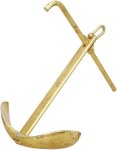
Yes they do, and alas they rust and get bent. The most common anchor on the RNLI boats is a Lewmar Delta, but you will also find a Danforth and in one class an admiralty pattern fishermans.

Q & A post production checks and oversight at the manufacturer can make sure a product is a good one. Many top of the range German parts are made in China or India, but the companies involved are subject to serious oversight, and in the case of critical stainless parts, the final annealing, heat treatment, work hardening or Nitride process, plus final polishing is done in the UK, USA or Germany.

PS: Be careful about the new Lewmar Epsilon, as no one seems to have published a video of tests and there are a few reports of them rusting, alas any anchor with shap points or point will rust if it starts hitting or rubbing rocks. Some of the modern anchors set quickly because they have fine points, but that is a dubious design feature if you are interested in appearances, and most privare owner operators are. They really get excited about rust stains on the deck, or missing yellow paint on their Spade.

PPS: It might be possible to work out some variance figures for the tests if you like statistics. Any tests are in reality of little use withut a variance figure:
Variance Calculator (calculatorsoup.com)
 
Last edited:
VIDEO: How to Anchor a Boat, Part 1: Anchoring a Small Powerboat (offcenterharbor.com)

That's an interesting article and clip if you are thinking about aquiring a fishermans of any type, but this is the part I like:

Transcript
We’re at Torrey’s Island this morning, and we’re about to anchor. And we’ve more or less picked our location, it’ll be fine-tuned as soon as I get the anchor set up and we’re ready to go. Setting it up, this is called a stock anchor, a yachtsman’s anchor, and sometimes a Herreshoff anchor. It’s my favorite, it’s the only type I use.

He has a steel copy, the real Herreshoff is Bronze. They are still in production, but I've no idea if its a good copy or not. There is no way I would recommend a copy, as it might be made of cast Iron, so prone to serious rusting and can be broken if hit hard enough.

When I did my first circumnavigation, I was not aware of just how important it is to carry a real good set of anchors and rodes, all I had was a genuine CQR, a West Marine steel Danforth and a folding grapnel for deep water or rocks. I only had one all chain rode, the other main rode had a good length of slightly under size chain and another 100m of 3 ply. If I had lost the main, the coral heads in the Western S.Pacific would have made short work of a rope rode. So I did not have a good selection of anchors or rodes.

The Herreshoff, genuine CQR or Lewmar Delta, and a PGX or other real good steel Danforth would have been a far better selection, cos if you lost or had your lovely Bronze Herreshoff stolen, all you have lost is your deep water capability, and that can be resolved by joining your 4 Panama canal lines together, or buying a homemade grapnel from a local fisherman. If you use a CQR and Danforth in rocks, the fluke of a Danforth, an alloy one in particular can easily fail in the case of a kit built one, or get bent. The CQR is worse than the Danforth, and if it does set, it could easily be lost after jamming between 2 rocks and breaking the chain link or pulling the windlass or cleats out of a cheap plastic boat. The Bruce is better than both in rocks, but still well below an Admiralty fishermans.

Typical Herreshoff scam page:
(4) Facebook
 
Last edited:
As I suspected - when challenged to come up with a test protocol, costs and funding - no answer.

Just another red herring - video - anyone can fudge a video.

All talk and no trousers.

Jonathan
 
Status
Not open for further replies.
Top