Anchor scope - why do we teach beginners such rubbish?

  • Thread starter Thread starter jdc
  • Start date Start date
.....So, go out there and try it for yourself. . . .
Seems very good advice!

One thing I would say is that my Britany (OK, it's the only 10kg anchor that will fit in the anchor locker of my little boat) seems to bite at only about 3 or 4 x depth (using all or mostly chain, 8mm). Maybe this has something to do with the glutinous quality of the mud in the Solent and Poole harbours I inhabit ...
 
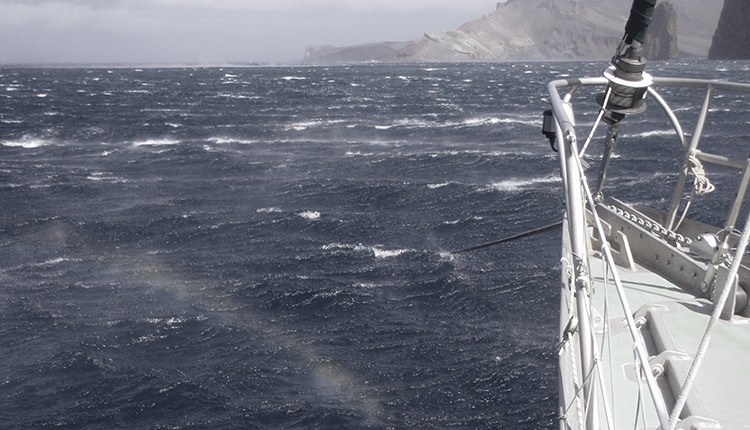
Those who recommend x3 for chain and x5 for rope have usually not experienced winds above 30kts in their anchorages

Those of us who are happy to use and recommend the 3x/5x rule know that it's a reasonable minimum for gentle to moderate conditions. By 30+ kts we've got the lot out, and I suspect the same goes for the 11.76m + 1/2 cot (depth^1.7 + log(windspeed - 1/2 Cd)) ... boys as well.
 
I'm afraid the tone young Craig takes here is the reason I would never consider a Rocna anchor. Well, that and the photographs of them turned up like a jester's shoe after hitting a rock. We have rocks round the west of Scotland, you see, and I can't be doing with an anchor which needs hammered flat again every time it hits one.

Hi Ubergeekian,
It would be interesting to know the exact circumstances of causing any anchor or ground tackle to break or bend.
One problem with modern anchors seems to be that they can 'bite in' to most sea bottoms very quickly. Could this mean that we don't need to go astern so quickly to get them to set?
I know that even in a sandy/muddy seabed, I can be thrown off balance on the foredeck by the speed and efficiency that my anchor sets.
I suppose when using a modern anchor with a rocky seabed, unless in an emergency, it would be best if you were going astern at less speed than you would with a sand seabed using an anchor from another era?
S.
 
Last edited:
It would be interesting to know the exact circumstances of causing any anchor or ground tackle to break or bend.
He's talking about a Rocna owner on here who posted photos of a bent-up edge at the very tip of the fluke. A small section of the chisel edge about 1 mm or less in profile had been curled up, obviously hung up on something solid. The Rocna is well balanced and unlike many anchors will hold even if only the very tip is providing all the resistance. But steel is steel and if subjected to sufficient abuse will fail according to its tensile strength. That's one reason the Rocna doesn't have quite as sharp a cutting edge as it might, something lost on certain competitor copy-cats.
 
He's talking about a Rocna owner on here who posted photos of a bent-up edge at the very tip of the fluke. A small section of the chisel edge about 1 mm or less in profile had been curled up, obviously hung up on something solid.

No, I'm talking about the other pictures. The ones where a couple of inches had bent up.

Ah, chinese metallurgy, doncha lurve it?
 
all work and no play

JDC

You really should get out more!


Stu

I agree, so far this season I've been far too stuck in the office so no oceans crossed:-( But the season isn't over so I hope to get out more yet.

So far on my boat only Falmouth, Helford, Kilcobben, Carick Luz, Portloe, Yealm, Plymouth, Campbelltown (we didn't stop between since the wind held, albeit northerlies all the way), Mallaig, Plockton, Portree, Crowlin islands, Lochs Kishorn and Carron, Kyle, Loch Scavaig/Cuilice (including some climbing and the bad-step to Elgol), Canna, Eriskay, Gighay/Hellisay, Castle Bay Barra, Tobermory (F11 forecast, so this was a bit of a panic dash), Loch Sunart, Staffa, Inch Kenneth (from where we climbed Ben More), Iona, Oban, Puilldobhreain, Gigha (stopping just long enough to buy chcocolate), Port Erin IoM (for Fish and Chips), Falmouth, Port Mellon / Mevagissey and back to Falmouth. On other boats have done Exmouth - Alderney - Brixham - Exmouth and a brief go on an Extreme 40 during Cowes week.

So as you say, not enough. But what do you do during night watches on your own? I do maths. - there's nowt so queer as folk!

More seriously, nobody, in the 100 odd posts, has actually said either (i) that doing what my graphs show will be wrong or bad or worse than any other rule (some Blimpish handwringing because maths - heaven forfend, only nasty foreigners do that - was used to derive them); or (ii) that there is something incorrect in the maths or logic. Craig wimped out on my challenge, saying I'd got it all wrong, yet his argument boiled down to 'if you use a Rocna you can let out less scope than this, yet it's too complicated to put into an algebraic statement'. If he believes his 8 degree number, all he needed was

if rocna {vertical_force = max(horizontal_force x tan(8 degrees), gamma x anchor weight);}

I also believe the frequent assertion that the catenary flattens and the rode becomes straight in any sort of blow to be false in general(1): how do you know? How have you determined it? Just by looking at the few meters near the stem-head, from above? If so you are more or or less in the same plane as the chain, and in no position at all to judge what curve it takes in that plane, especially below the water which will be turbid and refracting. But 8 degrees remains a mantra without anybody providing either empirical evidence or theoretical justification. I at least tried the experiment with a tractor and 60m of heavy chain.

(1) It may be true in particular, if you use very little or very light chain that is. But then don't make assertions without an appropriate caveat.
 
So far on my boat only Falmouth, Helford, Kilcobben, Carick Luz, Portloe, Yealm, Plymouth, Campbelltown (we didn't stop between since the wind held, albeit northerlies all the way), Mallaig, Plockton, Portree, Crowlin islands, Lochs Kishorn and Carron, Kyle, Loch Scavaig/Cuilice (including some climbing and the bad-step to Elgol), Canna, Eriskay, Gighay/Hellisay, Castle Bay Barra, Tobermory (F11 forecast, so this was a bit of a panic dash), Loch Sunart, Staffa, Inch Kenneth (from where we climbed Ben More), Iona, Oban, Puilldobhreain, Gigha (stopping just long enough to buy chcocolate), Port Erin IoM (for Fish and Chips), Falmouth, Port Mellon / Mevagissey and back to Falmouth..

JDC

You should stay in more.


Dog.


(Your making us look bad.):)
 
No, I'm talking about the other pictures. The ones where a couple of inches had bent up.

Ah, chinese metallurgy, doncha lurve it?
News to me, geek. If you want to make such comments you'd do well to provide references. Considering the negative nature of every post of yours addressed to me personally or Rocna generally, comments like your last come close to disparagement.
 
More seriously, nobody, in the 100 odd posts, has actually said either (i) that doing what my graphs show will be wrong or bad or worse than any other rule (some Blimpish handwringing because maths - heaven forfend, only nasty foreigners do that - was used to derive them); or (ii) that there is something incorrect in the maths or logic.
.


I do believe the logic behind the graph is incorrect.I did say that ,politely, in post 12
I don’t believe you have taken into account the dynamic loads.
The fundamental flaw is that you have assumed the weight of the rode is going to keep the pull at the anchor horizontal. If you dive on your anchor the next time there is a strong wind you will see this doesn’t happen.
.


I also believe the frequent assertion that the catenary flattens and the rode becomes straight in any sort of blow to be false in general(1): how do you know? How have you determined it? Just by looking at the few meters near the stem-head, from above? If so you are more or or less in the same plane as the chain, and in no position at all to judge what curve it takes in that plane, especially below the water which will be turbid and refracting.
(1) It may be true in particular, if you use very little or very light chain that is. But then don't make assertions without an appropriate caveat.

I have dived on the anchor in strong wind (call me mad, but the Med waters are warm and so clear that even in a blow the visibility is the same back home) and the chain completely lifts off the bottom and becomes essentially straight.
I have 13mm chain on a 47 foot boat.
 
Last edited:
So far on my boat only Falmouth, Helford, Kilcobben, Carick Luz, Portloe, Yealm, Plymouth, Campbelltown (we didn't stop between since the wind held, albeit northerlies all the way), Mallaig, Plockton, Portree, Crowlin islands, Lochs Kishorn and Carron, Kyle, Loch Scavaig/Cuilice (including some climbing and the bad-step to Elgol), Canna, Eriskay, Gighay/Hellisay, Castle Bay Barra, Tobermory (F11 forecast, so this was a bit of a panic dash), Loch Sunart, Staffa, Inch Kenneth (from where we climbed Ben More), Iona, Oban, Puilldobhreain, Gigha (stopping just long enough to buy chcocolate), Port Erin IoM (for Fish and Chips), Falmouth, Port Mellon / Mevagissey and back to Falmouth. On other boats have done Exmouth - Alderney - Brixham - Exmouth and a brief go on an Extreme 40 during Cowes week.
If you want a p*ing contest you're likely to lose with some of the folk around, as you should be seeing from some of the responses you're getting. I assume it took a while to find and type all those names so from what principles are you trying to argue your case, the original theory or are you falling back on an argument from claimed authority?

Craig wimped out on my challenge, saying I'd got it all wrong, yet his argument boiled down to 'if you use a Rocna you can let out less scope than this, yet it's too complicated to put into an algebraic statement'.
I must have missed the challenge sorry. I told you what would be required to formularize what you're trying, and it's a massive amount of data pertaining to the 3 or 4 variables involved, that would not be practical to gather let alone use. You basically need to know in all likely scenarios at what force every size of every type of anchor will drag. Why do you think the likes of Rocna don't just do it?

I also believe the frequent assertion that the catenary flattens and the rode becomes straight in any sort of blow to be false in general(1): how do you know? How have you determined it? Just by looking at the few meters near the stem-head, from above?
We know from the catenary curve as dictated by the math according to the forces involved and the size chain! You're the one trying to put a number on everything, try putting some reasonable force numbers into your formulas... Here's another pic for ya:

chain-straight-deception-island.jpg


That's 6:1 scope and the chain is pointing as near as makes no difference straight at the anchor, take it as read. That's 50 knots wind coming through in sharp gusts and the chain is that straight when it takes up; the boat is veering a little. What do you think it would look like in 60 or 70 knots? What if the veering was bad enough we had to bother with a snubber?

And that's a biggish boat (15 m) - the argument for catenary gets worse the smaller you go.

If so you are more or or less in the same plane as the chain, and in no position at all to judge what curve it takes in that plane, especially below the water which will be turbid and refracting. But 8 degrees remains a mantra without anybody providing either empirical evidence or theoretical justification.
What mantra? It's just a convenient point of diminishing returns to quote. Look at a graph and find the point where the curve starts running out.

What 'plane'? Looking from the bow of the boat you are looking down the chain at a very acute angle, any curve in it is exaggerated! Look at the above examples from the side and you can't detect any curve whatsoever.

I at least tried the experiment with a tractor and 60m of heavy chain.
Great. Where's the data, and correlated to a real world situation? I guarantee from personal experience that you're taking things out of context.

(1) It may be true in particular, if you use very little or very light chain that is. But then don't make assertions without an appropriate caveat.
The pics above are all-chain rode using 12 mm G40, when we would prefer to be using 10 mm G70. It's over weight as it is.

All these arguments are math are worked through here:
www.petersmith.net.nz/boat-anchors/catenary.php

You can only really argue that for your particular boat the forces are smaller and more easily manageable, or you've not experienced being exposed to bad weather at anchor / don't intend to either. But even in that case it's easy then to just say you're carrying a lot of heavy chain you don't need...
 
I have dived on the anchor in strong wind (call me mad, but the Med waters are warm and so clear that even in a blow the visibility is the same back home) and the chain completely lifts off the bottom and becomes essentially straight.
I have 13mm chain on a 47 foot boat.
An underwater camera would be very handy. Bit cold where Kiwi Roa is but you've no excuse... :)
 
More seriously, nobody, in the 100 odd posts, has actually said either (i) that doing what my graphs show will be wrong or bad or worse than any other rule (some Blimpish handwringing because maths - heaven forfend, only nasty foreigners do that - was used to derive them); or (ii) that there is something incorrect in the maths or logic.
Your initial proposition was that what was taught was rubbish. I think the general consensus is that:
- an overly detailed / mathematical approach - your approach - is impractical to teach
- students will remember a rule of thumb such as "3x (or 5X) max depth, to the stemhead, more if it blows"
- such a rule of thumb is actually pretty effective in most circumstances
- your maths don't account for dynamic loads, which can be important in many situations

Now I don't know exactly what is being "taught", but I find it hard to conclude that it is "rubbish" compared with your approach. Your approach might (or might not) be more precise, but it is hardly practical to teach.
 
Your initial proposition was that what was taught was rubbish. I think the general consensus is that:
- an overly detailed / mathematical approach - your approach - is impractical to teach
- students will remember a rule of thumb such as "3x (or 5X) max depth, to the stemhead, more if it blows"
- such a rule of thumb is actually pretty effective in most circumstances
- your maths don't account for dynamic loads, which can be important in many situations

Now I don't know exactly what is being "taught", but I find it hard to conclude that it is "rubbish" compared with your approach. Your approach might (or might not) be more precise, but it is hardly practical to teach.

I must admit I agree. It is of academic interest to ponder such things but when dropping the hook it is easier to get the crew to understand 3x or 6x depth or whatever depending on conditions. I don't need to know how much pressure to put on the handbrake in my car to ensure that it doesn't roll away. I just yanks on the lever until it is secure. In my simple world it is much the same with anchoring.
 
Balls

Because of my lack of experience, i saw this thread developing and decided that i should at some point set aside 30mins to read it all and learn something. Have just done that and very entertaining it was too. Did i learn anything? Well I think ive learnt that the old adage of 'if in doubt, let more out' is still good advice. What concerns me now is swinging room. How far away from the other boats can i safely anchor if i dont know whether they are of the 3x,4x or 10x persuasion. Perhaps if you have exceeded the rule of thumb ( oops sorry, lets not start that again ) you should show more than one ball??? I shall now take it that all those boats anchored close together are all Rocnas and the poor sod out on a limb is suffering from Danforth syndrome. At least he can run his genny without upsetting the neighbours.
 
An underwater camera would be very handy. Bit cold where Kiwi Roa is but you've no excuse... :)
The water is 27 C so lots of diving. You learn a lot from observing how well anchors have set, watching them rotate round with a change of wind direction etc
If more people could see this I think there would be less anchor arguments and lot more new generation anchors sold.
I do need to get an underwater camera to photograph the anchors and other much less exciting stuff such as this photo of a turtle, taken by a friend a couple of weeks ago.It spent an hour swimming around our boats.
 
Last edited:
Using a chain hook and up to 10m of springy Octoplait on my boat has totally stopped my boat sheering about - it's also made a drag a thing of the past, even though I'm using that ill-considered anchor, a CQR.
Previously the boat used to sail smartly up to the chain, give a few hearty flips and then drop away going to (usually) starboard. Result, frequent drags.

This combination also avoids swinging round on a conspicuously different arc to others (as I use 8-5:1 as scope).
In windspeeds above 25 knots you can forget about chain catenary (on my boat), but you can dramatically reduce the angle of pull by having a bight of chain after the point of connection of the chain-hook.

I've experience 47 knots with that combination and virtually no movement of the boat about its position. The chain-rode were appearing above the water in gusts.
 
4 x & 6 x depth.

Bloody hell! Do they really? I hadn't realised that inflation had been so rampant in recent years.

I was taught 3x depth for chain, 5x for warp, for my Yachtmeister theory, but that was in the days when men were men, chain was 'Made in England', and dragging your anchor from time to time was probably thought character building. By the time the First Mate was doing her Yachtmaster theory a couple of years ago it had gone up to 4x for chain. If the RYA is now saying 5 to 7x depth for chain, how much do they expect for warp, for goodness sake?

Doesn't this mean that any small yacht will either have to carry enough chain to sink it, or use warp and only find enough swinging room to anchor in big ship anchorages? I blame the Labour Government (or was it decimalisation?).

Current RYA Day Skipper booklet, page26, chain 4 x depth & warp 6 x depth.
 
Top