Anchor rode length?

Indeed!

Just to answer a couple of quick questions, the amount of chain I have is "some" and the link size is "medium."
Nope, I have no idea.
In my defence, we haven't used the boat yet (only to move it to it's present location) so it's just one of the things on the list.
I'll measure the chain length and link size at the weekend.

If you PM me details of your boat length and the size and length of your chain I'll send you a table that shows how the chain will behave in various conditions (the size of the chain is the diameter of the bar used to make the links).

And happy to discuss if you prefer - I'm just down the road from you.
 
Don't be in such a tearing rush to change everything.:)

I'm not, honest! Just trying to make sure everything is done properly which is difficult with no idea about anything!

Try to get an instructor on your own boat for a day or weekend and ask his advice about what you need or don't need.

Certainly going to do that, I think it will be the fastest way to learn :)

If you PM me details of your boat length and the size and length of your chain I'll send you a table that shows how the chain will behave in various conditions (the size of the chain is the diameter of the bar used to make the links).

And happy to discuss if you prefer - I'm just down the road from you.

Thanks very much John, very good of you. Will get the measurements at the weekend :)
 
Because two forces(three really) keep you in place using an anchor.

One is a horizontal pull on the anchor, which needs this to stay dug in and even seek to dig in deeper. Since your boat will always be above the anchor, something heavy like chain is the most efficient at turning your boat's angled pull into a horizontal one in the shortest distance.

Two, the combined weight of ALL your ground tackle (another "NEW" expression for you!), anchor and chain, is a very important factor in holding you safe apart from the actual grip of the anchor itself.

And the Third, not to be overlooked, is the actual friction between chain and seabed. Try pulling your anchor chain across the surface of the laying-up hard single handed and compare this to pulling a rope and you'll see what I mean.

Rope rodes can also be a menace to others since you need a far bigger swinging circle and it often catches the unwary who don't notice your "odd-one-out" approach until it's too late and they've got you around their prop. A chain will hang straight down in a near calm but a rope can still be lying out for quite a distance dangerously, just below the surface.

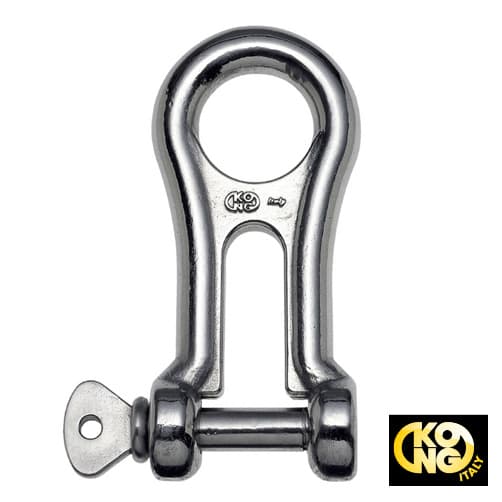
As to "Shock protection", the chain by it's very nature lies in an extendible, geometric curve called a "catenary" which acts like a spring and is fine for most situations, however a short length of rope can be introduced, to prevent chain "growl" or excessive snatching in extreme conditions being transferred to the boat, with one of these
Chain%20Gripper%20Main.jpg


or by just threading a couple of metres of rope from a foredeck cleat, through the chain and back to the cleat and letting the chain hang slack between it and the bow roller.

I use a chain hook or rolling hitch
 
Because two forces(three really) keep you in place using an anchor.

One is a horizontal pull on the anchor, which needs this to stay dug in and even seek to dig in deeper. Since your boat will always be above the anchor, something heavy like chain is the most efficient at turning your boat's angled pull into a horizontal one in the shortest distance.

Two, the combined weight of ALL your ground tackle (another "NEW" expression for you!), anchor and chain, is a very important factor in holding you safe apart from the actual grip of the anchor itself.

And the Third, not to be overlooked, is the actual friction between chain and seabed. Try pulling your anchor chain across the surface of the laying-up hard single handed and compare this to pulling a rope and you'll see what I mean.

Rope rodes can also be a menace to others since you need a far bigger swinging circle and it often catches the unwary who don't notice your "odd-one-out" approach until it's too late and they've got you around their prop. A chain will hang straight down in a near calm but a rope can still be lying out for quite a distance dangerously, just below the surface.

As to "Shock protection", the chain by it's very nature lies in an extendible, geometric curve called a "catenary" which acts like a spring and is fine for most situations, however a short length of rope can be introduced, to prevent chain "growl" or excessive snatching in extreme conditions being transferred to the boat, with one of these
Chain%20Gripper%20Main.jpg


or by just threading a couple of metres of rope from a foredeck cleat, through the chain and back to the cleat and letting the chain hang slack between it and the bow roller.


I have 50m of chain and like Steve I use a rope harness which is Y shaped, the top parts of the Y connect to each forward cleat and the tail connects to the chain by way of a fastener that goes through a link.I let out more chain so the strain is on the cleats not the windlass.As a final safeguard I attach a rope (which is also connected to a front cleat) to the chain by using a rolling hitch knot.( just in case the harness fixing link to the chain gives way.) UK Yacht and Rigging supplies in Hull ( i think) made the harness for me - google them up if you want to do this.I anchor in a 7 knot tidal estuary and 3 times chain/depth has served me ok to date.
 
I'm not, honest! Just trying to make sure everything is done properly which is difficult with no idea about anything!

Certainly going to do that, I think it will be the fastest way to learn :)

Thanks very much John, very good of you. Will get the measurements at the weekend :)

Just some thoughts for you:
On a boat nothing is quite good enough :rolleyes:,
There is no point in being a big rush to learn everything, you never will ;),
There is always another way to do anything on a boat :p,
If no one got hurt and you did not break anything you did not do it wrong, although you can always do it better :o.

When it comes to learning, asking here is a great way to start. As you can tell you get lots of opinions. Reading books & magazines also has many benefits. Instruction is another good way to learn, but remember its not definitive and there are other ways (look at threads and opinions about lassoing buoys :eek:).

Take your time and enjoy...
 
Just some thoughts for you:
On a boat nothing is quite good enough :rolleyes:,
There is no point in being a big rush to learn everything, you never will ;),
There is always another way to do anything on a boat :p,
If no one got hurt and you did not break anything you did not do it wrong, although you can always do it better :o.

When it comes to learning, asking here is a great way to start. As you can tell you get lots of opinions. Reading books & magazines also has many benefits. Instruction is another good way to learn, but remember its not definitive and there are other ways (look at threads and opinions about lassoing buoys :eek:).

Take your time and enjoy...

Might print that out and stick it on my forehead! thank you ;)
 
>it appears that this is unsuitable and I should change it to 12mm nylon rope with just a short length of chain.

I don't know where you got that from but it is wrong, all chain will hold better in strong winds than chain and rope, it also cuts down the swinging about.

The key to anchoring is the length of chain to the depth it is not a fixed number. e.g 5 metre depth 10 x depth, 30 metres 3 x depth. What you are trying to do is use the weight of the catenary and chain on the bottom to hold the boat without pulling on the anchor, the anchor is back up if the wind increases significantly.
 
>it appears that this is unsuitable and I should change it to 12mm nylon rope with just a short length of chain.

I don't know where you got that from but it is wrong, all chain will hold better in strong winds than chain and rope, it also cuts down the swinging about.

The key to anchoring is the length of chain to the depth it is not a fixed number. e.g 5 metre depth 10 x depth, 30 metres 3 x depth. What you are trying to do is use the weight of the catenary and chain on the bottom to hold the boat without pulling on the anchor, the anchor is back up if the wind increases significantly.

Just through Googling.
All the small boats I've been on all had rope and chain so I thought I'd check to see if all chain was OK.
The site I discovered said not, hence my post.
 
Bit of clarifying, but take into consideration I do not know your boat, and do not know anything about MOBs, don't use engines on water. As yet :D
All chain tackle work nicely because of sheer weight. Chain forms catenary down there, lying on bottom. Boat has to lift this before any strain comes on the anchor. Frankly, there's not much need for this hook at end. Guys told me they had new shiny stainless hook, which was stolen - underwater :p They didn't notice, might have been few days before they decided to raise the hook...

Then there was also some talk of shock absorbing.
Well, normally you drop that iron down, it's indestructible and easy to operate, if heavy.

But then sometimes you will experience a shock.
There comes a time when you're in unprotected place, on comes a blow and swell, huge force is exerted on the ground tackle. Happens to anybody sooner or later, sooner really, as later you will be more prudent :D

Now boat is taken back with force, it hauls on the chain, lifting it clear off in straight line. From this moment chain acts as straight rode, each swell jerks the hook from bottom. Unless it is really a hook (much to be said for Admiralty or Herreshoff) catching some rock, it is now pulled up from bottom gradually. Until it breaks off.
Lost two friends from younger days this way lately, close to Ushuaia - they anchored... then there came like 15 Beaufort. They saved all the crew, but not themselves. Down with the ship, true honorable fashion.

What you need at this moment is second anchor, preferably bigger or another kind made for it, that you carry as second bower, kedge or hurricane hook - whichever convenient. This should be capable of holding with rode going a bit upwards, easy to deploy if it's secondary hook, and ON NYLON. Nylon will absorb the shocks.
So there is good chance that each tug from each swell will be damped and the hook stays put, moreover your bows will not disintegrate under load...

Heard some stories about Rockna (small for holding power), Spade well penetrating, easily stored Fortress, and such.
I'm not current, awaiting opinions of forumites that have them, and tried. Would carry a fisherman down in the bilges for it, or if right kind of bottom have 35 pound original CQR stored on bows, at hand.

Scared enough? :D
 
You should definitely change your rode and take the advice of whatever weird publication you have read.

If not you risk being in the very vast majority of boats in this country that have all chain rodes.:D

Not sure what your boat is, but assuming it is a normal cruising boat I have never met anyone who does not have all chain. Yes, have some extra warp for ununsual conditions, but in this country chain is the rode of choice.
 
GOOD BOY :p Knowing dangers beforehand makes for great explorer - the one that comes back :D

:D

All you need to do now is ask "which anchor should I use" ;)

p.s. on a light displacement trimaran I use 10m chain & nylon, east coast.
I put depth x wind force down, never had a problem, yet ....

Nope, going to use a Danforth anchor due to it's mud holding ability (apparently)
The fact it was the one that came with the boat has nothing to do with it! ;)
 
You should definitely change your rode and take the advice of whatever weird publication you have read.

If not you risk being in the very vast majority of boats in this country that have all chain rodes.:D

Not sure what your boat is, but assuming it is a normal cruising boat I have never met anyone who does not have all chain. Yes, have some extra warp for ununsual conditions, but in this country chain is the rode of choice.

Could explain in then, all the small boats I've been on have been in foreign climes.
Live and learn!
 
on a light displacement trimaran I use 10m chain & nylon, east coast.
I put depth x wind force down, never had a problem, yet ....
Yup, on cat. Lightweight. I like nylon rode personally, but everything depends on boat really, lighter boat exerts more jerks on rode, but then with less force. Wide bows can be lifted more then sharp. Etc. That is why I advise both approaches if it is possible on boat, as space and displacement may be an argument.

BTW: why newest AWBs carry mostly rope? Because they cannot carry chain. Imagine 50 fathoms of proper chain + two hooks + windlass on those bows, sharp as needle, with no displacement at all. With some substantiall mass storied there they would not lift to the sea, but just go down under. :p
This is not exaggeration - as I may sound with this flu, not to speak about cider.
See for yourself: http://www.youtube.com/watch?v=dXM_93TIMZE
 
Last edited:
Just my two-penneth!

We have a Colvic fishing boat and fish/cruise around the Milford Haven area. We have 30ft of 12mm chain and then 300ft of 10mm rope. Never let us down yet, but we dont anchor overnight to sleep (only fish) and we are, in the main, "fair weather" fishermen (its supposed to be a fun hobby after all, not a survival test!).
There is a train of thought with small boat anglers that one and a half to two times the length of the boat in chain coupled to 3 to 4 times the depth of water you are going to fish in rope should cope with most situations. Obviously not a hard and fast rule as such, but it works for us and a lot of others.
 
There is a train of thought with small boat anglers that one and a half to two times the length of the boat in chain coupled to 3 to 4 times the depth of water you are going to fish in rope should cope with most situations.

Makes sense, for anglers. I guess you don't usually have a windlass to haul up a lot of heavy chain, and you tend to anchor in much deeper water for fishing than we do for an overnight stop.

Pete
 
Thanks for that, anchoring for fishing is an important consideration! few other reasons to drop anchor, surely? :D
 
Top