Anchor riding sail?

Tim Good

Well-Known Member
Joined
26 Feb 2010
Messages
2,888
Location
Bristol
Visit site
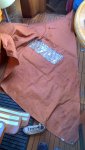
I’m making an anchor riding sail from an old squib sail. It’ll only be used in a strong blow as that’s really the only time we thrash about on the hook.

I didn’t want to cut across the window so the eventual size will be around 28sq ft but I’ve found various mentions that it should be around 20sq ft.

We’re 43 ft but heavy at 17t. If anyone has experience of using these then is my planned size going to be too large given the strength of wind I want to use it in.... I.e 30kts plus. Would I struggle to sheet it flat in such a blow being that size?
8CB4B3A6-A627-4F3F-B3C0-1E747102C852.jpeg
 
I’m making an anchor riding sail from an old squib sail. It’ll only be used in a strong blow as that’s really the only time we thrash about on the hook.

I didn’t want to cut across the window so the eventual size will be around 28sq ft but I’ve found various mentions that it should be around 20sq ft.

We’re 43 ft but heavy at 17t. If anyone has experience of using these then is my planned size going to be too large given the strength of wind I want to use it in.... I.e 30kts plus. Would I struggle to sheet it flat in such a blow being that size?

View attachment 116637
I would be careful of using such a light sail. My limited experience of such winds is that even surprisingly heavy fabrics flap themselves to oblivion. Could you use your storm jib which probably much heavier and cut flat? If it's not for storm use then less of an issue. I use the mizzen to stop sheering and the principle is good.
 
I think NormanS is one of the few here who has professed to have used a Riding Sail on a yacht, possibly, similar to yours. I have not noted him to have been active (apologies if I have missed his posts) - maybe send him a PM.

But I would be interested in how your project develops - so I will, try to, follow your thread. I cannot contribute further - I have no application knowledge.

Jonathan

I'll amend my post - why do you 'thrash about'. Is this some intrinsic 'fault' of the yacht design or do you store your dinghy on the foredeck, have 2 furled head sails etc, or are the anchorages prone to wind shear....???? We veer, but due to wind shear - and manage that yawing with a 'V' anchor. I'm interested in the mechanisms - AND on your project.
 
Last edited:
When we yaw around the bay on anchor, it's generally because the wind is swinging about.
There's not that many times when I've thought a riding sail would help much.
 
When we yaw around the bay on anchor, it's generally because the wind is swinging about.
There's not that many times when I've thought a riding sail would help much.

We veer about at a very wide angle even if the wind direction is steady. It’s the usual reason I think - modernish boat with high freeboard and flattish section underneath. Exacerbated no doubt by dinghy on the foredeck (although it appears to veer as much even if it’s trailing from the stern), the furled genoa and a Bimini (which does nothing) rather than a sprayhood which might help.

I have tried a light flat dinghy cover ( just a cheapo garden plastic cover really) and it seemed to help but tore quickly so I think a proper riding sail would work. I have also tried other things like trailing the kedge anchor so it‘s point is dragging along the bottom (works in light winds), a drogue at bow and at stern (did nothing as the veering speed is slower than I thought), and VEE anchoring which virtually stops it but is a faff.
 
Here are Keith Stanley's instructions for constructing a "Piota" twin riding sail


V-twin Riding Sail 4
Dimensions for a 32-footer : Adjust for other boat sizes Luff 8ft (1.5in.) Leech 9ft.8in. (1.75in.) Foot 5ft 6in (1.0in.) (Hollows in brackets)

Cloth: dacron/polyester 5oz.

Fittings: D-rings, must be of a size to accept the splice of a 6/8mm sheet and the tapered end of the spar.

Construction: Lay one sail on the other, (corners corresponding): turn over top one like a page of a book to leave the luffs edge-to-edge. Join luffs with 2" flat webbing to stiffen and 'round' the leading edge of the 'V' when set; to minimise turbulent eddies which cause attrition or noise.

Spar: 30mm alloy tube with wooden plug and/or plastic boathook fitting each end. A wooden spar would do.

THE TRICK at the design stage is to make a mock-up of all the edges in string joined with slip- knots; then adjust the dimensions of the sail and spar to meet these criteria:

1. The luff is clear the boom. (1/2 in. is enough!)
2. The spar is clear of the backstay: ahead is preferable to abaft for ease of setting-up.
3. The tack-lines, forward and outboard, should be close to bisecting the angle at the tack.
4. Viewed from abeam, each sheet from the stern-rail should bisect its clew,
Contrary to what might be expected, it is neither necessary nor desirable to attach anything to the backstay. When all the dimensions are compatible and the sail is set flying it is self-stabilising.
I used 6mm 3-strand nylon line for sheets and 8mm braided polyster for the tack-lines. The sheets double round the stern-rail and loop over the spar ends. The tack-lines have clips to the stanchion- bases.
It is worth having length to spare until it has been used a few times and everything is adjusted and settled: then splice at the correct length.
 
I have, and occasionally use an anchor riding sail. Sod's Law dictates that while it's easy to rig a riding sail on a boat with a mizzen mast, such boats tend to lie more docilely at anchor anyway. Any boat with a disproportionate windage forward will tend to shear (or yaw) about at anchor.
My boat is a 36' Deck Saloon ketch, and although yawing has never been a serious problem, I decided to experiment. After playing about with a mock-up, I got a sail maker to make the final article. It is a twin "Vee" triangle. The common luff has slides which go onto the mizzen mast, and each clew is sheeted out to the extreme corners of the taffrail/pushpit. A simple spreader bar (boathook) between the two clews helps to stabilise things. It works very well.
The luff is 3250mm, the foot (feet?) 1830mm, which gives an area of approximately 3 sq metres or 32 sq ft.
I see some ketches leaving their mizzen sheeted hard in when at anchor, but when I tried that, there always seemed to be quite a noticeable bang when the sail filled from one side to the other. The advantage of the twin sail is that it is always "filled" so that there is no noise from it at all.
Mine is made from heavy sail cloth, the same weight as my storm jib. I wouldn't have thought that light sailcloth from a dinghy would last long.
As I say, it's easy to rig such a sail with a ketch, but for those with sloops, who actually have more to gain, it's time to get inventive, maybe using the end of the boom cocked up with the topping lift, or something rigged from the backstay.
 
Riding sails are FLAT, with no draft. I suspect a repurposed sail will perform poorly unless all of the seams are ripped and it is resewn flat. That may not even work, if the cloth has stretched.

I've never thought much of single luff riding sails. A V is far more effective.
 
Another vote for V-shaped riding sails. A different world to flat ones. We have used them on and old fashioned Ohlson 38 and a modern Southerly 110. Up to storm 10. Boat sits still, it is astonishing.
 

Attachments

  • V riding sail.jpg
    V riding sail.jpg
    95.2 KB · Views: 69
Another vote for V-shaped riding sails. A different world to flat ones. We have used them on and old fashioned Ohlson 38 and a modern Southerly 110. Up to storm 10. Boat sits still, it is astonishing.
Hi. How much cloth or sail size do you have. I have a 41ft boat and trying to get one made just unsure of size.?
 
Another vote for V-shaped riding sails. A different world to flat ones. We have used them on and old fashioned Ohlson 38 and a modern Southerly 110. Up to storm 10. Boat sits still, it is astonishing.

Great feedback. When the wind gets to that strength that exactly when you’re glad you’re sitting straight and no snatching around.

One thing I did find helps, was a trick a challenge that worked with boreal found... that was to attached a small single cone drogue to the anchor chain and lower it just under the water. As the boat beers off and wants to snatch back in a gust the drogue slows everything down and you don’t get that sharp pull in the anchor.

Perhaps with a decent anchor sail its a redundant method.
 
Rupert, post 6, says a drogue at the bow and/or stern is a waste of time, Northcave says it works

I'm assuming both are correct.

It should be simple (a drogue) more detail might define why one is a supporter and one says a waste of time.

The advantage of a drogue is that it will manage wind sheer rather than the yawing caused by the inherent characteristics of the yacht.

Jonathan
 
We inherited a small purpose made riding sail with the boat a goodly number of yrs ago, and use it regularly in strong winds at anchor. No bullsh*t , it settles the wee boat down a treat.
 
, was a trick a challenge that worked with boreal found...

I do hate auto correct. I sometimes re-read my script and the gibberish is so incomprehensible I cannot work out what I actually meant to type. I might be losing my marbles - but I cannot guess what Northcave meant either :). However unlike my boring posts I'm sure he meant something really profound and interesting........?

Jonathan
 
I think NormanS is one of the few here who has professed to have used a Riding Sail on a yacht, possibly, similar to yours. I have not noted him to have been active (apologies if I have missed his posts) - maybe send him a PM.

But I would be interested in how your project develops - so I will, try to, follow your thread. I cannot contribute further - I have no application knowledge.

Jonathan

I'll amend my post - why do you 'thrash about'. Is this some intrinsic 'fault' of the yacht design or do you store your dinghy on the foredeck, have 2 furled head sails etc, or are the anchorages prone to wind shear....???? We veer, but due to wind shear - and manage that yawing with a 'V' anchor. I'm interested in the mechanisms - AND on your project.
My boat, a Dufour Classic 30, sails about at anchor or on a mooring in a similar manner, The freeboard and anything contributing to windage is not particularly excessive, but perhaps its fairly shallow canoe body in relation to its topsides may have something to do with it. Here are some of the vital statistics
Displacement:
6,834 lb / 3,100 kg
Ballast:
2,346 lb / 1,064 kg
S.A./Disp.:
18.45
Bal./Disp.:
34.33
Disp./Len.:
167.14
The boat used to belong to a club/sailing school of which I was a member. Another ex member told me that she was a trainee on the boat's maiden cruise, and when at anchor, the instructor hoisted the storm jib up the backstay on a short strop, and sheeted it coupled to the kicker purchase.
There was a very informative thread on here a year or two ago about riding sails.
 
Rupert, post 6, says a drogue at the bow and/or stern is a waste of time, Northcave says it works

I'm assuming both are correct.

It should be simple (a drogue) more detail might define why one is a supporter and one says a waste of time.

The advantage of a drogue is that it will manage wind sheer rather than the yawing caused by the inherent characteristics of the yacht.

Jonathan

I've tested drogues from the bow off several boats. It's one of those methods that depends on the conditions and the boat. The faster the yawing, the more it helps. Easy enough to test, but don't expect it to hold the boat still. It's function is to slow things down and reduce the range perhaps 30-40%. More helpful when more rode is out. Size also matters (needs to be about the same size as a storm drogue for best effect).

If the boat is pitching, it is better to place it 15-20 feet down the rode. Then it just holds the rode still, instead of trying to stop the bow.
 
Is not an alternative method to stabilize the boat, to lead a line from the anchor rode to an aft quarter cleat and pull the boat so it lays 10 -15 degrees off the wind. The downsides to this would be increased heel and increased load on the anchor rode but very easy to implement maybe in conjunction with a snubber line too!
 
Top