Anchor - Mantus M1 (apologies for the extended opening post - don't read if you have a train to catch).

One significant difference to me between the Rocna and the Mantus is that the Rocna has quite an upturned lip at the very rear where it appears the Mantus does not. I wonder if this contributes to the Rocnas known weakness of clogging up between this lip and the roll bar?
 
There are a number of, very, significant differences between a Mantus and Rocna. You point to one difference that the Rocna has an upturn at the heel and that a Rocna, subjectively, has a great propensity to collect and compact mud. I might suggest that the size of the roll bar, the size of the hole/space between roll bar and fluke has an influence (as will the upturn). I would agree that Mantus appears to carry less mud - but then it sets more shallow so the mud is thinner (flows more easily).

As Noelex points out Rocna and Mantus viewed from the side, sitting flat on the floor, have similar fluke/shank angles. The fluke shank angle is the angle between a line from shackle point and the centre of the crown and the fluke itself. For a Fortress or Bugel this angle is the angle the shank makes with the fluke, with other anchors you simply ignore the crank in the shank and draw the line as described.

For most anchors this angle is 30 degrees. Fortress allows you to vary the angle between 30 and 45 degrees (for mud). So softer substrates higher angles. On the Mekong the anchors are set at about 40 degrees.

However the other significant difference between Rocna and Mantus is that a Rocna has a double thickness of steel in the toe, or the front portion of the fluke. This is, or acts, like ballast. I measured it and it weighs much the same as the lead in the ballast chamber in a Spade or the cast steel in an Excel (comparing similarly sized anchors). This ballast is missing from a Mantus.

The Mantus has no ballast.

Suggesting therefore that a Mantus and a Rocna are similar lacks any credibility at all.

If you look at other unballasted anchors, Bugel, Fortress, Knox - the crown (that junction between shank and fluke, where the weld or hinge is located) is at the heel. Mantus has its crown 'about' 1/3 forward from the heel - in the same location as the crown of a (ballasted) Rocna in fact Rocna and Spade have their crowns in the same location - but then they are both ballasted anchors..

So Rocna has a lump of steel in the front of the fluke and the Mantus which has its crown in the same location as that of a Rocna has no ballast.

The ballast alters the way the anchor sets in the seabed - as you might expect with a big lump of steel - in one and not the other.

Let us take a Fortress, or Bugel, as an example to compare with the Mantus.

Generally - when a Fortress has set you will find that the shank, if it is not buried, is lying parallel to the seabed - if the shank is parallel with the seabed then the fluke must be at 30 degrees - because that is the angle between the fluke and shank. Simple?

Now take that Rocna, that we had sitting on the floor and we measure its fluke, shank angle. We drew a line between the shackle and crown and another line along the 'flat' of the fluke. Now keeping the line in mind look at a picture of a set Rocna - the line between shackle and weld/crown is parallel with the seabed - so the fluke must be in the seabed at 30 degrees - still simple?

Now take a Mantus, on the floor, and what you will find is that if you extend a line from the long section of the shank, draw it on your computer screen, and draw a line from the fluke to the point where the 2 lines interest - then the long of the fluke is at 16 degrees to the fluke. Now take any of Noele x images and you will find that that portion the long of the shank is horizontal - consequently the fluke is at 16 degrees. I hope - still simple.

I think 7 years old would understand this - though maybe as I'm not a primary school teacher - maybe its still not clear.

Now - You can set any anchor you like on the floor and draw a line from the centre of the weld to the shackle point and draw another line indicating the fluke (some anchors you need to guess where the fluke line might be) and these 2 lines will be at 30 degrees to each other. Now draw a series of parallel lines above the crown shank line and look at how they intersect various parts of the cranked shank. You will find that those parallel lines are roughty in the exact same location as the seabed on any set anchor, which of the parallel lines you draw is the right one depends on how deep the anchor is set. Noelex has lots of pictures of set anchors - make your choice.

If you look you will now find that a Mantus always sets with the fluke at 16 degrees and that every other anchor (except the ones that are badly set) have a fluke seabed angle of around 30 degrees - its not exact I have found it can vary between 25 and 35 degrees (but Mantus is surprisingly consistent).

As Noelex says as the anchor dives the angle reduces and the anchor actually drags when the angle gets to around 10 degrees. But you will never set your anchor, so deep, that you can drag it with engine power (unless its far too small). A 15kg modern anchor will hold about 2t - the highest tension you will have in your rode (assuming you use a 15kg anchors, will be about 500kg-700kg - at the extreme.

Go back to my opening post and you will find links - check the one with graph of the effect of fluke angle on hold - hold is halved if your fluke angle is 16 degrees compared with 30 degrees. Yes the Fluke/shank angle is important but so are other characteristics.

The best way to do all this is to print out pictures of anchors, many website have 'engineering' drawings of a side elevation. Draw the lines. Then print out pictures of set anchors, ones that are set correctly.


I set a challenge - do as I suggest and average the fluke/seabed angle - post what you come up with.

The easy one is Mantus - the long of the shank is at 16 degrees to the fluke (and you can check that easily) - go measure.

Go back to my opening post and you will see the simulation I mocked up with a Mantus and also a Mantus and Rocna. I have a batten showing horizontal and you can measure the fluke angle yourself with a protractor.

Now tell me if you think that Mantus and Rocna are the same - don't fear controversy. We all learn from mistakes, healthy debate is one way we make progress. Ask questions. Don't be afraid of showing ignorance - this was all new to me once - and its obviously new to others. If I am wrong I need to know.

I hope its raining in the UK - this will fill your time! (actually I hope its a lovely day and you get out on the water).

If you don't have time - have your 7 year old daughter, or granddaughter do the work - they will be sufficient adept they can do the whole exercise on a computer - its only those of more mature years (like me) who need resort to paper and pencil or simulations with the real thing :(

Jonathan
 
To avoid confusion.

There are a number of critical angles in anchor construction.

There is the fluke/shank angle.

Draw a line from the centre of the joint between shank and fluke (this is the hinge for a Danforth, or the centre of the weld for non articletaed anchors) and another line replicating the 'flat' of the fluke. This will normally be 30 degrees for most anchors (Fortress and Supermax allow the angle to be varied). So if you look at a side elevation - draw 2 lines one from the end of the shank to the centre of the weld and another line along the fluke (assuming is flat) the angle between them will be around 30 degrees. For a Delta you need to guess where the line goes, in the same way you need to approximate for a Rocna. Fortress and Bugel are easy - its a flat fluke

The angle determines (plus other dimension and angles) how the anchor addresses the seabed when laying on its side


There is the fluke/seabed angle

See the links I attached for the impact of fluke seabed angle on hold. You can simulate that angle by looking at the shape and dimensions of the anchor and estimating fluke seabed angle. This angle should not be confused with the fluke/shank angle - they may be the same (30 degrees) but because some anchors have ballast - that can impact the angle.


There are the angles of the fluke itself in plan view. You will note that many anchors are very similar and the angles are 'common' because they have been found to be the ideal in most seabeds. Note that the toe of the anchor has a narrower angle than the read section of the anchor. If you look at the plan of a Delta, Spade and Rocna fluke the angles and ratios are very similar.

Some anchors have stock, this contributes to how the toe addresses the seabed but also it stabilises the anchor and keeps it symmetrical.


Less easy to describe but there is the engagement angle of the fluke to the seabed - this tends to be around 70 degrees. Look at how the anchors lies on its side - the fluke edge is commonly at 70 degrees to the seabed.


Now many of these angles and characteristics simply ensure that the anchor engages quickly (to a great or lesser degree) the critical angle is the angle that the fluke makes with the seabed when set as its the fluke that determines the hold. In many respects nothing else matters - as long as the fluke, when the anchor is set, is at 30 degrees to the seabed (FOR SAND). Higher angles and the fluke will not penetrate - lower angle (that 16 degrees) and you lose hold (big time)

Large commercial anchors (ships anchors), oil rig anchors, our anchors all have different geometries - ours are more complex as the anchor must sit on a bow roller, must align itself to the seabed and must work in as wide a cross section of seabeds as possible - but all anchors need to meet the criteria of maximising the hold when set.


It is well known, and has been for decades that in very hard seabeds you need a fluke/seabed angle less than 30 degrees and a very sharp toe. But very hard seabeds are not common (how often have you and your anchor been defeated because the seabed is hard?). To have an anchor optimised for an extremely hard seabed means you sacrifice hold in common seabeds, sand, and are optimised for a seabed that it largely illusory.


Jonathan
 
Jonathan,

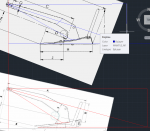
I really would like to see what you're saying but I'm struggling. Having a engineering background (ok, soft eng, as in architecture...) I tried to get the two side elevations of them in ACAD and scale them properly for the 20kg anchors (since that's what I have as well).
Couldn't see that much of a difference other than seemingly there's more "space" under the shank of the Rocna. So started with the chain connection point and aligned them vertically (on this red line) and then based on the flat of the fluke (maybe got it wrong on the Rocna, not sure) I aligned the flat to be horizontal for comparison.
Then tried to draw this line that denotes the 16 vs 30degrees to no avail, drew some more lines (just since it's easy...) trying to see the original shank section midpoint projection to the horizontal (in this particular placement).
Oddly seems that chain mount point is 17mm higher from the flat on the Mantus vs the Rocna and the angle seems very similar (if not smaller on the Rocna)

Any help appreciated:

MANTUS-ROCNA_1.png

btw, engineeringwise, I'm afraid drawing a line from the chain mountpoint to the middle of the weld is meaningless, why middle and not near or far, what does that point have to do with weight distribution, size of fluke, who can simulate how the forces go once the chain starts pulling. Further why pivot point is the axis in the Fortress? in the same way it should be the midpoint between axis and the lip that keeps it at 45 or whatever degrees, if you see my point.

I feel that's just unsubstantiated talk which if fine in a forum, but what maters is test cases with forces applied and results (as in drag or whatever) measured in a controlled environment.
No idea if someone has done that, how impartial s/he was.
You may have that, fine, but even so, going back and founding your findings on this elusive angle is a bit far fetched (imho)

cheers

V.
 
It is a convention for anchors, or (all and any) anchor makers to define fluke/shank angle as the angle of the lines from the shackle point to the middle of the joint (which is a weld or hinge) and another line being the fluke. This angle as you clearly show is the same for both the Mantus and Rocna - at 30 degrees. This is the same angle as the shank makes with a Fortress fluke - and most other anchors are the same. Anchors for specialised applications vary, usually higher, for Fortress. some oil rig anchors (and on the Mekong it seems 40 degrees is preferred).

So your drawing is correct and this is precisely what Noelex pointed out. Its nothing new 30 degrees has been used by everyone for decades.

Stepping back a bit - you will note that the front section of the fluke of a Rocna is a double thickness of steel, this may be there for strength but it also adds weight, call it ballast. Mantus does not have this ballast - the fluke is the same thickness of steel from toe to heel (apart from a tiny triangle at the immediate toe. So a Rocna has a big lump of steel, of not inconsequential weight, at the front (toe) of the fluke. The Mantus has no ballast. Similarly a Spade has ballast, a Delta has ballast and an Excel has ballast. A Fortress, Bugel, and Knox have no ballast.

The crown, that joint of fluke and shank is at the heel for a Fortress (and all other unballasted anchors, except Mantus) and about 1/3 forward from the heel on ballasted anchors, Rocna etc.

So a Mantus has its crown in the location that is chosen by a cross section of ballasted anchor makers.

Now don't you find it odd that Danforth, Fortress, Bruce, Bugel etc etc located the
If you now take a picture of a Rocna se at the heel - but not Mantus?

However much of this does not matter - what matters is how it performs

If we take your drawing of the Mantus you have a blue line passing through the hole at the end of the shank, near the letter 'G' and the line runs down through the middle of the long of the shank to a word Polyline. This line makes an angle of 16 degrees with the fluke. If you now look at Noelex images and imagine that line on his anchor the long section of the shank is parallel with the seabed - which means the fluke is at 16 degrees. Not once but in every picture.

If you now look at pictures of a Rocna in the seabed then you will find that the fluke will be buried but the fluke/shank line you have drawn is parallel with the seabed, your line will be buried in a well set anchor but the seabed will be parallel to that line - the anchor fluke is thus at 30 degrees.

Go back to my links and look at the impact of fluke angle.

Now - cogitate over this and ask again - I'd like you to ask until we are on the same page.

Jonathan
 
Vas,

Might I suggest you read the links I provided in my opening post. The hold data is there, the information is there. The information has largely been available for many months - no-one has offered any other information that has any credibility.

I've tried to provide data and information totally independent of me, a PhD thesis from Houston, details from a book published years ago - its NOT internet chat.

Which leads me to a question:

Why did you buy a Mantus? - all the comments I have seen are - well..... internet chat

Now - I don't want to belittle the importance of shank/fluke angle. Kim in his thesis defines why the crown should be at the heel. Now imagine a shank at 30 degrees but, say, the crown moved to the toe - how do you think the anchor would perform? Location is everything! Rocna and Spade have ballast - they have ballast to engender self righting (the classic being the historic CQR and then Delta). If you don't have ballast you need 'something' else to self right the anchor - Bruce had 2 answers, the anchor we know as a Bruce or a Roll bar. There are no alternatives that have been successful.

But if you have ballast then Kim's tests are not so strong and it is possible to move the crown forward (but if you move the crown forward without the ballast - Kim shot what happens.

So

This is not internet chatter - this is all based on hard testing and all I've done is pull those tests together. I've then conducted some holding capacity tests and moved the shank of the Mantus into a more sensible position.

Read my links and then ask the questions.

Then look at Noelex post -tell me - does he know what he is talking about?

And why did you buy a Mantus - in the absence of holding capacity detail.

Jonathan
 
Jonathan,
I really would like to see what you're saying but I'm struggling. Having a engineering background (ok, soft eng, as in architecture...) I tried to get the two side elevations of them in ACAD and scale them properly for the 20kg anchors (since that's what I have as well).
This is exactly correct. The fluke shank angle of the Mantus and the Rocna is the same. Depending on exactly how the angle is measured, the correct value is around 30° for both. I am sure many, like you who have read anchor threads on YBW are under the mistaken impression that the fluke shank angle of the Mantus is significantly less than the Rocna.

Let’s look at another issue repeated on numerous occasions on YBW:

“The Mantus M1 supposedly has no ballast.”

This is raised and continually and frequently repeated on many anchor threads even many threads unrelated to the Mantus M1. This was from yesterday:

Rocna has ballast and Mantus has no ballast. Even a 7 year old would accept this makes a difference.
Well, there is never a seven year old around when you need one :).

If you look at the Mantus M1, the ballast is obvious. I am not sure how anyone could not see this, or claim otherwise:

y6f0tsE.jpg


The physical ballast on the Mantus M1 is smaller than on the same sized Rocna, but I am at a loss to understand why anyone would claim there is no ballast. It is even on the top of the fluke where it is very hard miss. This is just misinformation.

Any discussion of ballasted roll bar anchors would point out that because of the geometry and longer fluke length of the Mantus, the force driving the tip into the substrate is significantly higher. This has all been independently measured. These are the measured weights at the blade tip as a percentage of the total anchor weight.

Mantus 50%
Steel Spade 47-50%
Rocna 35%
Delta 28%

If you are a reader of YBW anchor threads you may have been under the impression that the Mantus M1 has a low tip weight and is unballasted. This is just plain wrong.

You may also have been under the impression my photos of the Mantus show it performing poorly. Take a look at the images yourself. By any reasonable assessment the Mantus is performing superbly.

I do not wish to continually correct the disinformation written by one poster about the Mantus M1 on this forum. To do so would risk dragging the forum into mindless bickering. However, many of the repeatedly made claims about the Mantus M1 are incorrect and can be shown to be obviously incorrect quite simply. Hopefully this thread will serve to dispel these myths once and for all.
 
The fluke angles are different. Put a protractor on this.

The angles formed by the red dashed lines on the Mantus are about 50 and 25 degrees respectively. The same angles on the Rocna are about 54 and 28. A small difference, but enough to change behaviors. I've modified anchor angles just to see, and 5 degrees makes a very noticable difference. As an example, a change of 13 degrees to a Fortress anchor (32 vs. 45) will completely prevent it from setting in all but the softest mud, but also triple its hold in soft mud once it sets. So 3-5 degrees is important.

Any engineer will tell you that these are the angles that are important to the force vectors, irrespective of the shank location (which effects toe weight, stowage, and clogging, but not the hold force vectors once the anchor is burried). Blade shape also has an effect. But these angles were selected to overlook most fabrication differences and focus on the basics.

Is this better or worse? It is different and results in the Mantus having different properties. I've tested both, and they behave differently in the way I would expect. I've tested a lot of anchors, and I'm still not ready to pick a single favorite, because most are best at something but not something else. Everytime I start to say "my favorite is..." I find myself saying "... on the other hand...."

And all of this ignores clogging. Fortress is the worst for that.

So argue on.

anchor%2Bangles%2Brochna%2Bmantus.jpg
 
I think anyone suggesting that the ballast on the Mantus is in any way comparable to the ballast on a Rocna is - clutching at straws.

Thinwater has underlined that anchors are not quite as simple as people might think.

However as a number of independent parties show what is important is what these different variables have on the characteristics of the anchor in the seabed, and in the case of leisure anchors - do they fit on the bow roller, do they self right

Going baclk the the drawings.

When a Rocna sets, or is set, it lies in the seabed with Vas' shank end to middle of fluke line horizontal. We have already agreed this line is at 30 degrees to the fluke - so if the shank/fluke line is horizontal the fluke is at 30 degrees to the seabed. Check any, independent, picture of a Rocna set in the seabed, take a screen shot from one of the, many, videos - that is what you will find. You can then look at other anchors, Spade etc and make the same analysis. There are plenty of Vids, just get one showing the anchor side on - take your screen shot.

Mantus when set has the long of the shank parallel with the seabed when the anchor is set. On Vas' diagram this is the line that runs from the shackle hole (through the centre of the long of the shank) to the word 'poly line' on his diagram. That line is at 16 degrees to the fluke. If you look at pictures of a Mantus in the seabed the long of the shank is always horizontal - consequently the fluke is at 16 degrees. You can also look at vids, mantus had videos showing this (they did not understand either).

This is the critical point - define exactly what angle all of Noelex pictures of a Mantus show. Everything else falls into place. I simulate this in my picture of a Mantus in my article. You can use Noelex pictures they are taken unaware of what he is showing - we can consider them independent. And though he is an expert he is 'obfuscating'.

It is important you choose your pictures - then they are then your choice, not mine. It is important we use Vas' diagrams, or Thinwater's - then they are independent.

Look at post 902, I chose the picture at random, though I actually had to search for a picture of a Mantus

Photos of Anchors Setting - Page 61 - Cruisers & Sailing Forums

You will not that the 'long' of the shank is horizontal.

You make your now choices, I will be accused of choosing biased pictures - I'm happy to be so accused - because you can choose your own and find the same.

All the research shows that a fluke set at 16 degrees will have 50% of hold of a similar fluke set at 30 degrees. Note this research is not mine, its independent.

I have moved the Mantus shank aft, so that the fluke angle with the seabed increases and i achieve a commensurate increase in hold. I have measured the hold of a Mantus, in its original state and hold is slightly better than a Delta. This data is not independent, its mine, so I'm down playing it. There is plenty of independent information that backs up what I say.

The answer would be if someone independent, or even Mantus, measured hold - but for some reason Mantus has never measured hold. On one of the Panope videos, a more recent one when he started to measure hold - did remark that the hold of a Mantus was not stellar.

Jonathan
 
Last edited:
And you wondered what you were going to do this weekend!

Mantus have a series of promotional videos here:

Test Video - Mantus Marine

You can pull out any number of screen shots.

If you look at the video 'Mantus Boat Anchor Sand, Isla Mujeres' and go to the end of the video sequence where they show the anchor setting you will note when the anchor is almost completely buried the shank is actually not horizontal (assuming the seabed is horizontal). The shank is actually skying - you can decide by how many degrees. But if the shank is pointing above the horizontal then the fluke is at less than 16 degrees - and getting near the point where the anchor drags. For a 15kg Rocna or Spade you would need a tension of 2,000kg to get them to drag (in most seabeds (and they would be well buried). A 15kg Delta would drag with a tension of about 1,000kg.

I noticed this skying effect on another Mantus video - but I cannot recall which - and it might have been withdrawn.

But pull out your screen shots - these are not independent but showing Mantus in its best light. Look especially at that last sequence as indicated.

Jonathan
 
At last the last two days my batteries have gone into float :)
Come on guys put each other back on your Christmas card list .
I honestly don't think these back and fro arguments isn't going to help anyone newbee to anchors buy the one for him .
 
All this thread has done has added confusion and put me off buying a new anchor.
Just remember that it's perfectly possible to anchor successfully without worrying about all the finer points of the technicalities of anchor design, materials, and construction. It's like being able to switch on a TV without knowing how it actually works.
 
Top