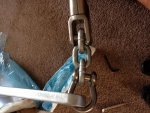
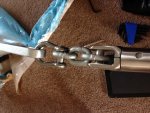
Anchor Loads - Which size of swivel?

These anchors with a round hole in the shank, will not take the eye of a bow shackle, should always have an over large 'D' shackle, so the clevis pin should be as large as you can fit in the hole - within reason. You can then fit a bow shackle the 'right way' round (or add extra links).

Yes good point.... Odd that the designers did that and as you say you can't get a very strong bow shackle through it at all. The Crosby range I am looking at for the drogue is the G-2140 with Alloy Steel rated a lot higher than standard carbon alloy and a lot higher again than normal galvanised shackles. Info here:

http://www.thecrosbygroup.com/html/default.htm#/en/82

Anyway the diameter of the hole in my anchor is about 22mm so I wouldn't even get their smallest Bow shackle in the hole which is rated at 2t SWL. (see link above). So you are suggesting putting a massive D Shackle in there and then putting on a bow shackle after that?

Surely if I went for a back-to-front bow shackle but massively over rated with pin nearly the diameter of the anchor hole then it wouldn't really matter if it was side loaded.
 
While not disputing that the Crosby lifting and hoisting shackles are very strong I think I should point out that almost all of the stainless steel 10 mm shackles that I tested were stronger than 8 mm chain, so not a weak link at all. The three notably weaker shackles tested were all galvanised, bought over the counter at various chandleries. How do the Crosby shackles with the bolt/pin fare long term in seawater? My Wichard stainless shackles have been in regular and frequent use for nine years now with no sign of degradation. The only galvanic corrosion that has occurred is partial loss of zinc on the final three or four links of the chain.
 
I am not sure, at all, but the picture of the anchor shank leads me to think its a CQR. Original CQRs had a monster 'D' shackle welded into the hole in the shank. I'm not old enough to know but as it was all welded together I assume the intention was to use 'another' shackle to attach the chain to the welded 'D' shackle (but maybe they used rope then). Today it is possible to buy a 3/8th bow shackle (from Crosby, Peerless or Campbell) with a 2t WLL and manufactured to a 4.5:1 to 6:1 safety factor - giving a min break load of 9t-12t. Bigger shackles are obviously stronger. The 3 manufacturers have different safety factors but the tested strengths are very similar. Your limit for the bow shackle is the size of the chain (or the hole in the last link). I'd check as despite chain being made to a standard the hole size varies as does the size of the pin in the shackle. The quality of Crosby shackle you need is a G209A, check that whatever you buy is a Grade B galvanised shackle. Crosby's are designated with a silver clevis pin.

But you are correct - if you go for the largest, within reason, 'D' shackle to fit the hole in the shank it should be strong enough as the hole is so big, but make sure you can fit the bow shackle, check, check and check again. I'd buy a rated 'D' shackle - they cost peanuts and its not worth trying to save money. The only ones I know, sorry I'm in Australia, are Van Beests Green Pin shackles (Van Beest, Holland). The Green Pin shackles, guess what colour the clevis pin is!) are Grade A shackles and are about half the strength of Grade B shackles.

There must be other manufacturers of Grade B shackles, but I have not found them. Some of the lifting equipment companies make some pretty fancy shackles but we only need those with a simple clevis pin, no bolt at the end - it might foul the bow roller.

I think you should be able to get both Green Pin and G209A from Tecni Lift, or any lifting equipment supplier (selling slings, chain etc.

I would try to source my Grade B shackle, once I know what WLL it will be (one that fits my chain) I'd then buy my 'D' shackle to match the strength, being bigger it should not be difficult to match.

Anyone reading this with a similar problem but smaller chain has a problem. Campbell and Crosby, as far as I ascertain, only make Grade B shackles with a size of 3/8th" or bigger. This might be fine for 8mm chain, but I'd check - I cannot fit a clevis pin from a 3/8th" shackle in a Maggi metric 8mm chain. If you need smaller than the Crosby or Campbell 3/8th" Grade B shackle the only source I can find is from Peerless, their Peerlift range. I have no idea how you source them in the UK. The Peerlift range come in both Grade A and Grade B and are both blue pin - so check, check and check again. I think Peerlift Grade B shackles start at 1/4' but it might be smaller 3/16th" (again try Tecn-lift). Companies like defender and 1st Chain (First Chain) will courier these grade B shackles but the courier costs are factorially greater than the shackle. Maybe if you know someone in America they can send normal America Post - its cheap and reliable. Why American mail order have this fixation with courier companies - beats me.

I confess I only know of Tecni Lift and I have bought from them previously, suggested by Vyv.

If you source Peerlift in the UK, or to the UK - it would be of value to post the source. If you find another source of Grade B shackles t would alsp be of value. A 3/8th rated shackle costs a very few pounds stg. A Grade B 3/8th" shackle should cost less than 10stg.

I have not mentioned CMP Titan shackles. Their Grade A shackles, yellow pin, seem fine, a 3/8th" shackle, 1t WLL, 6:1 safety factor broke at 8t, their Grade B shackle, black pin, 3/8th", 2t WLL, 6:1 safety factor broke at 8t. I only tested one shackle of each.

Jonathan
 
Can I just ask after reading on here, Vyvs website etc I've bought some new holding tackle for my Moody 376, namely:

20kg Rocna
Peterson Certified Bow Shackle, WLL 1.5t
3 links Aqua 4 grade 40 10mm
Kong swivel 8-12mm
8mm certified ss chain 50 meters (already on the boat)

Does that look a decent set up and is the shackle ok that way round? On photographs iimage.jpgve seen the bar goes through the shaft!

All feedback welcome.

image.jpg
 
That looks OK to me. I think I might prefer the shackle the other way around but from a strength point of view I don't think it matters.

Brilliant, thanks Vyv,

I too would have preferred it the other way but it won't go through, I'm more concerned about strength of the set up and would the shackle be any weaker that way round (don't know why it would but just started to question myself)

Thanks again
 
I like the shackle the way round it is - what a clumsy sentence!

With the bow through the shank it can swivel, articulate. If the pin is through the shank there is every chance of the pin being loaded unevenly and its the pin that usually fails. Good shackles fail because the pin sheers, usually at the thread, poor shackles fail because the pin is soft and pulls out of the thread. Shackles are meant to be used 'in line' load at 90 degrees and you reduce the WLL by 50%.

Vyv - can you advise your reasoning to have the pin through the shank?

I'm interested in your 8mm stainless chain. What does 'certified' mean? Do you have a test cert of the ultimate tensile stress?

Jonathan
 
I like the shackle the way round it is - what a clumsy sentence!

With the bow through the shank it can swivel, articulate. If the pin is through the shank there is every chance of the pin being loaded unevenly and its the pin that usually fails. Good shackles fail because the pin sheers, usually at the thread, poor shackles fail because the pin is soft and pulls out of the thread. Shackles are meant to be used 'in line' load at 90 degrees and you reduce the WLL by 50%.

Vyv - can you advise your reasoning to have the pin through the shank?

I'm interested in your 8mm stainless chain. What does 'certified' mean? Do you have a test cert of the ultimate tensile stress?

Jonathan

Thanks Jonathon, again, reassuring!

I've not owned the boat long and although I bought it through a broker I managed to trace the last owner ( a German couple) who Have been very kind in answering my questions, they owned the boat for 15 years and had bought it off another German couple who had had it for 10 years since new.

I specifically asked about the chain, the reply I got was:

"We fitted the 50m inox chain in 2002. It's a German made and tested quality"

Although I don't have a certificate (it may be on board?) looking at the upgrades and the way this boat has been looked after throughout its life I have no reason to doubt it's of a good quality- maybe it'll have 'etchings' to confirm its rating like my shackle does??

Is that likely?

Cheers
 
Vyv - can you advise your reasoning to have the pin through the shank?

I prefer to load the pin over as wide an area as possible, avoiding point loading that could bend the pin. In this case the shank is wider than the chain so that would be my preference. Where the chain is on the pin it is almost inevitable that the load will be highest at one side or the other, which is slightly weaker.

However, I was shown this idea at a CA meeting where I talked about anchors and anchoring. Seems like a very neat and simple device that overcomes this small problem. Just a couple of cones that fit the pin.
IMG_0744_zps860c5c90.jpg
 
I see the logic but unless the load is in the same line as the shank then the clevis pin is going to be 'point' loaded by the edge of the slot in the shank and as getting the load at exactly the same line as the shank, especially if a snatch load, I'd prefer some articulation.

The cones are a good idea - but where would you get them? The only source I can think of is as 'olives' in pressure couplings of pipe.

I've been breaking shackles and when I test I've been using high tensile rings for both the pin and bow. There might be some distortion, but it tends to be limited, but though the rings 'point load' I find rated shackles are trustworthy, apart from the Black Pin one I mention above. Failure is where the thread reduces the pin size and the pins shear. But if you source Grade B rated shackles you are going to be much safer than most. Unrated shackles and stainless shackles can fail by the pin simply pulling out of the thread, basically the thread distorts.

The only reliable stainless chain I know of, I'm not keen on stainless chain so have not researched it much, would be a G50 grade. I think this is used in the food industry and in environments where 'normal' chain might corrode (or contaminate). As the designation suggests it will be stronger than both G30 or G40. But if it is a lifting chain it should be marked with a '5' or a '50'. If it is not market I'd be suspicious. The marks might be every 300mm or 1000m - so they might take a bit of finding! There might be other grades of stainless chain, I'm sure there are - but I do not know.

Jonathan
 
I rarely disagree with Vyv but I must say, having the Bow bit of the shackle through the anchor makes more sense with respect to loading from different directions.

I my case I can't do this since my anchor hole DIA is 22m limiting me to either putting the swivel directly on the anchor or putting a bow shackle pin through the anchor hole.

My doing the latter you are limited by the internal clearance of the chain of course. In my case 13mm which leaves you limited to a working load of 1.5T. That said, by using the swivel and 3 links of chain it means you can up the chain size at that point and increase you anchor bow shackle which, again, is what I am doing. so my setup will be:

10mm chain > Kong Swivel > 3 links 12mm Chain > 19mm pin Bow Shackle (pin through anchor, bow on chain)

Kinda gives me more strength than my anchor would allow by just putting chain to shackle.
 
Thankfully those of us who still believe in the benefit of catenary, and who use relatively heavy chain in order to achieve said catenary, have no worries about SWLs or UTS etc. Our gear, like ourselves, is not so stressed. :D I appreciate that light displacement boats, where every kilo counts, do not want to be encumbered with heavy gear, and so their equipment and procedures have to be different.

Incidentally, remember that for obvious reason, there will be considerably less load on the anchor attachment, than there will be on the chain at the bow roller
 
If you are using a 10m nylon snubber there is no load on the bow roller, at all, and minimal load on the anchor and attachments.

Sadly there is load on the bow roller and equal load on the anchor attachments when you are retrieving the anchor (well set), the chain is vertical and the bow is hit by a big wave. Size is not an issue - strength of bow roller, anchor shank and anchor shackle might be. Catenary is no help here.

Anchors are bent on retrieval, anchors are lost on retrieval when the shackle, unbranded, opens up.

Jonathan
 
If you are using a 10m nylon snubber there is no load on the bow roller, at all, and minimal load on the anchor and attachments.

Sadly there is load on the bow roller and equal load on the anchor attachments when you are retrieving the anchor (well set), the chain is vertical and the bow is hit by a big wave. Size is not an issue - strength of bow roller, anchor shank and anchor shackle might be. Catenary is no help here.

Anchors are bent on retrieval, anchors are lost on retrieval when the shackle, unbranded, opens up.

Jonathan

I don't anchor where there are big waves.
 
Obviously very lucky, if only life were that perfect. Don't sail Australia's east coast, we have some big bays, sheltered from wind but open to the swell. Trial Bay, Broughton Island, Byron Bay. Or try Sandy Cape, Tasmania's west coast - or simply stay stay in Sydney Harbour and retrieve just as ferry wash, or the go faster mobo wash, hits you.

Jonathan
 
Obviously very lucky, if only life were that perfect. Don't sail Australia's east coast, we have some big bays, sheltered from wind but open to the swell. Trial Bay, Broughton Island, Byron Bay. Or try Sandy Cape, Tasmania's west coast - or simply stay stay in Sydney Harbour and retrieve just as ferry wash, or the go faster mobo wash, hits you.

Jonathan

Our own West Coast is quite exposed too, but we are well provided with completely sheltered (from the effects of the sea) natural anchorages.

If you're worried about breaking out your anchor when the boat is jumping up and down, try adjusting the clutch on the windlass, so that it will slip before dangerous loads develop. Anglers do it with their reels.
 
The anchor I've bought is galvanised, even though it's all shiney at the moment. The links came with the anchor, I did look at inox but for circa £30 I felt it was a bit excessive when the galvanised would do the same job.

The inox chain that's on the boat is 8mm and wouldn't fit the Kong connector on that side.
 
Thanks - if only my clutch were that sensitive. Maybe I have the wrong windlass?

The windlass does that all by itself and dumps the chain overboard with me scrambling about looking for a winch handle to lock it off! Its one of a few reasons I retrieve the anchor and my wife deploys.

Jonathan
 
10mm chain > Kong Swivel > 3 links 12mm Chain > 19mm pin Bow Shackle (pin through anchor, bow on chain)

Kinda gives me more strength than my anchor would allow by just putting chain to shackle.

The three links of chain to reduce the side loading on the swivel is very sensible. When doing this, I have noticed a lot of people use thicker chain for the three links as you have done.

This has advantages in allowing the use of stronger (but bulkier) shackles. The added weight is minimal, but I wonder if it is best practice.

Most modern anchors bury in the end of the shank (where the thicker chain and larger shackles will be) very early on. I am not sure what anchor you have, but this photo of a Delta illustrates the point:

image.jpg1_zps1l8obzf4.jpg


You can see the fluke is only just starting to bury. At this stage the anchor does not have a lot of grip. However, the end of the shank is already buried.

If you hinder the end of the shank burying, you also hinder the fluke from burying. This happens very early on in the setting process so making the end of the shank bulkier will have some effect on most sets.

The use of thin wire rope close to the anchor has been suggested as a means of improving anchor performance (one manufacturer even supplied wire for this purpose with their anchor). I think this is probably overkill. Chain is more reliable than wire rope. However the message is be careful not to make the chain and shackles, close to the anchor shank too bulky.

12mm chain is quite a bit bulkier than 10mm and larger shackles add to the drag. It is difficult to know the practical effects of these sort of differences, but in hard substrates I suspect it will make some difference.

These are only small details, but if you can use 10mm chain next to the anchor with smaller shackles and still have adequate strength, I think this is better.
 
Top