
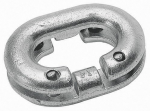
Anchor chain link

Sea Devil

Well-Known Member
Joined
19 Aug 2004
Messages
3,906
Location
Boulogne sur mer & Marbella Spain, Guadeloupe
www.youtube.com
1617526178638.png I have just ordered another 30 metres of 8mm together with one of these joiners - In the past I have always used this type to join anchor chain with no problem but the chandlers who sold me the chain pointed out that the breaking strain of the chain is 2 tons and this link is 1 ton... I am trying to get my head round the 1 ton breaking point - In one hell of a blow is the strain on a anchor chain from a 32 ft boat greater than one ton - I actually do not know - I have an opinion but I have no scientific proof.. would be grateful for info on actual proof..
 
That looks like a Crosby. Look up Crosby link specs.

They are about as good as you can get.

When in the motorcycle business I made Bowden Cables for customers, many to be used on high speed racing motorbikes.

So as to be sure of quality I used my big Churchill press to test the breaking strain of the various inner cables and also the strength of the nipple soldering.

The medium size for clutch cables broke at well over two tons. The soft soldered nipples pulled at nearer four tons with the heaviest cable used on front brakes. As the forces human hand pressure multiplied by the leverage with motorcycle cable systems is nowhere near these figures I was very happy with my results.

I dont think I would worry.
 
That looks like a Crosby. Look up Crosby link specs.

They are about as good as you can get.

When in the motorcycle business I made Bowden Cables for customers, many to be used on high speed racing motorbikes.

So as to be sure of quality I used my big Churchill press to test the breaking strain of the various inner cables and also the strength of the nipple soldering.

The medium size for clutch cables broke at well over two tons. The soft soldered nipples pulled at nearer four tons with the heaviest cable used on front brakes. As the forces human hand pressure multiplied by the leverage with motorcycle cable systems is nowhere near these figures I was very happy with my results.

I dont think I would worry.
That is my opinion and I have anchored in some pretty awful conditions with chain connected by these links and not even worried about it - and the link did not break! The chandler person just raised the issue and I thought it worth pursuing - Thank you Rotax
 
Thanks for the 'links' GHA - the first one was really just opinion but the 2nd one excellent - and actually I am becoming less concerned as nobody is saying they are disaster.

What I was really interested in was the pull - snatch weight of a 32 ft yacht on an anchor chain in bad conditions - is it more than a ton?

- But probably nobody has ever tank tested this -
 
You should be able to buy a Crosby 'C' link in the UK from a company called Tecni. They sell mail order (I use them to buy Crosby shackles - I've never bought a 'C' link from them).

I think you are correct - when the tension in the rode is high the last thing you are thinking of is introducing a load cell and recorder into the rode.

I did measure tensions in the rode on our catamaran, 38' x 7t and at 650kg I chickened out and stopped the testing. 650kg loads on the rode are, at best, scary the rode was a 8mm G30. I can assure you that you will have moved long before tensions have reached even 450kg on a 32' yacht. If you have not moved - your rode is the least of your problems - you will be looking at crew mutiny and divorce.

BUT I would still focus on the Crosby link (do not buy anything else, they all 'look' the same - make sure it is a Crosby link - they are the best available, I have not heard of failures (that does NOT mean some have not failed). I would check the 'C' link on a regular basis. Do NOT think that welding the link will make it more secure - you will destroy the temper and its strength. You will need a big hammer and something to act as an anvil to rivet it together.

Jonathan
 
When I used those links many years ago I was concerned with the strength so I welded the link closed and then got the whole chain 70 meters re galvanized.

Even it changed the temper / strength of the link it made up by having a much cross section are at the week point where the link is thinner.
 
Jonathan hello,
Thank you for that -
One of the problems I have living in France is that importing stuff from the UK is a real hassle and the C-link here in France is calibrated to 1 ton so from what you said it's fine - I did ride out some pretty dodgy conditions in Lady Musgrave some time back and there were at least 2 c-links in the chain I had out and they were OK - This is a video of it
 
When I used those links many years ago I was concerned with the strength so I welded the link closed and then got the whole chain 70 meters re galvanized.

Even it changed the temper / strength of the link it made up by having a much cross section are at the week point where the link is thinner.
Roger thank you,

I think I am worrying unnecessarily - I just could not get my head around the pull - snatch weight of a 32 ft yacht on an anchor chain in bad conditions - is it more than a ton?
 
Roger thank you,
snatch weight of a 32 ft yacht on an anchor chain in bad conditions - is it more than a ton?

That's a very good question . I have no idea would need to fit a load cell in the chain to measure the snatch load in various conditions.

Snatch loading is why we Engineers have a largish safety factor in lifting chain and wire rope to allow for the snatch loading
 
If you take a link of chain and make 4 saw cuts across it to half the diameter how can it then be as strong as uncut chain of the same dimensions?

Of course it can't be, unless it is made of material with twice the tensile strength of the uncut chain.

The same argument must surely apply to these C-links.

If I am wrong about that, I would like to know why.
 
If you take a link of chain and make 4 saw cuts across it to half the diameter how can it then be as strong as uncut chain of the same dimensions?

Of course it can't be, unless it is made of material with twice the tensile strength of the uncut chain.

The same argument must surely apply to these C-links.

If I am wrong about that, I would like to know why.


That was why I decided to weld up my C link as I could not determine what and if any heat treatment the C link had and so what the UTS could be.

In fact I have even cut through a chain link at the weld opened it up to connect 2 chains together and re welded it back together after chamfering the weld point to get good penetration. Welded wit Tig for a good quality weld.
 
That's a very good question . I have no idea would need to fit a load cell in the chain to measure the snatch load in various conditions.

Snatch loading is why we Engineers have a largish safety factor in lifting chain and wire rope to allow for the snatch loading
Only happened to me once but in a shallow mooring in the Bahamas I had a load of chain out and was not dragging but as a 'wave' came in the chain was actually lifting out of the water! 36 ft Angus Primrose Moody - much heavier than my Benateau 323! Come to think of it there were at least one C-link in the chain... I ton breaking strain has to be fine - thank you for the advice - I am no engineer...
 
If you take a link of chain and make 4 saw cuts across it to half the diameter how can it then be as strong as uncut chain of the same dimensions?

Of course it can't be, unless it is made of material with twice the tensile strength of the uncut chain.

The same argument must surely apply to these C-links.

If I am wrong about that, I would like to know why.

Most anchor chain is a mild steel made from wire 300 Mpa or 400 Mpa in strength. Crosby 'C' links are quench and tempered steel, which is why you should not weld them, you will destroy the temper (and negate any accompanying certification). I don't know the rating of 'C' links, I am sure Crosby will quote it (but I have never used one) but I guess it will be a G70 or G80 quality. The steel will thus be around 2 times as strong as the steel used in the chain. If you use a G209a Crosby shackle it is a G80 quality.

This is the relevant specification for Crosby 'C' links - not the pear shaped ones but the oval ones.

Crosby® 335 Galvanized "Missing Link" Replacement Links - The Crosby Group

Note the WLL is in lbs not kgs.

For the OP

I'm struggling to help you living in France with a source for Crosby components that don't come from the UK :(

Crosby now own Gunnebo who are a supplier of lifting equipment, chains etc etc. Gunnebo quality is top of the range, based in Sweden, distributors - internationally. I'd check the Gunnebo website for your nearest distributor, I'd have thought in France - send them an email and ask them how you can buy a Crosby 'C link. I use a lot of Gunnebo components in my rode - the chain itself came from Gunnebo.

I would for peace of mind, were I you, search out sourcing a Crosby link - its just an email, or better - phone call. It will cost peanuts - and I don't skimp on ground tackle :)

Jonathan
 
Last edited:
These Crosby 'C' links use a 4:1 safety factor which gives a minimum breaking strength of around 2.4t - comfortably more than the MBS of you chain. I assume your chain is 6mm and the 1/4" link will fit.

There are 2 companies called Gunnebo - make sure you are looking at the one focussing on lifting.

Aquaculture & HDG

Now that I think a bit more - if you don't have a windlass you don't need to use a 'C' link - you could use a hammerlock. If you speak to Gunnebo they now make a galvanised G80 chain and they must make fittings for the chain, also galvanised (though I have never seen them in their catalogue). The galvanised G80 is for aquaculture (and frankly I don't see how you can use the chain without fittings). So - if you don't have a windlass (possible if you use 6mm chain) then ask Gunnebo what options they can suggest.

I use hammerlocks, which I have galvanised here, but to join 6mm chain to anchor (and we have a windlass)

Stay safe, take care

Jonathan
 
That's a very good question . I have no idea would need to fit a load cell in the chain to measure the snatch load in various conditions.
Really wouldn't be that difficult or expensive to do, make a rope tension meter under a length of line taking the load. I've played around with the concept using a bust electronic kitchen scales and arduino. Amazingly accurate so even with the load divided by a big factor it should be enough to show trends anyway even if not accurate down to a kilo. Then just send the data every half second over wifi to a raspberry pi, logging and viewing the data is simple. Certainly would be fascination along with logged windspeed, boat velocity/acceleration etc. One day.. ?
 
Top