Anchor chain length for med

Nup!

That's the same one we live in:

Storm warning (by HF) once a month, in summer. Nearest marina, a one day overnight sail; nearest fuel, gas, supermarket - 18 hour sail. Nearest lobster 30 minutes. No fixed VHF, no mobile phone, no TV. Not sure how far to the nearest road.

But home to the, endangered orange breasted parrot.

And an evocatively named hill 'Mount Misery'.

God's country

Jonathan
 
Draining into the grey water tank seems like a sensible idea :encouragement: makes the chain locker no different to a shower tray - combined with a fresh-water deck-wash it sounds like a good solution - as the germans say, "again what learned" ... "Wieder was gelernt"

Hm, personally I think it's a seriously eccentric plan to have the chain locker below water level, when it can be so easily avoided. I know that ship's chain lockers are like that, but for a moderate yacht, it just seems like an unnecessary complication. Sorry.
 
Hm, personally I think it's a seriously eccentric plan to have the chain locker below water level, when it can be so easily avoided. I know that ship's chain lockers are like that, but for a moderate yacht, it just seems like an unnecessary complication. Sorry.

I can see the point of it .... AWB chain lockers up front are perfect for your average cruiser, I love mine .... but the hatch is not waterproof and there are stories of large chain lockers filling with water in heavy seas and not draining properly.

In the chain pipe versus anchor locker debate, one of the main arguments is that a contemporary on-deck anchor locker is much more difficult—often impossible—to make watertight. The International Sailing Federation’s (ISAF) Offshore Special Regulations treat anchor wells as cockpit volume. This is a clear indication that watertight status is not always in the cards, and in heavy weather, inundation may involve more than the drip from a wet anchor rode.

In heavy seas, even the locker’s drains can become floodwater inlets, as PS Technical Editor Ralph Naranjo discovered on a lumpy passage from Bermuda. The boat’s crew learned the hard way what an anchor well full of water could do to decrease buoyancy and increase the pitching moment of a Swan 48 MKII. It took the repeated efforts of crew wedged in the forepeak to pump the locker dry using a permanently installed manual bilge pump.

https://www.practical-sailor.com/issues/37_3/features/A_Look_At_Anchor_Lockers_10154-1.html

It's down to intended use again ... and the OP appears to be building a more traditional, blue-water boat.
 
Hm, personally I think it's a seriously eccentric plan to have the chain locker below water level, when it can be so easily avoided. I know that ship's chain lockers are like that, but for a moderate yacht, it just seems like an unnecessary complication. Sorry.

I think it makes sense to keep heavy items like chain (200kg) as low as possible and away from the bow (or stern

Few people would argue the Hallberg-Rassy is not one of the best yachts produced and I'm sure you'll find their anchor lockers are not above the waterline.

I came across the following in the Halber-Rassy manual.
Maintenance Chain:
Check the “Bitter end” rope regularly. The bitter end of the chain is connected to the bottom of the chain locker and can easily be cut in case of an emergency. Turn the chain around after some years. (Put the a.....
 
Last edited:
I think it makes sense to keep heavy items like chain (200kg) as low as possible and away from the bow (or stern

Few people would argue the Hallberg-Rassy is not one of the best yachts produced and I'm sure you'll find their anchor lockers are not above the waterline.

I came across the following in the Halber-Rassy manual.
Maintenance Chain:
Check the “Bitter end” rope regularly. The bitter end of the chain is connected to the bottom of the chain locker and can easily be cut in case of an emergency. Turn the chain around after some years. (Put the a.....

That reminds me .... my last chain started to rust which was the primary reason for the replacement - along with a need for a bit more chain.

The part that rusted was at the anchor end due to the constant immersion in seawater and abrasion from rocks, sand and grit - it destroyed the galvanising - I still have about 30m of useable chain which hasn't rusted even though it spent most of it's life in the bottom of my chain locker - it will get spliced to a rope and used as a backup anchor/shoreline when I get round to it - the "beaches" in northern Croatia are mostly razor-sharp rocks so a length of chain is a great help.

The HR advice to turn the chain round every few seasons would certainly make a chain last longer .... does anyone do this? ... I think it's a good idea, but it makes painting the chain a less attractive option because you have to reverse the meaning of the marks (assuming it has symetrical marking) or remove the old marks and re-paint.

Yet more to think about ....
 
Hi, don't mean to upset you but the chain locker looks like it is below the water line as mentioned also by NormanS. Where does it drain? The bilges?

When pulling up the anchor, it will bring seawater on board along with other filth, sand, mud, weed, etc. ... a deck-wash to wash the chain as it comes aboard will help with this - fresh-water if you have a watermaker with the available capacity to use your freshwater tank to feed a chain wash, or clean seawater will at least get rid of the grit and sand.

The seawater will need to be pumped out of the boat if it is below the waterline, but wherever it ends up, it will likely leave copious quantities of crystalised salt behind, which is a magnet for moisture and a corrosion risk.

Perhaps talk with the designer/builder to ensure you have a well thought out way of removing the salt water - or maybe even move the chain locker further forward if possible and well above the water line, with decent drainage outside the boat - looks like your boat will be easily heavy enough to take it. Chain lockers are damp, salty, filthy places which is why most AWBs have them right up front with good drain holes and easy access through a deck hatch so you can jet-wash the contents when in harbour.

I grew up on a boat with a chain locker buried in front of the berths in the forward cabin, chain came down through a hawse-pipe ... it was a filthy, smelly hole and going in there to knock the backed up chain over regularly was not a nice job. The boat was fiberglass so there were no rust issues in the boat other than the chain and it all drained down into the bilge, which was always damp and salty. This was acceptable in the late 60s when the boat was built, but is not often the case now.

There may be ways to mitigate all this which I don't know, so don't get disheartened, I don't mean to criticise, but I would imagine avoiding shipping salty water into the bowels of a steel boat should be a priority that out-weighs the weight of the chain up front. Just my opinion.

Fixing this in the build phase will be much cheaper in the long run than fixing the possible rust in the superstructure from saltwater escaping from your chain locker into the boat.

Drawings look awesome by the way, nice boat! :encouragement:

PS: It also depends heavily on your intended use, if crossing oceans then maybe a large non-watertight locker up front is a no-go ... horses for courses and every design is a compromise.

Our Van de Stadt has a chain locker below the bow locker. You access it by removing a quick release panel in the floor of the bow locker. The chain locker was designed to hold 70m of chain. We currently use 60m of 10m chain but have a drum of 25mm anchoplait, 50m in length permanantly connected to the chain. This drum sits in the bow locker above the anchor chain locker. We rarely need the rope as mostly the 60m length of chain is adequate. The design of the chain locker is exceptional. We never need to access the chain when anchoring or raising the anchor. We see lots of boats with a stick messing with their chain making sure it sits correctly in their chain locker. We never do this. Since our chain locker is very low in the boat, the bottom of the locker is below the water line. It cant self drain. The locker has always had a through hull fitting in the main watertight bulkhead that takes a 1/2” pipe that runs through the bilges to our very deep sump. Here the water is picked up by the electric bilge pump. The pipe has a s/s filter accessible under the front bunk that stops and sediment blocking the pipe. It doesnt. We clean the locker out when we lift the boat when going back to the UK but we havent done this for a couple of years and the filter hasnt needed cleaning. We anchor permanently and we clearly dont bring up enough sediment to be a problem. We do have a deck hose that can wash the anchor chain as we lift it but we dont anchor in mud that often. The sump pump has an alarm fitted such that everytime it runs we hear the alarm. Even taking green water over the bow in 30kts of wind we get a minimal amount of water entering the sump. The pump in bad weather may run briefly to remove a cupful of water, say once every couple of hours. Its always reassuring when you here the alarm go off.
We like the system we have and have no concerns at all about our chain locker design. It works far better than most people chain lockers in as much as it needs no human intervention to park the chain. It is also further back in the boat being so low which means it keep the weight out of the bow. 10mm chain is heavy but for a 18.5 ton boat it is cheap and effective and not a significant weight if not located far forward
 
Our Van de Stadt has a chain locker below the bow locker. You access it by removing a quick release panel in the floor of the bow locker. The chain locker was designed to hold 70m of chain. We currently use 60m of 10m chain but have a drum of 25mm anchoplait, 50m in length permanantly connected to the chain. This drum sits in the bow locker above the anchor chain locker. We rarely need the rope as mostly the 60m length of chain is adequate. The design of the chain locker is exceptional. We never need to access the chain when anchoring or raising the anchor. We see lots of boats with a stick messing with their chain making sure it sits correctly in their chain locker. We never do this. Since our chain locker is very low in the boat, the bottom of the locker is below the water line. It cant self drain. The locker has always had a through hull fitting in the main watertight bulkhead that takes a 1/2” pipe that runs through the bilges to our very deep sump. Here the water is picked up by the electric bilge pump. The pipe has a s/s filter accessible under the front bunk that stops and sediment blocking the pipe. It doesnt. We clean the locker out when we lift the boat when going back to the UK but we havent done this for a couple of years and the filter hasnt needed cleaning. We anchor permanently and we clearly dont bring up enough sediment to be a problem. We do have a deck hose that can wash the anchor chain as we lift it but we dont anchor in mud that often. The sump pump has an alarm fitted such that everytime it runs we hear the alarm. Even taking green water over the bow in 30kts of wind we get a minimal amount of water entering the sump. The pump in bad weather may run briefly to remove a cupful of water, say once every couple of hours. Its always reassuring when you here the alarm go off.
We like the system we have and have no concerns at all about our chain locker design. It works far better than most people chain lockers in as much as it needs no human intervention to park the chain. It is also further back in the boat being so low which means it keep the weight out of the bow. 10mm chain is heavy but for a 18.5 ton boat it is cheap and effective and not a significant weight if not located far forward

Sounds like an excellent setup that works well for you.

I anchor regularly but there are certain bays in Croatia where the holding is excellent but the bottom is utterly disgusting (get too close to the fish farm in Medulin for example) ... the mud is dense, extremely sticky and foul smelling ... it clogs up all the holes in the chain links and if you have no choice but to lift it in a hurry it makes the foredeck disgusting - I certainly wouldn't want it in the interior of my boat. I use a high-pressure washer to clean the chain and wash all the crap out of the chain locker.

I grew up on the Scottish West Coast and as soon as I was strong enough, I was used by my parents as a cheap alternative to a Lofrans anchor winch. The problem there was rotting bits of seeweed and other crap finding it's way into the chain locker in the boat interior. It is hard to wash off a chain while simultaneously pulling it up by hand - especially once the anchor was broken out - it was a mad rush to get it on board and safely stowed before my dad got out of the anchorage. :rolleyes:
 
Our Van de Stadt has a chain locker below the bow locker. You access it by removing a quick release panel in the floor of the bow locker. The chain locker was designed to hold 70m of chain. We currently use 60m of 10m chain but have a drum of 25mm anchoplait, 50m in length permanantly connected to the chain. This drum sits in the bow locker above the anchor chain locker. We rarely need the rope as mostly the 60m length of chain is adequate. The design of the chain locker is exceptional. We never need to access the chain when anchoring or raising the anchor. We see lots of boats with a stick messing with their chain making sure it sits correctly in their chain locker. We never do this. Since our chain locker is very low in the boat, the bottom of the locker is below the water line. It cant self drain. The locker has always had a through hull fitting in the main watertight bulkhead that takes a 1/2” pipe that runs through the bilges to our very deep sump. Here the water is picked up by the electric bilge pump. The pipe has a s/s filter accessible under the front bunk that stops and sediment blocking the pipe. It doesnt. We clean the locker out when we lift the boat when going back to the UK but we havent done this for a couple of years and the filter hasnt needed cleaning. We anchor permanently and we clearly dont bring up enough sediment to be a problem. We do have a deck hose that can wash the anchor chain as we lift it but we dont anchor in mud that often. The sump pump has an alarm fitted such that everytime it runs we hear the alarm. Even taking green water over the bow in 30kts of wind we get a minimal amount of water entering the sump. The pump in bad weather may run briefly to remove a cupful of water, say once every couple of hours. Its always reassuring when you here the alarm go off.
We like the system we have and have no concerns at all about our chain locker design. It works far better than most people chain lockers in as much as it needs no human intervention to park the chain. It is also further back in the boat being so low which means it keep the weight out of the bow. 10mm chain is heavy but for a 18.5 ton boat it is cheap and effective and not a significant weight if not located far forward

On the other hand, if the chain locker is above sea level, you don't need pumps, sumps, filters and alarms and so on. I find that gravity has never let me down. (There's a pun in there). I have a good deckwash pump, and normally it removes most of the mud etc. Some mud will inevitably get into the locker, and it's easy, particularly when a lot of chain is out, to use the deckwash to wash out the locker and thus keep it clean, clear, and fresh.
 
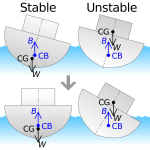
200 kg of chain 4 ft above the center of buoyancy will probably account for 400 kg of ballast. The more weight I can keep down low the more stable the yacht will be.

2000px-Ship_stability.svg.png
 
On the other hand, if the chain locker is above sea level, you don't need pumps, sumps, filters and alarms and so on. I find that gravity has never let me down. (There's a pun in there). I have a good deckwash pump, and normally it removes most of the mud etc. Some mud will inevitably get into the locker, and it's easy, particularly when a lot of chain is out, to use the deckwash to wash out the locker and thus keep it clean, clear, and fresh.

Ok if your anchor locker is large but if not it can be helpful to deepen it, which may allow the whole rode to be recovered without redistributing it. Barry Nielsen of Sailing Holidays modifies many of his boats like this.
 
Why are anchors so emotive? ;)

I've got an AWB, when I'm in coastal cruising mode, my anchor sits on the bow roller with a reasonably big, easily accessible anchor locker which self-drains and can be jet-washed. I tend to avoid heavy weather so I've never encountered a stability problem with chain up front, or the anchor locker flooding.

Others prefer to carry their chain in the bowels of the boat to keep the weight low and the foredeck free of big holes that can fill with water. This needs drains and pumps, which my AWB doesn't need.

If I ever decided to cross an ocean, you can be damn sure that after 1 day out, my entire ground tackle would migrate to the bowels of the boat and be made fast - you can't anchor in the middle of the Atlantic. The drains would be cleared out and I'd secure the locker lid. Having the weight out of the bow and down low makes sense, so instead of pumps and drains, I have to physically move my ground tackle.

Both systems work - which is better is a matter of personal opinion and choice.
 
On the other hand, if the chain locker is above sea level, you don't need pumps, sumps, filters and alarms and so on. I find that gravity has never let me down. (There's a pun in there). I have a good deckwash pump, and normally it removes most of the mud etc. Some mud will inevitably get into the locker, and it's easy, particularly when a lot of chain is out, to use the deckwash to wash out the locker and thus keep it clean, clear, and fresh.

The sump is there anyway its where the bilges naturaly drain into. The alarm isnt fitted because the chain locker drains in to it. The alarm is fitted because I want to know if we have a constant running bige pump ASAP. It works so well that I adedd the same system to the lazzarette locker so that drains in to the main bilge sump as well.
 
The sump is there anyway its where the bilges naturaly drain into. The alarm isnt fitted because the chain locker drains in to it. The alarm is fitted because I want to know if we have a constant running bige pump ASAP. It works so well that I adedd the same system to the lazzarette locker so that drains in to the main bilge sump as well.

What's a sump? I thought it was a car part? ... I've got bilges but nothing drains into them, I usually vacuum out the crumbs and fluff once a year .... the electric bilge pump collects quite a bit of fluff round the bottom. ;)

Confused AWB owner ....
 
What's a sump? I thought it was a car part? ... I've got bilges but nothing drains into them, I usually vacuum out the crumbs and fluff once a year .... the electric bilge pump collects quite a bit of fluff round the bottom. ;)

Confused AWB owner ....

I wish my Awb was the same - at least a few litres a day get pumped out
 
What's a sump? I thought it was a car part? ... I've got bilges but nothing drains into them, I usually vacuum out the crumbs and fluff once a year .... the electric bilge pump collects quite a bit of fluff round the bottom. ;)

Confused AWB owner ....
Haha, its a three foot deep section between the inbuilt diesel tank and inbuilt water tank under the floor boards. You know, on your boat its the bit that you lift that has the hull just three inches below, next to yer keel bolts:)
 
Why are anchors so emotive? ;)

I've got an AWB, when I'm in co...........................

Others prefer to carry their chain in the bowels of the boat to keep the weight low and the foredeck free of big holes that can fill with water. This needs drains and pumps, which my AWB doesn't need.

If I ever decided to cross an ocean, you can be damn sure that after 1 day out, my entire ground tackle would migrate to the bowels of the boat and be made fast - you can't anchor in the middle of the Atlantic. The drains would be cleared out and I'd secure the locker lid. Having the weight out of the bow and down low makes sense, so instead of pumps and drains, I have to physically move my ground tackle.

I agree with everything you say.

I saw a photo of a yacht recently and on deck was an outboard (attached to the pushpit), gas bottles x2, 2X jerry cans of fuel, inflatable dinghy, solar panels, life-raft and a hard dodger. I wonder how stable that yacht was?
 
I agree with everything you say.

I saw a photo of a yacht recently and on deck was an outboard (attached to the pushpit), gas bottles x2, 2X jerry cans of fuel, inflatable dinghy, solar panels, life-raft and a hard dodger. I wonder how stable that yacht was?

It depends on the size of the boat for starters. Clearly on a small boat all that gear would be a higher percentage of the ballast ratio than on a larger boat. But on a boat with a high ballast ratio that gear wont be significant. It is not uncommon here the Caribbean to see solar panels mounted very high on monkey bars with a heavy rib slung beneath. A heavy fourstroke engine on the rail, a wind turbine on a pole, a row of diesel and water cans filling the side decks amd a liferaft somewhere on deck. If you start off with a lightweight AWB and you add that kind of gear you will effect the stabilty. Add in the fact that on a AWB there is usually no bilge under the floorboard then fuel and water tanks tend to be in the spaces under bunks adding to the high c of g. Lots of boats these days have cast iron keels instead of lead that further reduces the potential righting moment.
We carry a 10hp and 15 hp two stroke outboard, a gas bottle, a liferaft, solar panels, and our dinghy on deck. We dont have davits or monkey bars to support solar but we do have a 41% ballast ratio, 800litre water tank, 450litre fuel tank and 125litre holding tank under the floor as well as lots of other heavy items such as cans of food. We dont have a concern about stabilty :)
 
Top