
Anchor chain length for med

That's really interesting, thank you.

Will do a bit more reading up on it. My wife, a maths teacher, will enjoy the equation!

here's another one,

https://www.desmos.com/calculator/ensnjys9f9

x axis is water depth, y axis scope (chain length / water depth )

And the equation, would be interested if there's better :) >
9xdmZqd.png
 
I did not bother with the maths and was only interested in our, then, rode.

I took 30m of 8mm chain and deployed it in air (down the garden) at a 5:1 scope. The tension to lift the last link of the ground was just shy of 80kg (converted for water). I had previously measured tension in the same rode, in water, during different wind speeds. I had also measured the windage of our cat its roughly the same as a 45' Bav (though different weight, that I ignored).

80kg of tension is roughly equivalent to the tension developed on that Bav 45 at 20 knots.

So at 20 knots, actually slightly less, (and measured at the masthead) in my simulation and measurements, all the chain is off the seabed, 30m of 8mm at 20 knots. By the time you get to 30 knots the chain looks as straight as a billiard queue (it is not straight - but as good as).

Most people carry more than 30m of chain and are usually (but not always) able to deploy more.

I did not then repeat the experiment at 50m - the garden is not long enough nor do I have the height to maintain the same scope!

Actually - just when you need the chain the chain is working at its limit - which is where decent snubbers come in (or heavier chain and more of it).

Jonathan

https://www.sailmagazine.com/cruising/anchor-snubber-tips

https://www.sailmagazine.com/diy/how-to-dealing-with-snatch-loads-in-an-anchorage
 
Last edited:
I did not bother with the maths and was only interested in our, then, rode.

I took 30m of 8mm chain and deployed it in air (down the garden) at a 5:1 scope. The tension to lift the last link of the ground was just shy of 80kg (converted for water). I had previously measured tension in the same rode, in water, during different wind speeds. I had also measured the windage of our cat its roughly the same as a 45' Bav (though different weight, that I ignored).

80kg of tension is roughly equivalent to the tension developed on that Bav 45 at 20 knots.

So at 20 knots, actually slightly less, (and measured at the masthead) in my simulation and measurements, all the chain is off the seabed, 30m of 8mm at 20 knots. By the time you get to 30 knots the chain looks as straight as a billiard queue (it is not straight - but as good as).

Most people carry more than 30m of chain and are usually (but not always) able to deploy more.

I did not then repeat the experiment at 50m - the garden is not long enough nor do I have the height to maintain the same scope!

Actually - just when you need the chain the chain is working at its limit - which is where decent snubbers come in (or heavier chain and more of it).

Jonathan

https://www.sailmagazine.com/cruising/anchor-snubber-tips

https://www.sailmagazine.com/diy/how-to-dealing-with-snatch-loads-in-an-anchorage

The observations tally well with mine at anchor. The first time I realised this was at Cala Volpe in Sardinia quite a few years ago. This remarkable bay is all sand and shallows so gradually as to be almost imperceptible. We anchored quite safely in 2 metres, drawing 1.4 metres. It was very windy throughout our stay there and ultimately I had 35 metres of 8 mm chain out, a scope of well over 10:1. Swimming in the crystal clear water I could see all of the chain off the bottom at the extremities of every yaw, and quite often between. Wind speed was anywhere between 20 and 30 knots.
 
I haven't read through all the comments because my concern is possibly a little off topic. I have 80m of 10mm chain (yacht still under construction) but I've wondered if it would be a good idea to add an extra (say) 20M of rope tied (belayed to a cleat). My worry is that I might let out all the chain through the winch and see it disappearing into the depths. If I couldn't retrieve the anchor and I had to relocate urgently I could at least tie a marker to the rope and toss it overboard so I could come back later and try to retrieve the anchor. (Some anchorages in Australia are not well surveyed)

NOTE I have just discovered the thread Adding anchor warp to existing chain. That may well answer my query.
 
Last edited:
I haven't read through all the comments because my concern is possibly a little off topic. I have 80m of 10mm chain (yacht still under construction) but I've wondered if it would be a good idea to add an extra (say) 20M of rope tied (belayed to a cleat). My worry is that I might let out all the chain through the winch and see it disappearing into the depths. If I couldn't retrieve the anchor and I had to relocate urgently I could at least tie a marker to the rope and toss it overboard so I could come back later and try to retrieve the anchor. (Some anchorages in Australia are not well surveyed)

Splice a couple of metres of rope to the last few links of chain and make the other end fast to a strong point in the anchor chain locker. If you need to let go of your anchor and chain for some reason, you can cut the rope, but it stops the end of the chain disappearing over the side when you let it all out.

Make the rope long enough that it can reach the windlass gypsy, then you really know when you're out of chain and can stop the windlass before it rips the rope out for you ;) ... put too much rope on the end of your chain and you will need to find somewhere dry in the anchor locker for it to sit, otherwise it's under all your chain, giving it a permanent, warm salt bath.
 
Thanks for that Baggywrinkle.

That sounds like excellent advice and I will certainly follow it.

Cheers

Clive
 
Coopec,

Do something like the advise from Baggywrinkle - to suit your specific anchor/chain locker.

But take the cordage part, that is attached to the strong point and stow it in the top of the locker (secure with lightweight cable ties). This way you keep the rope out of the locker floor (where it will accelerate corrosion of your chain) but be ready to use - the cable ties will simply snap.

Mark, any way you like, near the end of the chain so you know when the 'end is nigh' - and you can stop deploying chain and never need to deploy those last few metres of rope.

If you are having a yacht built - make sure the locker can fully drain - you want your locker to be self draining - a wet locker means reduced chain life.

If you have not actually bought the chain, nor installed the windlass, I would very seriously look at a high tensile 8mm chain. It will save a lot of weight, save space, the windlass will use less power and be a little bit cheaper to buy. You don't need the weight, of the chain (though many would argue 'I am wrong') but you do need a good snubber arrangement. An acquaintance in Oz having a 50' FreeFlow built in Thailand has swapped his 10mm chain for 8mm. We swapped our 8mm for 6mm. If you want more - PM me with an email address (and I'll send you an article from CH).

Jonathan
 
Last edited:
Jonathan

Thanks for that. I was planning something similar to what you are suggesting.

My anchor locker is self draining but only built of 3/4 in fiber -glassed ply. So I am going to attach a threaded rod to a "rib" (under the floorboard) and take it to the top of the anchor locker where I will attach the rope. In an emergency I will be able to remove the inspection hatch and cut the rope.
Thanks for your advice.
 
Coopec,

All anchor locker are meant to be self draining but I have seen too many newly commissioned production yachts at boat shows with water in the locker base to know 'self draining' can be an illusion. Once the locker is really full of chain, a bit of rope, the snubber etc - the eventual owner of that boat show display model (and presumably other new yachts), might never notice. The rope itself can block the drain hole though eventually mud and weed will be the major culprit.

Larger drain holes, the plural is intentional :) , with clam shell outer covers is one thing to consider.

I'd add, if you can, 'fibre glass grating' (sold here, Oz, by Locker, or Lockers - and used on pontoons, docks and parks - or something similar (chopped up milk crate) as a base on which the chain can sit - and drain. You really need an offcut (maybe try your local council or National Parks). Common, brown, rust is not the only issue 'white rust' (something else to google) is also common (simply caused by damp) - which again I have seen on yachts at boat shows - and means you are losing gal.

If you think this reflects poorly on people displaying yachts at boat shows - I would agree (and wonder what else they get wrong).

Good luck with the new yacht!

Jonathan
 
Thanks again Johnathan: good advice I'm sure.

Temp Mauritius.JPG

The drain hole at the bottom of the locker would be 2 in. but I will consider a grating. When I installed the 170 cfm fan in the toilet/shower I exhausted it into the chain locker thinking that might dry things out. Maybe?
 
2" sounds good.

A 'real' yacht - I can understand the lack of interest in downsizing chain - you would not notice the difference in weight!

Anything you can do to increase the flow of air, over or through, the chain would be good (hence the grating). I'd normally suggest opening the locker hatch when at anchor - as the bow should be pointing into the wind. The other thing you could consider - we duct the 'air' from our chain locker through to the fridge compressor aided by a computer fan wired into the compressor circuit. This will suck air through the hawse pipe and might be the coolest air you have (though less effective if you are in the tropics). It will increase airflow through the chain locker.

Jonathan
 
Thanks again Johnathan: good advice I'm sure.

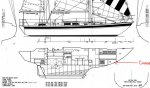
View attachment 78047

The drain hole at the bottom of the locker would be 2 in. but I will consider a grating. When I installed the 170 cfm fan in the toilet/shower I exhausted it into the chain locker thinking that might dry things out. Maybe?

I hope I am wrong, but from your drawing it looks as if most of the chain locker may be below the WL. :confused:
 
Jonathan

Thanks for that. I was planning something similar to what you are suggesting.

My anchor locker is self draining but only built of 3/4 in fiber -glassed ply. So I am going to attach a threaded rod to a "rib" (under the floorboard) and take it to the top of the anchor locker where I will attach the rope. In an emergency I will be able to remove the inspection hatch and cut the rope.
Thanks for your advice.

Hi, don't mean to upset you but the chain locker looks like it is below the water line as mentioned also by NormanS. Where does it drain? The bilges?

When pulling up the anchor, it will bring seawater on board along with other filth, sand, mud, weed, etc. ... a deck-wash to wash the chain as it comes aboard will help with this - fresh-water if you have a watermaker with the available capacity to use your freshwater tank to feed a chain wash, or clean seawater will at least get rid of the grit and sand.

The seawater will need to be pumped out of the boat if it is below the waterline, but wherever it ends up, it will likely leave copious quantities of crystalised salt behind, which is a magnet for moisture and a corrosion risk.

Perhaps talk with the designer/builder to ensure you have a well thought out way of removing the salt water - or maybe even move the chain locker further forward if possible and well above the water line, with decent drainage outside the boat - looks like your boat will be easily heavy enough to take it. Chain lockers are damp, salty, filthy places which is why most AWBs have them right up front with good drain holes and easy access through a deck hatch so you can jet-wash the contents when in harbour.

I grew up on a boat with a chain locker buried in front of the berths in the forward cabin, chain came down through a hawse-pipe ... it was a filthy, smelly hole and going in there to knock the backed up chain over regularly was not a nice job. The boat was fiberglass so there were no rust issues in the boat other than the chain and it all drained down into the bilge, which was always damp and salty. This was acceptable in the late 60s when the boat was built, but is not often the case now.

There may be ways to mitigate all this which I don't know, so don't get disheartened, I don't mean to criticise, but I would imagine avoiding shipping salty water into the bowels of a steel boat should be a priority that out-weighs the weight of the chain up front. Just my opinion.

Fixing this in the build phase will be much cheaper in the long run than fixing the possible rust in the superstructure from saltwater escaping from your chain locker into the boat.

Drawings look awesome by the way, nice boat! :encouragement:

PS: It also depends heavily on your intended use, if crossing oceans then maybe a large non-watertight locker up front is a no-go ... horses for courses and every design is a compromise.
 
Last edited:
I hope I am wrong, but from your drawing it looks as if most of the chain locker may be below the WL. :confused:

maybe the red arrow points wrongly?
How could the chain end up in this small area? No easy vertical gravity fed access to that spot!
I'd have thought that chain would go in the area to the right in section...
 
I hope I am wrong, but from your drawing it looks as if most of the chain locker may be below the WL. :confused:

Thanks Norman and Baggywrinkle.

Rightly or wrongly I am draining the chain locker into the gray water holding tank. I plan to install a 21 gal (US) per hour water-maker and wash the anchor chain as it leaves the water. (I have a 24V 160 psi pump for that purpose)

I have read a lot of crap comes up with the chain and a lot of it stinks so I want to keep the chain locker sealed and keep the chain as clean as I can.

Thanks for your advice..
 
Thanks Norman and Baggywrinkle.

Rightly or wrongly I am draining the chain locker into the gray water holding tank. I plan to install a 21 gal (US) per hour water-maker and wash the anchor chain as it leaves the water. (I have a 24V 160 psi pump for that purpose)

I have read a lot of crap comes up with the chain and a lot of it stinks so I want to keep the chain locker sealed and keep the chain as clean as I can.

Thanks for your advice..

Draining into the grey water tank seems like a sensible idea :encouragement: makes the chain locker no different to a shower tray - combined with a fresh-water deck-wash it sounds like a good solution - as the germans say, "again what learned" ... "Wieder was gelernt"
 
Last edited:
Sounds good to me too. I find that when cleaning mud off chain it takes time, or pressure (and more pressure than we have). So we tend to retrieve about 4m, as we can see 4 m at a time (we have a decent run across, or along, the deck). and clean that and then retrieve another 4m. It is obviously slow. It would be valuable for us to have a high pressure wash actually aimed at the bow roller, with a supplementary hand wash (which would be focussed at the chain on the deck). Strangely our chain locker simply does not smell - maybe we have achieved the right answer.

Fortunately not all anchorages are mud and sand is a breeze. Most weed simply falls off, or can be plucked off by hand.

If you are in a hurry this all goes by the board.

Washing every time with fresh water is the ideal - I think most of us will be envious. The chain will, obviously, still be wet when it is in the chain locker - trying to get a through draft to dry it and ensuring the chain does not sit on a wet locker base (damp rope) will help with that longevity.

Given that you appreciate the issues of smell and have accepted that chain longevity depends on cleanliness - you have the correct motivators, seem to have thought it through and have the answers.

Good luck

Jonathan
 
In the Med, sometimes it's not that simple. Anchorages can get quite crowded so you sometimes have no choice but to anchor a bit further out ... that's when a bit of extra chain comes in really handy - an extra 15-20 metres can make the difference between a pleasant evening with a G&T and an hour-long trudge to the next available anchorage.
So not different to any other coast on the planet.

The original post is really the classic, "how long is a piece of string".

Personally I carry 60 meters of 8 mm chain, giving us a max depth of 10 meters in a blow or 15 meters usually, but rarely anchor anything more that 5 meters.
 
Top