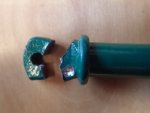
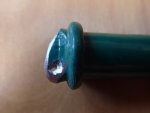
Anchor attachment

Connection choicew

  • 1 Anchor -> Swivel

    Votes: 3 25.0%
  • 2 Anchor-> 3/8" shackle- > 3 links of 10mm chain -> swivel

    Votes: 3 25.0%
  • 3 Anchor ->1/2" shackle -> 3 links of 12mm chain -> swivel

    Votes: 5 41.7%
  • 4 Anchor -> 1/2" shackle -> swivel

    Votes: 1 8.3%

  • Total voters
    12
We have used a swivel for very many years. Our Rocna inevitably comes up reversed and the crew is unable to rotate it without a swivel.

Our original swivel broke due to stress-corrosion. I replaced it with a Kong and developed the three chain links method, in about 2007. A Kong is a quality item, considerably stronger than the chain.

Destructive testing results on many rode items including swivels are on my website Cox Engineering.
 
We have used a swivel for very many years. Our Rocna inevitably comes up reversed and the crew is unable to rotate it without a swivel.

Our original swivel broke due to stress-corrosion. I replaced it with a Kong and developed the three chain links method, in about 2007. A Kong is a quality item, considerably stronger than the chain.

Destructive testing results on many rode items including swivels are on my website Cox Engineering.

I used to expend a lot of effort rotating the Rocna before it went onto the roller, until I realised that if I just raised it and stopped when the anchor was half-on-half-off, it would right itself.
 
I used to expend a lot of effort rotating the Rocna before it went onto the roller, until I realised that if I just raised it and stopped when the anchor was half-on-half-off, it would right itself.
Not with a grooved roller, which we have to hold the anchor centrally. Otherwise it slides from side to side on tacks. Also seems to prevent a Boomerang from rotating it although NormanS' round bar version will probably work.
 
Now, if you have an intelligent anchor, which knows which way is up, it would rotate itself with the help of a swivel. I don't think that even the very latest whizz bang magic anchors, are that clever. 😀
 
Nice to read that I'm not in a minority that find a swivel unnecessary.
If the anchor is facing the wrong way, whilst it is still hanging vertical on the chain over the bow, I use a pole (broom handle / boat hook) to turn and guide it over the roller. A swivel doesn't turn the anchor so I've come to the conclusion that a banana would be a useful addition.
 
Our original swivel broke due to stress-corrosion. I replaced it with a Kong and developed the three chain links method, in about 2007. A Kong is a quality item, considerably stronger than the chain.

Vyv was the first to come up with this idea and it is by far the best method of attachment if you want to use a standard swivel. If I remember correctly, at the time he argued with the swivel maker Kong who said it was unnecessary, however, they have since seen the light of sound engineering practice and incorporate Vyv’s idea into their instructions.

Providing you use this method with a quality swivel (such as Kong) there is nothing wrong with using a swivel.

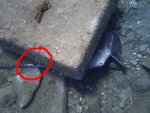
There are a small number of swivels that have more articulation where the extra links of chain are not needed, but with most standard swivels side loading will cause damage, as the photo below shows (notice how the forks of the swivel are splayed out), although that is least of his worries :).

I am not a great fan of anchor straighteners. They do not solve the problem of chain twist (although some incorporate a swivel feature). There is lot of bulk and connections that can become hung up on the anchor and cause an unfair lead and this added bulk inhibits the anchor performance.

The anchor coming up backwards can be a nuisance, but for most concave anchors reversing the boat will swing the anchor around to the correct orientation without a swivel.
EBC3001A-5213-4822-8A80-11B68C35FF2D.jpeg
 
Not with a grooved roller, which we have to hold the anchor centrally. Otherwise it slides from side to side on tacks. Also seems to prevent a Boomerang from rotating it although NormanS' round bar version will probably work.
We have a grooved roller and a Rocna with no swivel. With the grooved roller the anchor comes up the right way 90% of the time - particularly if encouraged with a gentle reverse.
If been particularly boisterous and not aligned correctly, a quick pull on the roll bar with the boathook generally will hold it aligned correctly to restow. Windlass remote helps.
 
Vyv was the first to come up with this idea and it is by far the best method of attachment if you want to use a standard swivel. If I remember correctly, at the time he argued with the swivel maker Kong who said it was unnecessary, however, they have since seen the light of sound engineering practice and incorporate Vyv’s idea into their instructions.

Providing you use this method with a quality swivel (such as Kong) there is nothing wrong with using a swivel.

There are a small number of swivels that have more articulation where the extra links of chain are not needed, but with most standard swivels side loading will cause damage, as the photo below shows (notice how the forks of the swivel are splayed out), although that is least of his worries :).

I am not a great fan of anchor straighteners. They do not solve the problem of chain twist (although some incorporate a swivel feature). There is lot of bulk and connections that can become hung up on the anchor and cause an unfair lead and this added bulk inhibits the anchor performance.

The anchor coming up backwards can be a nuisance, but for most concave anchors reversing the boat will swing the anchor around to the correct orientation without a swivel.
View attachment 152814
It was Jimmy Green chandlery who stated that the three links were unnecessary. They now sell them specifically for the job.
 
So, despite my attempt at trying to limit things to four options, as ever, particularly when it comes to anything involving anchors, it is never that cut and dried. I should have included these two as well..

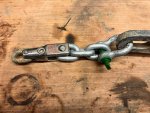
5: Anchor -> 3/8 shackle -> 8mm chain
IMG_8313.jpg


6: Anchor -> 3/4 shackle -> 10mm chain -> Kong Joiner -> 8mm chain (But I don't think this particular sized Kong Joiner is rated high enough as it was from our previous smaller boat so would opt for the next size up)

IMG_8315.jpg
 
Both 5 and 6 are OK (with good swivels and shackles), but I would use 8mm chain between the swivel and the anchor. 10mm chain is adding bulk and even with the smaller shackle needed with the 8mm chain the weak link is still the overall chain strength.
 
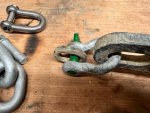
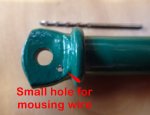
Incidentally one modification I like to make is to cut the head off the shackle pin. This reduces the risk the that shackle will jam on the bowsprit or forestay when the anchor is retrieved. The anchor windlass has a considerable amount of power and this can cause damage if something jams. If you remove the head completely the shackle cannot be moused and also cannot be undone. So I leave a small amount of the head in place and drill a small hole. This enables the shackle to be moused and also removed, although you need some good vice grips to accomplish the latter.

I dont think this weakens the shackle, but I have never formally tested this (other than the practical test of strong wind at anchor), so it is perhaps best done when the shackle has some reserve strength even in side loading.
7370CE15-D5E9-4C7E-9917-CA1B601CE255.jpeg
9132067B-11A0-4626-A6AE-1B0758A4E716.jpeg
90D07273-6FBE-451D-A176-E0D9E5725426.jpeg
 
Last edited:
It's very easy to open up the end link of the chain, using a tapered drift and a hammer. This allows the use of a bigger, stronger shackle. OK with mild steel chain, - don't know about doing that with some of the higher grades of chain.
 
It's very easy to open up the end link of the chain, using a tapered drift and a hammer. This allows the use of a bigger, stronger shackle. OK with mild steel chain, - don't know about doing that with some of the higher grades of chain.
Don't worry about doing this, as you only have to open up 8mm chain very slightly to get a half inch shackle through it. It might even go in anyway as some chain size diagrams show a 13mm dimension. If opening the end link damages the galvanising, again don't worry as its only the final link and you can always cut it off if it gets too rusty. You might also open the end link enough just by squeezing it endwise in a big vice.
 
Top