An armchair naval architecture poll

The longitudinal position of boat CoG is around...


  • Total voters
    37
P, what problem are you trying to fix?
Do you mean with the installation of a gyro or with its placement?
Ref the latter, my doubt is that the best placement from a logistic viewpoint would be astern, and I was wondering how far it would be from the boat CoG.
But if you meant the first, I'm actually far from being sure to have any problem, to start with.
As I said, IF I'll eventually fit a gyro, it wouldn't be before completing the next season.
Otoh, winter is long and cold, why not use it for thinking about our toys a bit...? :D
 
If you want to establish the Longitudinal COG look for a hoist that can give you a readout, ours a MarineTravelift machine year 2005 gives you a hydraulic pressure and with some interpretation a weight on forward or aft slingsets. with some interpretation again you can work out a reasonably accurate overall weight and LCG far better than asking a guesswork question on this forum looking at a fairly nondescript GA drawing with poor detailing.
If you are going to spend northwards of 50k on a set of fins work it out properly don't guess it.
 
I'm not sure to like fins on a 30+ kts boat, tbh.
Also because, in principle, I'd rather steer clear of the sea conditions where fins do work much better...
In fact, I'm not even sure to fit any stab system at all!

@ Bandit: good point, but the boat will not be on a hoist for some months, and the PC keyboard is within easy reach! :rolleyes:
 
I'm not sure to like fins on a 30+ kts boat, tbh.
...

I'll asc you again after summer, when you've finsihed that long trip down from Venice to Sardegna,
and knowing that you have XX (how many?) years experience with a fin stabbed boat ;) :encouragement:
 
Glad to stand corrected if appropriate, but I suspect to be the asylum member with the longest stabilized boat ownership, XX being equal to 17 years, no less.

That said, a P boat and a real trawler are different in so many ways that If there's one thing I'm positive about, it's that those 17 years will never come back, regardless of any equipment I could add to the DP - last but not least because we won't get any younger, in the meantime.
In fact, I would even dare saying that slow & stabilized boating is fine when you're young, because the thought that life's too short for going places by boat never crosses your mind.
Now that it does, a pipe and slipper boat is more appropriate: a faster one, that is! :cool:
Mind, I don't disagree that the journey can be more important than the destination.
BUT, been there, done that, got the video and the T shirt...

All that said, I honestly don't know what I will reply to your question next summer.
That's why I'm keeping an eye on all options, as this thread proves! :encouragement:
 
In fact, I would even dare saying that slow & stabilized boating is fine when you're young, because the thought that life's too short for going places by boat never crosses your mind.
Now that it does, a pipe and slipper boat is more appropriate: a faster one, that is! :cool:

oh? and I alway's thought it is the other way round :D
 
LOL, I can see why! :D
Then again, let's scratch the surface.

What's more pipe and slipper than Portofino's Itama?
You just wait for a glorious sunshine day, then hammer the throttles to reach Villefranche, drop the hook, and reach La Mere Germaine in time for a sumptuous lunch.
Back onboard for a nap, wake up whenever you fancy, have a swim, and then rush back to the marina, before driving back home in your Bentley, to enjoy a Jacuzzi while sipping an apéro.
And if by chance some wind picked up in the meantime, you just push the boat a bit faster, for some soft wave jumping, courtesy of deep V hull.

At the other end of the scale, what do we have? TwoHooter with his go-anywhere tank, who just keeps going no matter what the sea throws at him - also because he doesn't stand a chance to escape in time to avoid bad weather!
And this can possibly happen for several days in a row, non-stop, and in places with not even a McDonald in sight, let alone La Mere Germaine...

Now, which is the pipe and slipper and which is the adventurous boat? :cool:
 
Where would you expect the CoG of the following boat to be placed, longitudinally?

If this was a Ferretti, that would be very easy to answer. Directly under the fuel tank;);)

Btw maybe I've missed the answer to this but what are the red/blue boxes? I take it the 2 red boxes either side of the engines are fuel tanks and the blue box forward is the freshwater/holding tanks but whats the red box in the middle?
 
If this was a Ferretti, that would be very easy to answer. Directly under the fuel tank
I'm afraid that's only partially correct, M.
In fact, at Ferretti they weren't always as religious as they claim to be, with regard to the tank(s) placement.
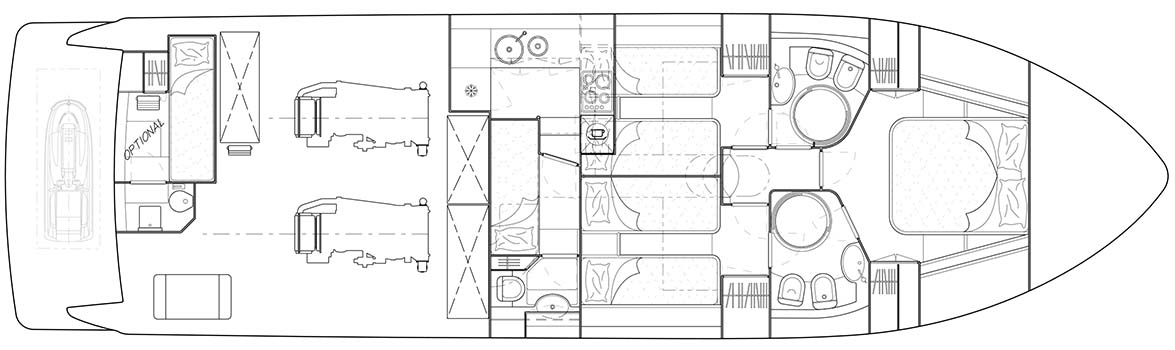
For instance, you might remember that your old 53 had two tanks transversally located at the forward end of the e/r, which indeed is rather likely the longitudinal CoG, but one was along the centerline, and the second on stbd side (the opposite space on port side being used for the galley). A third tank was astern on port side, go figure.
And the funny thing is that in spite of this weird solution, the 53 hull is widely regarded as one of the best in its size range.
I have it on good authority that on some larger boats (like the 68 IIRC, but I'm not positive about this), due to the transversally asymmetrical tank placement, it's necessary to correct the listing with the flaps depending on how full the tanks are...! :o

Back to the point, yep, the red boxes are all fuel tanks - the one along the centerline being down inside in the hull V, to keep the weight as low as possible.
There's a somewhat sophisticated reasoning behind that solution, i.e. that when the boat is fully loaded it's better to carry the additional weight astern.
The side tanks (which are higher) are the first to get emptied, leaving the last third or so of fuel in the center tank.
So, while the boat becomes lighter, the weight stays low, and the weight variations are concentrated more forward.
The blue box is indeed for fresh water, and in theory it could be used to further optimize the boat trim during a long cruise, leaving it more or less full.
But that's hair splitting, sort of. It's nice to have also that weight as low as possible anyway, not to mention that all the hull sections with structural tanks are also a flotation reserve: after hitting some floating stuff badly enough to crack the hull along the centerline, unless the damage is very extended transversally, there would be no water ingress onboard.
 
For instance, you might remember that your old 53 had two tanks transversally located at the forward end of the e/r, which indeed is rather likely the longitudinal CoG, but one was along the centerline, and the second on stbd side (the opposite space on port side being used for the galley). A third tank was astern on port side, go figure.
Not sure thats correct. The forward tanks on the F53 stretched across the whole beam of the boat as far as I remember. I've just rechecked my photos of my own F53 to confirm that although what the photos cannot show is whether the volume of the port side tank was reduced by the galley fridge forward. I also had the 3rd tank aft on the port side on my boat but I was told that was a small optional extra tank to increase the fuel capacity and in fact I never used that 3rd tank. I certainly dont remember any lateral stability issues that might indicate lopsided tanks on my boat that needed trim tab correction. In fact I have very rarely had to correct lateral trim using the tabs on any of my Ferrettis. The fact remains though that according to what I've been told, Ferretti always place their fuel tanks over the longitudinal CoG to ensure that differing fuel loads do not affect the fore/aft trim


The side tanks (which are higher) are the first to get emptied, leaving the last third or so of fuel in the center tank.
So, while the boat becomes lighter, the weight stays low, and the weight variations are concentrated more forward.

Well that surely is an argument for putting the tank(s) forward of the engines across the beam like Ferretti do in order that the fuel load is always carried lower down in the hull compared to wing tanks. Also wing tanks either side of the engines restrict access to the outboard side of the engines which is another argument for putting them forward. Yes this is splitting hairs but what I can say is, unlike other boats I've owned, differing fuel loads in my Ferrettis havent made a huge difference to trim or speed. Oddly enough on my current F630, whether or not the water tanks are full makes a greater difference to trim and performance than whether the fuel tank is full and I guess that is because the water tanks are well forward of the fuel tanks
 
Not sure thats correct.
You made me wonder if by chance I was mixing up memories with some other boats I've seen, so I just checked some old Ferretti brochures which I collected during my search.
Btw, I can forward them to you if you're interested, but they are up to 2005, and the 630 ain't included yet.
Useful if you would like to check the standard equipment of all other models of those days though, up to the 880... :)

Anyway, it seems that my memory didn't fail me this time - see floorplan below.
And the 3 tanks layout was indeed standard equipment, according to their specs sheet.
It's the furnishment of the large lazarette astern, in order to use it as 2nd crew cabin, that was a 14k Eur option (!)

Interesting to hear that you never used the stern tank though, any reason?
I never heard anyone complaining about the F53 trim, and I can imagine that most folks just use all tanks without even bothering to close the valves to separate them...
The slight listing variation depending on load which I previously mentioned was surely related to another model, in fact. IIRC the 68, but possibly even bigger.
bomyKfUd_o.jpg
 
Interesting to hear that you never used the stern tank though, any reason?
It’s fairly simple. When I took delivery of the boat I found the transfer pipe to the aft tank closed and the tank empty which suggested to me that the previous owner didnt use the aft tank. I asked the dealer why and he told me this. He said that the aft tank was an optional extra and fuel could only flow from the aft tank into the forward tanks when the boat was stationary and level and if the transfer pipe was left open with the boat on the plane it would flow the other way. In other words, in theory, the engines could run out of fuel at speed with spare fuel sitting in the aft tank if the transfer pipe was left open in error. Yes I know you’d have to be very low on fuel overall for that to happen. Anyway for that reason I left the transfer pipe closed all the time and never used the 3rd tank. Yes I know by doing that the fuel capacity of the boat was reduced (by around 500 litres IIRC) but as you know in Croatia there is a fuel station on nearly every corner. In truth had we had any long passages to do I would have filled the 3rd tank and used it as it was intended to be used ie additional fuel storage

And no the boat still ran very flat!
 
Thanks, but I did understand the 2.5 bit.
It's the ATB which I didn't get, though in hindsight I suppose it's just an acronym for all the best...? :o
If so, ATB 2 U 2! :cool:
 
Top