Ambassador rope cutter

emnick

Well-Known Member
Joined
30 Sep 2003
Messages
721
Location
Essex
Visit site
I have had one of these fitted for one season. I removed it to check and found what looks like crevice corrosion under the cutter blade part. I may need a new prop shaft but would like to refit it after. I presume that I am not allowing O2 to the prop shaft Is there a way round this or should I just not fit it back.
Thanks
 
I would be tempted to have a chat with the manufacturer. I can't remember his name, but I have always found him very helpful. Have had Strippers on my last two boats and not seen your problem.

j
 
Hi Sean. I don't think the Stripper would be sufficiently sealed to cause crevice corrosion on your shaft. It has not done so on mine over many years. As a precaution you could polish the new shaft in the area the stripper will cover but if it were me I would suspect fatigue in this area rather than crevice corrosion. I would just re assemble putting stripper in place but it's your choice
Martin
 
The crevice corrosion page of my website shows a number of examples, including one of a rope cutter. The first thing to check is that your shaft is made from 300 series steel, using a magnet. If the magnet is strongly attracted it is not a 300, probably a 400. 304 is sometimes weakly attracted, sometimes not, dependent upon levels of retained ferrite. Then check that the cutter is fitted correctly, unlike the one on my website. Assuming it is, try to relate the position of the corrosion on your shaft to any small clearance on the cutter. If there is a crevice that is probably the cause of the problem it will almost certainly be eliminated by mounting the cutter on sealant, Sikaflex 291 being perfectly OK but probably many others equally good.
 
Thanks for the replies. I will post some pics when I get back to the boat. Is there a way of distinguishing between crevice and electrolysis ?
 
Thanks for the replies. I will post some pics when I get back to the boat. Is there a way of distinguishing between crevice and electrolysis ?

Where is electrolysis coming from? The word gives the clue, an electric current is passed through it. Seems unlikely in your circumstances. Did you mean galvanic? Again, fairly unlikely given that the Ambassador is 316 stainless steel and the shaft is very likely the same, assuming the magnet test says so.
 
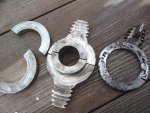
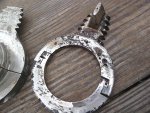
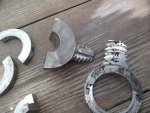
hi not strictly the same problem as I don't have a problem with shaft to rotating blade parts only the fixed blade which is insulated from shaft by bearings , in contact only with striker that is fastened to cutlass housing that is not attached by through bolts ,so not in hull anode circuit. any ideas ! no way can this the first this has happened


IMG_20180617_195437.jpgIMG_20180617_195447.jpgIMG_20180617_195511.jpg
 
Something odd going on there. The pitting on the blades cannot be crevice corrosion as they are in open seawater as far as I remember. Without more knowledge I would guess that the material was wrong, maybe 304 not 316 or even a 400 series. Is it magnetic? Is this the genuine article or a cheap bargain?
 
HI Vyv many thanks for your quick diagnosis
Looks as if you nailed it first shot, just checked with magnet & spot on all *but* the fixed blade parts non magnetic, I wasn't aware that copies existed so I wonder if ambassador perhaps turned out a faulty batch as original thought this can't be the only one with this problem .
regards, chris
 
Everything except the anode on our prop gets greased thick with waterproof grease during assembly (the blue Volvo prop shaft grease is excellent) Not quite as annoying to remove as sealant and seems to stay around just fine in protected areas like that. Also helps disassembly next time!

No corrosion problems with the Ambassador on our Saildrive, although I wish it had a little counter that reads how often it has actually cut something :)
 
HI Vyv many thanks for your quick diagnosis
Looks as if you nailed it first shot, just checked with magnet & spot on all *but* the fixed blade parts non magnetic, I wasn't aware that copies existed so I wonder if ambassador perhaps turned out a faulty batch as original thought this can't be the only one with this problem .
regards, chris

It just might be Duplex but I thought they used 316. Duplex e.g. 2204 would be better as a cutting device but corrosion resistance only about as 304. It also suffers crevice corrosion.
 
Where our spool (quicKutter rope cutter) covers the shaft we have never seen corrosion issues, but this is a composite and not another piece of SS.
 
It just might be Duplex but I thought they used 316. Duplex e.g. 2204 would be better as a cutting device but corrosion resistance only about as 304. It also suffers crevice corrosion.

Hi Vyv I have had contact with Robin at Ambassador Marine & he has explained that it is an elderly example of their manufacture, quote- Your fixed cutter is a precipitation hardened ferritic stainless steel and we still use that for special applications. For general use such as yours application they are all 316.

so your diagnosis is again spot on.

regards, chris
 
Hi Vyv I have had contact with Robin at Ambassador Marine & he has explained that it is an elderly example of their manufacture, quote- Your fixed cutter is a precipitation hardened ferritic stainless steel and we still use that for special applications. For general use such as yours application they are all 316.

so your diagnosis is again spot on.

regards, chris

Thanks. Glad we sorted that one. May I use your photos please?
 
Thanks. Glad we sorted that one. May I use your photos please?

Hi Vyv
No problem at all using pics, all good info backed up with photo examples is what this forum & your own site are built on
One of my main concerns on seeing the corrosion was this having a detrimental effect to the cutlass bearing housing hopefully not

Regards Chris
 
Top