Aluminium dinghy

Arcady

Well-Known Member
Joined
9 Dec 2010
Messages
673
Location
Guernsey
Visit site
Does anybody make a small aluminium rowing tender? 10' would be ideal, 12' absolute tops. There are various aluminium fast planing tenders available, but the only manufacturer I can find that makes a decent, displacement, rowboat-shaped dinghy is Linder, but their smallest version is 4.1m - i.e. over 13', and that's too big. I feel like a lone voice, extolling the virtues of a tender that can rowed for pleasure, or one that slips along effortlessly with even the smallest of outboards. Surely there must be others who feel the same?!
 
Re the Linder boats, here is a link to their 4.1 m. rowing boat.
https://linder.se/en/products/rowing-boats/410-fishing
The hull shell thickness is 'only' 1.7 mm (approx 18 SWG equivalent) - I think that they must have a large die and stamp out the shapes (including the 'clinker' effect which adds a lot of stiffness).

Pretty much any rowing tender designed for construction with plywood could be easily adapted for aluminium instead.
However it will invariably be heavier and more expensive - hence the reason why there are so few around.
The density of plywood is approx 600 - 700 kg / cubic metre, while the density of aluminium is typically around 2,700 kg / cubic metre.
And as for steel, it has a density of approx 7,800 kg / cubic metre - more than 10 times that of plywood.
Even if you use 1.7 mm thick aluminium sheeting in lieu of (say) 4 mm thick marine plywood, this dinghy will still be 50% heavier than the plywood version.
The plywood dinghy would be fairly bullet proof (metaphorically) if you built it from 6 mm / 1/4" thick plywood, and it would still be lighter and cost less than an aluminium tender.
The main cost in aluminium work is the cost of welding the stuff, re the consumables used (including argon gas for shielding the weld which is very expensive stuff).
 
Last edited:

Thanks, newtothis, Mr Google was not so obliging when I searched. That is sort of what I had in mind, but (being really picky) a bit smaller than I would like. I currently have a deflatable, but am missing the 10' Tideway GRP dink we used to carry. That was a very handy size for all sorts of things.

Bajansailor - you have made a convincing argument why such boats don't exist. If plywood could survive rocky shores and general abuse without constant attention, it would be a no-brainer...
 
My plastic thing can survive all manner of abuse. My version is a bit small for you but plastimo and others do bigger ones.

My GRP one is older about 20 years old but however battered unlikely to sink or fall apart. Whats the attraction of a tnny?
 
If you are happy with an ally tender being a bit heavier and a bit more expensive than a plywood dinghy, then you could get some plans for a plywood tender that you like, and find an aluminium workshop nearby and see if they might like to build it for you?

I built (in plywood) a smaller (7'10") version of Danny Greene's Chameleon dinghy - the standard one is 10' long, and I am sure it rows even more beautifully than my smaller version.
Here is an article about her in Good Old Boat -
https://www.goodoldboat.com/promo_pdfs/March12_Promo.pdf

And a nice article about building a Chameleon, albeit in plywood -
Building Robbie

One used to be able to get plans from her designer, but he appears to be rather elusive now :(
Chameleon

Alternatively, the BIC Sport Yaks are made of plastic rather than fibreglass as such and are fairly indestructible - good at bouncing off rocks.
Bic Sport Yak 245 | Rigid Dinghy | Boatworld UK
The 245 is probably a bit small for you at 8' long, but she has good load carrying capacity.

The Fun Yak dinghies are similar -
Fun Yak Boats Archives - Fun Yak
 
Last edited:
Last year I met someone who had built a very interesting aluminium tender. It was round bilged and quite long and narrow, but would separate into two nesting halves. He said he had stopped using his outboard because the wee boat rowed so beautifully using a pair of long sweeps. It was light enough, and robust enough, that it could be easily dragged up a stony shore.
Unfortunately I think it was a one off, and it was certainly not cheap- he said it cost around £3k.
 
We have a Chrysler/ Grumman 13ft ally dink. Very light, skin is under 1mm. Fake clinker (for stiffness) and the single seam /chine each side is rivited. Rows well and takes an o/b up to 5hp. Quite durable, as it was bought by my wife's familly back in the 60s? More recently, I used a similar but much shorter one (8ft) over in the states, where they are common, as they are in OZ.
 
Interesting difference in markets

Lot of aluminium dinghies and manufacturers in Australia, decent second hand market. They range is size from 2 person to well beyond dinghy size (100s of feet).

Too heavy for us, but lots use them.

Not the sort of thing you can easily include in your luggage :(

Jonathan
 
Thanks Bajansailor. Those links are typical of many: either fast planing hulls, or lightweight fishing punts. Neither will row well. I liked the sound of Kelpie's acquaintance - a slim, nesting hull could be good to row. (Granted it may not be the best possible load carrier). I wouldn't even mind paying that sort of premium for a really decent tender. (I once looked at the diminutive Portland Pudgie 8' plastic dink and was shocked to see that come in at close on £2k delivered to the UK).
 
If you want it to be pleasant to row, you want to have the maximum waterline length you can live with, and the minimum waterline beam.
Obviously it will be tippy if too narrow.
I'm not sure Aluminium is the material I'd choose.
Kevlar/Carbon/Epoxy maybe?
 
I don't think anything with epoxy would be my choice for a dinghy that spends a lot of its life sitting in the sun, and anything too high-tech seems to me to be unsuitable for dragging up beaches.

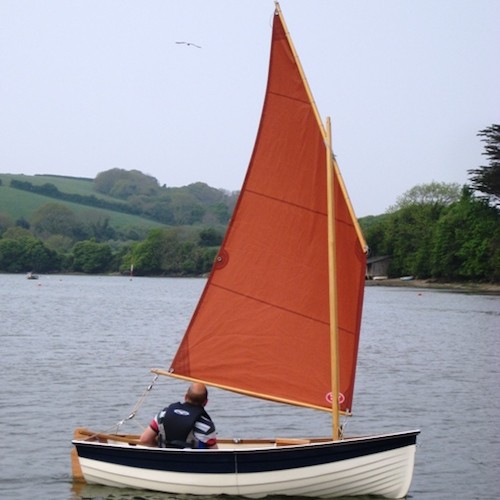
For a tender, I'd place a higher priority on stability than rowing ability but for an easily stored toy, I could definitely fancy this:

Nestaway 9ft Clinker Stem Nesting Dinghy - Nestaway Boats

1.-Nestaway_9ft_Clinker_sailing1.jpg


A bit heavy for a tender at my age and feebleness, unfortunately.
 
I quite like the concept of a sailing tender.
But 'heavy' is going to kill the concept stone dead for me.
If you make something light enough, then dragging it up a beach is not only easier, but less damaging.
If you look at some of the Canadian style canoes, they are tough and light for their size. Some use kevlar and are reportedly tough and long lasting.

But there are good reasons why we use cheap and cheerful GRP tenders.
 
I don't know if towing is relevant to your usage but I remember still that while towing an aluminium dinghy,probably 2.4 ish, we had to cut it loose in the eastern entrance to the Swale ,when it's uncontrollable surfing in a strong wind and large chop meant that we were at any minute expecting it to broach-to and wrench the cleat(s) off our boat.As a teenager I was shocked that we had to do this,especially as we were carrying friends who owned the dinghy.
I am pretty sure that this was to do with the hull shape which included a flat bottom,the easiest thing to fabricate, and limited if no skeg.
Obviously better designs will exist.
 
I don't know if towing is relevant to your usage but I remember still that while towing an aluminium dinghy,probably 2.4 ish, we had to cut it loose in the eastern entrance to the Swale ,when it's uncontrollable surfing in a strong wind and large chop meant that we were at any minute expecting it to broach-to and wrench the cleat(s) off our boat.As a teenager I was shocked that we had to do this,especially as we were carrying friends who owned the dinghy.
I am pretty sure that this was to do with the hull shape which included a flat bottom,the easiest thing to fabricate, and limited if no skeg.
Obviously better designs will exist.
We tow our nesting 12’5” grp dinghy on short hops even in bumpy weather blowing circa 25/30kts. The secret for us is towing warps behind the dinghy! We have a cleat on each corner of the transom on the inside and simply attached a 20ft length of 10mm line fastening each end to the cleats and throw it over the side. It transforms how the dinghy behaves even in big waves. Its quite fun to watch it behind us. We also tow the dinghy on a 40ft polypropylene bridle. Its acts as a good shock absorber and reduces the risk of getting the line around our prop
 
We tow our nesting 12’5” grp dinghy on short hops even in bumpy weather blowing circa 25/30kts. The secret for us is towing warps behind the dinghy! We have a cleat on each corner of the transom on the inside and simply attached a 20ft length of 10mm line fastening each end to the cleats and throw it over the side. It transforms how the dinghy behaves even in big waves. Its quite fun to watch it behind us. We also tow the dinghy on a 40ft polypropylene bridle. Its acts as a good shock absorber and reduces the risk of getting the line around our prop
Yes, the old way was at least a wave behind so it could never surf down onto the yacht. We used to tow a 9 foot wooden dinghy behind an (also wooden) 24 footer when I sailed with my Dad. Not fast but we never lost it even in roughish waves or bars.
 
I don't think anything with epoxy would be my choice for a dinghy that spends a lot of its life sitting in the sun, and anything too high-tech seems to me to be unsuitable for dragging up beaches.

For a tender, I'd place a higher priority on stability than rowing ability but for an easily stored toy, I could definitely fancy this:

Nestaway 9ft Clinker Stem Nesting Dinghy - Nestaway Boats

1.-Nestaway_9ft_Clinker_sailing1.jpg


A bit heavy for a tender at my age and feebleness, unfortunately.
That’s very similar to my last tender (without the sails) but yes, it rowed nicely!
 
Top