Alternator output, is zero sometimes OK?

Sea-Fever

Well-Known Member
Joined
27 Jun 2017
Messages
691
Location
Port Solent
Visit site
Hello chaps, and chapesses....

Survey on my boat pre-purchase indicated the alternator output was low. I didn't think much of it as the belt was so worn and loose I believed that to be the cause....that and the fact that the water pump bearings were shot so what chance did the alternator have of turning properly.

Anyway, new belt and water pump later all is good.....or is it?…......

I now keep the batteries in tip top condition with an always-on conditioning charger. Consequently the engine starts fine.

I've now noticed that the orange lights (there are two) located above the chart table (about 20p in size) which used to glow whenever I turned the battery isolator on no longer illuminate.

As such I got the multimeter out and tested the batteries, first isolated; 12.76v, 13.18v

And then with engine running....same....literally no change.

So alternator or regulator is kaput? Or, if the batteries were (are) fully charged does the regulator effectively reduce voltage to avoid overcharging??? As you can see I'm no vehicle electrician.

Engine is a Mercedes OM636. Alternator is original Bosch I think. Regulator is external type in a little box mounted elsewhere on the engine.
 
I would certainly have expected those voltages to rise when the alternator is spinning unless the engine is only idling when it might not be generating very much.

Did you blip the throttle up to 1500 revs to initiate the charging process and get the output started and then check the voltages at higher revs? Some systems need that initial blip before the alternator kicks in.

Richard
 
Hello chaps, and chapesses....

Survey on my boat pre-purchase indicated the alternator output was low. I didn't think much of it as the belt was so worn and loose I believed that to be the cause....that and the fact that the water pump bearings were shot so what chance did the alternator have of turning properly.

Anyway, new belt and water pump later all is good.....or is it?…......

I now keep the batteries in tip top condition with an always-on conditioning charger. Consequently the engine starts fine.

I've now noticed that the orange lights (there are two) located above the chart table (about 20p in size) which used to glow whenever I turned the battery isolator on no longer illuminate.

As such I got the multimeter out and tested the batteries, first isolated; 12.76v, 13.18v

And then with engine running....same....literally no change.

So alternator or regulator is kaput? Or, if the batteries were (are) fully charged does the regulator effectively reduce voltage to avoid overcharging??? As you can see I'm no vehicle electrician.

Engine is a Mercedes OM636. Alternator is original Bosch I think. Regulator is external type in a little box mounted elsewhere on the engine.

12.76 is good for a charged battery that is "fully" charged and rested for 12 hours or so with no load or further charging.

13.18 presumably must have been on charge more recently that 12 hours ?

When you start the engine you should see the volts rise to the spec output volts for the alternator. Within a few minutes if the battery is already well charged.
No change means it is not charging. Regulator, rectifier, brushes or some other fault. If the light(s) you refer to are the "no cahrge" warning then very likely worn brushes if they don't illuminate at all
 
You should see a rise in voltage. First thing would be to check all of the connections, including the negative cables, back to the batteries. You can check the regulator by removing the plug and connecting the battery and field connections with a short piece of wire, you should get the full alternator voltage, circa 16v. Don't run it for long like this ! If the regulator is shot i have a brand new one on the for sale forum. You could also replace the alternator with one with a built in regulator.
 
Engine is a Mercedes OM636. Alternator is original Bosch I think. Regulator is external type in a little box mounted elsewhere on the engine.

Passing question, is it a steel hull, ? two little lights can be fitted to indicate pos / neg leakage to hull.

Brian
 
It sounds like the alternator warning light is not coming on.
This warning light provides a current which helps the alternator start up.
Without that current, their is no little or field from the rotor, so no power is generated to magnetise the rotor fully.
One reason for it not working is failure of the brushes in the alternator.

You could try temporarily wiring a bulb (not led, an old-skool bulb) of about 1.5 or 2 watts from D+ on the alternator (or the battery) to the WL terminal.
That should light when the engine is stopped and go out as charging starts.

Sometimes the alternator will start up from remaining magnetism if you rev the engine 'some'.
 
I would certainly have expected those voltages to rise when the alternator is spinning unless the engine is only idling when it might not be generating very much.

Did you blip the throttle up to 1500 revs to initiate the charging process and get the output started and then check the voltages at higher revs? Some systems need that initial blip before the alternator kicks in.

Richard

I generally give the engine a bit of wellie just to get it going.... so whatever the rights and wrongs of that (oil pressure etc.....I know I know) I would expect the alternator to have received sufficient charge to get itself going.
 
12.76 is good for a charged battery that is "fully" charged and rested for 12 hours or so with no load or further charging.

13.18 presumably must have been on charge more recently that 12 hours ?

When you start the engine you should see the volts rise to the spec output volts for the alternator. Within a few minutes if the battery is already well charged.
No change means it is not charging. Regulator, rectifier, brushes or some other fault. If the light(s) you refer to are the "no cahrge" warning then very likely worn brushes if they don't illuminate at all

To be honest don't understand what the little orange lights are. There's a separate one on the instrument panel in the cockpit.

...and yes you are right the 13.18 had just come off charge.
 
You should see a rise in voltage. First thing would be to check all of the connections, including the negative cables, back to the batteries. You can check the regulator by removing the plug and connecting the battery and field connections with a short piece of wire, you should get the full alternator voltage, circa 16v. Don't run it for long like this ! If the regulator is shot i have a brand new one on the for sale forum. You could also replace the alternator with one with a built in regulator.

I think the connections are labelled D+ D- and DF. So if I understand you correctly I can remove the regulator connection and, maybe using a short cable with spade connectors on, connect the DF and D+ together ??? And that will give full output to the battery, measurable across the batt terminals which will tell me if the reg is at fault???
 
I think the connections are labelled D+ D- and DF. So if I understand you correctly I can remove the regulator connection and, maybe using a short cable with spade connectors on, connect the DF and D+ together ??? And that will give full output to the battery, measurable across the batt terminals which will tell me if the reg is at fault???

Paul are you local to Portsmouth :-) ??
 
I think the connections are labelled D+ D- and DF. So if I understand you correctly I can remove the regulator connection and, maybe using a short cable with spade connectors on, connect the DF and D+ together ??? And that will give full output to the battery, measurable across the batt terminals which will tell me if the reg is at fault???

DF is the field connection, the battery should be marked B+, but you can check with your multimeter and connect whichever terminal is from the battery positive, to the DF terminal. If the alternator is working you will indeed see the full charge at the battery.

I think there should be a red light at the engine instrumentation panel, next to the starter key and buzzer, this is the charge warning light and it should be on. I don't think a pair of orange lights is standard.

I'm on the East coast.
 
DF is the field connection, the battery should be marked B+, but you can check with your multimeter and connect whichever terminal is from the battery positive, to the DF terminal. If the alternator is working you will indeed see the full charge at the battery.

I think there should be a red light at the engine instrumentation panel, next to the starter key and buzzer, this is the charge warning light and it should be on. I don't think a pair of orange lights is standard.

I'm on the East coast.

I think the connections are labelled D+ D- and DF. So if I understand you correctly I can remove the regulator connection and, maybe using a short cable with spade connectors on, connect the DF and D+ together ??? And that will give full output to the battery, measurable across the batt terminals which will tell me if the reg is at fault???

61 is the output from the field diodes to the regulator D+ , DF is the output from the regulator to the field winding F, E/ D- is negative

Until the alternator is actually generating there will be no output fron the field diodes so linking D+ and DF may not do anything if it is not energised via the warning light. Linking Battery + or B+ to DF/F will put the full battery volts into the field winding and the alternator will deliver its full output if spinning fast enough.

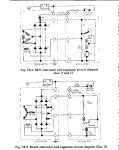
Here is a rather old diagram of an alternator with an electromechanical regulator. The new ones are of course electronic but the connections are all the same

scan0053.JPG
 
I'd expect the two lights to be alternator and oil pressure.
When the 'ignition' is on, there should be +12V on the common side of both.
Check the switch and fuse if there is not?

Some alternators you ground 'F' to energise the field, the other side of the rotor is connected to internal diodes.
Others, one side of the rotor is grounded (via a bruush) the other is F, which is taken +ve to energise.
Hence checking at the WL terminal of the regulator is a good start.
 
I think any boat with an inboard engine should have an amp meter on the alternator. Presumably OP does not have one. However quite simple to fit an analogue type with a shunt on the alternator out line. A bit more complicated for a digital one due to need to fit shunt in negative line. An amp meter can tell you what the alternator is doing and gives an indication of battery charge state especially useful when recharging batteries from the engine alternator. Tells you when you are getting little charge from engine running. If you have an amp meter you can then apply a load to the system, ie all lights on pumps etc and see the alternator output increase.
As suggested it could be worthwhile removing the brushes from the alternator (at the end away from pulley) to check for condition and tension and also check the slip rings (the copper rings that rotate that the brushes contact) for cleanliness. Or emove the alternator for checks by an auto electrician. good luck olewill
 
I think any boat with an inboard engine should have an amp meter on the alternator. Presumably OP does not have one. However quite simple to fit an analogue type with a shunt on the alternator out line. A bit more complicated for a digital one due to need to fit shunt in negative line. An amp meter can tell you what the alternator is doing and gives an indication of battery charge state especially useful when recharging batteries from the engine alternator. Tells you when you are getting little charge from engine running. If you have an amp meter you can then apply a load to the system, ie all lights on pumps etc and see the alternator output increase.
As suggested it could be worthwhile removing the brushes from the alternator (at the end away from pulley) to check for condition and tension and also check the slip rings (the copper rings that rotate that the brushes contact) for cleanliness. Or emove the alternator for checks by an auto electrician. good luck olewill

I'm going to nip down to the boat today and check it out further, thanks for the advice.
 
Top