Alternator doesn’t start charging...

wipe_out

Well-Known Member
Joined
23 Feb 2013
Messages
1,399
Location
Bournemouth
Visit site
....until I briefly bridge the terminals on the lamp and then it starts charging. Before that the lamp stays on permanently.
I have checked the wiring but can’t see anything that would cause this.
any ideas?
 
Last edited:
What happens when you speed up the engine ? My alternator doesn't charge till I give it a bit of throttle to cause excite lead to go to zero.

If your light goes out when you short it ... is it an LED or normal filament lamp ? Strange.

Usually the lamp is lit by the exciter feed .. when alternator is turning slow and not producing enough voltage - the lamp stays lit and no charging occurs. Speed up the engine so alternator is spinning faster - the exciter feed now gets the alternator to create its own field and reverses the 12v in the exciter lead - making it zero ... lamp goes out. But now alternator is charging batterys.

I would check the exciter lead and whether something has changed in its connections ..
 
Tried revving all the way up to 3000rpm but still no luck. I let the battery run down to 12.3v but still nothing.
Lamp is not LED. Standard looking plastic unit with embedded lamp.
 
The circuitry would be such that the lamp provides a current to the field coil (the rotating part via brushes) until such time as this magnetic field provides output on the stator coils to provide it's own field coil current. One might intitially suggest an incorrect lamp type. The resistance of the incandescent bulb controlling the current. When you short the bulb obviously more current which does kick the alternator into life. However if the bulb is original and has been working ok in the past we must think that the alternator has become tired over time and needs a bigger kick. The only thing that really wears in this circuit is the crushes and slip rings or the wiring itself which may have gained some resistance. Is the bulb as bright as ever? Just a few thoughts ol'will
 
It does suggest high resistance across the lamp ... that when shorted of course is then removed.

Has ANY connections / wiring been altered / remade / disconnected - reconnected recently ?

I think I would start at the exciter wire coming of alternator ... make sure ALL connections involving this 'circuit' are clean and well made ... that's of the alternator, to the lamp and then lamp back to alternator ...
 
It does suggest high resistance across the lamp ... that when shorted of course is then removed.
Has ANY connections / wiring been altered / remade / disconnected - reconnected recently ?
I think I would start at the exciter wire coming of alternator ... make sure ALL connections involving this 'circuit' are clean and well made ... that's of the alternator, to the lamp and then lamp back to alternator ...
I agree check the warning light wiring

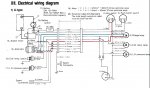
A blue/black wire from the alternator terminal L to the warning light and a 12 volt supply, via a red/black wire, from the key switch terminal "AC" to the warning light.

There should also be a 12 volt feed from the keyswitch a terminal "R" on the alternator . Also a red black wire.

Since the warning light appears to function I'd suspect this second feed from the key switch to terminal "R" to be the one causing the problem

Yanmar GM wiring.jpg
 
I agree check the warning light wiring

A blue/black wire from the alternator terminal L to the warning light and a 12 volt supply, via a red/black wire, from the key switch terminal "AC" to the warning light.

There should also be a 12 volt feed from the keyswitch a terminal "R" on the alternator . Also a red black wire.

Since the warning light appears to function I'd suspect this second feed from the key switch to terminal "R" to be the one causing the problem

View attachment 91195
Thanks for pointing out the second supply.. I will check to see if it's in place and a good connection..
 
I agree check the warning light wiring

A blue/black wire from the alternator terminal L to the warning light and a 12 volt supply, via a red/black wire, from the key switch terminal "AC" to the warning light.

There should also be a 12 volt feed from the keyswitch a terminal "R" on the alternator . Also a red black wire.

Since the warning light appears to function I'd suspect this second feed from the key switch to terminal "R" to be the one causing the problem

View attachment 91195
I am just wondering: why does this alternator need a positive feed from the key switch?

Daniel
 
I am just wondering: why does this alternator need a positive feed from the key switch?

Daniel
I assume it makes the initial excitation independent of the warning light and allows the use of an LED as the warning light. The R terminal is internally linked to the L terminal with a 50 Ohm resistor

ITYWF some VP engines have a similar feed via an external resistor where they are used with the modern panels which have LED warning lights
Depending how its done a diode may also be necessary.
 
I assume it makes the initial excitation independent of the warning light and allows the use of an LED as the warning light. The R terminal is internally linked to the L terminal with a 50 Ohm resistor

ITYWF some VP engines have a similar feed via an external resistor where they are used with the modern panels which have LED warning lights
Depending how its done a diode may also be necessary.
Thank you, it makes sense! I guess I am too old for these modern subtleties! :-)

Daniel
 
I was only saying ...

We both agree though - that the excite circuit appears to be the one at fault.
The limited amount of diagnostic testing does suggest that.

The direct exciting circuit should ensure excitation regardless of the warning light circuit, the function of the light being purely that of a warning light.

Its possible that the OP will find his installation does not have this direct excitation circuit if it is an old one, but it is shown in all the GM manuals I've looked a,. or if the alternator has been replaced with one that is not an exact equivalent of the original.
 
Last edited:
renew the bulb? old one draws too little current to do its job?
I would try that all well.

I assume that it is the same bulb that used to work but changing it would cheaply rule that out as it could be some sort of initial too high a resistance caused by corrosion on the bulb or fitting or inside the bulb. It sounds unlikely but ......

I replaced the alternator bulb on a car dashboard a few months ago with the modern LED replacement. After about 10 minutes of running I had to remove the dashboard and replace the original bulb. :(

Richard
 
Top