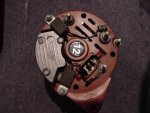
Alternator - Check my wiring please?

Tim Good

Well-Known Member
Joined
26 Feb 2010
Messages
2,888
Location
Bristol
Visit site
I sent my A127 Alternator to be reconditions. It came back looking nice and I wired it up exactly how it came off but isn't working. Photo one is the original wiring. Photo 2 is the new wiring.

17499168_10155041688263162_3614741158600448891_n.jpg


17458115_10155041688268162_2691259010340046948_n.jpg


All is the same apart form the little black box on bottom of the first photo. That didn't come back when it was reconditioned. It appears to connect from a body screw to the main battery positive which seems odd but that is how it was when it worked.
 
The missing black box is just a noise suppression capacitor and will not affect it working. Normally there would be one to the positive which you still have and sometimes one to the negative if you have an insulated earth return alternator- which looks like yours is. The connections seem correct but it appears that the regulator has been changed. What was the reason for the reconditioning?
This is an insulated earth return with two capacitors:
A127.jpg
 
Last edited:
Further to my last what is the single red wire, which appears connected with the brown/yellow, connected to at the other end? The brown/yellow will be the feed from the alternator warning light and should be on the smaller of the three spade terminals. The red wire terminal is also now uninsulated and is very close to the frame of the alternator which may be earthed depending on your setup. This may be shorting out the ignition feed form the warning lamp.
 
Last edited:
Further to my last what is the single red wire, which appears connected with the brown/yellow, connected to at the other end? The brown/yellow will be the feed from the alternator warning light and should be on the smaller of the three spade terminals. The red wire terminal is also now uninsulated and is very close to the frame of the alternator which may be earthed depending on your setup. This may be shorting out the ignition feed form the warning lamp.

Not sure what the red one is. I have since insulated it. That wouldn't stop the alternator out putting a good voltage into the main positive though would it?
 
Maybe if it is affecting the feed from the warning light but I am wondering what it is there for and it did supposedly work before you sent it away. The brown/yellow will come from the warning light which should glow once the ignition switch is in the run position. This supply to the alternator through the smaller blade terminal, the D+ connection, is what is used to excite the rotor coils and start the alternator producing an output. Once started the output rises and supplies its own feed to the rotor and at the same time opposes the input from the warning lamp feed which causes the light to go out.

The only other connection to the D+ I have seen is the connection I have on mine for a Sterling Advanced regulator where it is used purely to monitor the output of the alternator.

Your red wire is a resonably large gauge so I am intrigued as to what it is for.

Does the warning lamp come on when you turn the key to the first position? What happens when the engine starts?

Initially I would check the light is working and that it is giving a feed to the D+ terminal and try it without that red wire on to see it it works then.

I know you had it reconditioned but what did they do to it and why?
 
Not sure what the red one is. I have since insulated it. That wouldn't stop the alternator out putting a good voltage into the main positive though would it?

ITYWF that the red wire is a feed from the ignition switch via a (50 ohm ??) resistor for the initial excitation.
Some alternators incorporate the resistor, in which case the red wire would go to a separate terminal

If the red wire is disconnected the alternator may not start to generate if there is insufficient current via the warning light
 
Normally the feed to the D+ comes through the warning lamp which is more than enough to supply the initial excitation current. I have not come across a separate resistor arrangement as yet but you never know!

It looks to be a standard A127 Lucas alternator.
 
Other than checking the wiring to the alternator in that the feed to the D+ is working and what that red wire is for then you may have to return it to the reconditioner to get it checked.

In theory the only parts that would need changing if required would be the bearings, if worn, the regulator, to change the brushes, as it is easier to replace the whole unit and the slip ring assembly if worn, The diode pack was working before it went in so should be still working.

I have just overhauled mine and the only thing I changed was the regulator, and that was only because I fitted one that allows me to adjust the output voltage.

Does the spare work?
 
Post deleted

Because looking at the first photo it appears that the red wire is something added. Its does not seem to be part of the original wiring.

I think you should find out where the red wire goes and determine what its purpose is.
 
When I first bought the boat the previous owner had wired a split charge diode to charge both batteries were the red wire is in picture.As far as I am aware on the A127 alternator the terminals are an alternative positive output for vehicles that use the plastic push on connection its therefore connected internally to the positive stud connection
 
Last edited:
When I first bought the boat the previous owner had wired a split charge diode to charge both batteries were the red wire is in picture.As far as I am aware on the A127 alternator the terminals are an alternative positive output for vehicles that use the plastic push on connection its therefore connected internally to the positive stud connection

But in the OP's case the red wire is connected to the same terminal as the warning light!
On an A127 the other, larger, spade terminals in that group of three are alternative + output terminals.

Google will find connection diagrams
 
Last edited:
But in the OP's case the red wire is connected to the same terminal as the warning light!
On an A127 the other, larger, spade terminals in that group of three are alternative + output terminals.

Absolutely - and in both pictures it appears to be piggybacked onto the D+ terminal with the Brown/yellow which would appear to be the feed from the warning light.

If power is being drained away by the red wire it could be enough to prevent the alternator getting enough power for the rotor to excite.
 
Ok guys the problem is solved. The main negative feed to the alternator had a fuse in the line which had blown. See below.

Question: I don't have a replacement for this. I think inmust have touched the positive to the nagatice and blown the fuse during installation. If I temporarily install it without the fuse, will this be ok and as an fuse the negative lead normal?

View attachment 63452

P.s red lead for the warning light was not going anywhere it seems. I think it was for a second alternator which the original owner had running in tandem.
 
Ok guys the problem is solved. The main negative feed to the alternator had a fuse in the line which had blown. See below.

Question: I don't have a replacement for this. I think inmust have touched the positive to the nagatice and blown the fuse during installation. If I temporarily install it without the fuse, will this be ok and as an fuse the negative lead normal?

It's not normal to fuse the negative lead, and you can safely install it without a fuse. However, it would be advisable to have a fuse in the positive lead, as close to the battery as possible, as a safeguard against accidental shorts to earth.
 
It's not normal to fuse the negative lead, and you can safely install it without a fuse. However, it would be advisable to have a fuse in the positive lead, as close to the battery as possible, as a safeguard against accidental shorts to earth.

Thanks PVB... yeah I have some decent fuses right at the battery I suppose this was out in as it is possible that a negative and positive lead could be left dangling next to each other if you remove the alternator to have it replaced or reconditioned... in this case the fuse did its job well!

Will install without and replace in due course :)
 
Thanks PVB... yeah I have some decent fuses right at the battery I suppose this was out in as it is possible that a negative and positive lead could be left dangling next to each other if you remove the alternator to have it replaced or reconditioned... in this case the fuse did its job well!

Will install without and replace in due course :)

You really don't need to replace it at all, if the positive is fused.
 
Top