Alternative masthead wind units?

chubby

Well-Known Member
Joined
28 Mar 2005
Messages
1,108
Location
hampshire, uk
www.flickr.com
What is the best choice of unit?

To avoid thread drift, I definitely want one to save the posts " I have sailed for half a century without one" and I am more concerned with robustness than cost as there is the hastle of mast head access.

So I have a raymarine T120 wireless at present: the previous one lasted over 5 years in all weather until the bearings failed. The cups on the replacement blew away in 2 weeks in average south coast weather, not storm Amy! making me wonder if there is a quality issue.

So what replacement?

Another Raymarine, wired, wireless or smart: they seem to gave put effort into the engineering of the latest smart version but as a cruiser I am not interested in precise calibration.

Another make and an interface to my seatalkNG system?

Autonic look well engineered and robust.

Calypso ultrasound system: no moving parts? If it works, it sounds ideal but if so why doesn't everyone have one or the major manufacturers do similar?

So what will last, work and link to my existing Raymarine kit with seatalkNG networking?

Robustness is more important than price. Yes replacement cups for the T120 are cheap but every couple of weeks?

What do long distance cruisers or offshore racing yachts use?

The latest Raymarine is " smart" does?detecting mutlidirectional movement at the last head help or confuse?

What do the pundits have on their boats?
 
LCJ Capteurs CV-7 ultrasonic is a solid choice -- accurate, extremely reliable and long lasting. If robustness is your main goal, then this would be the best choice in my opinion.

Offshore racing yachts mostly use B&G mechanical sensors. The best one is the A+T reworked B&G 213, which is analogue (so you need an H5000 or similar). The current B&G ones are NMEA0183HS, with NMEA2000 converters where necessary.
 
There is a post here describing the Raymarine smart wind sensor.


I am very pleased with mine, the previous one would alter wind direction in light winds and waves, but the smart one is rock steady. Expensive but it does what it claims very well.
 
A service kit is available for the Raymarine T120 ex Tacktick masthead unit which includes new bearings. easy to fit. About £95.

I rebuilt mine from the kit, was surprising easy to do. That’s was nearly three years ago and still going strong, recorded 40kts today.
 
I am following his thread with interest. When the yacht get hauled out in a few days time the mast is being removed to do some remedial work on it.The Stowe navman wind unit has gradually ground itself to a halt, the direction output went years ago, The unit is 1985 so it has not done badly.To have the Stowe mast head repaired is very expensive. I just cruise so what i want is a simple standalone unit, just windspped would be enough. The NASA unit is £230 wired or 350 wireless. Nasa are simple and robust but what about the cups do they still blow way which means a trip up the mast, and for me that means paying to get it done, Nasa probably will not be mentioned as it will not do NEMA etc. but would like comments. No really highjacking the thread but it would make sense to get a new unit while the mast is down.
David MH
 
IThe NASA unit is £230 wired or 350 wireless. Nasa are simple and robust but what about the cups do they still blow way which means a trip up the mast, and for me that means paying to get it done, Nasa probably will not be mentioned as it will not do NEMA etc. but would like comments. No really highjacking the thread but it would make sense to get a new unit while the mast is down.
David MH

According to NASA it does NMEA - the base unit receives wind speed and direction data from the masthead transmitter and sends it to the Clipper Wind display or any other compatible NMEA display unit.

When our Stowe finally packed up, I replaced with NASA wireless. The cups are still there after about 4 years :)
 
LCJ Capteurs CV-7 ultrasonic is a solid choice -- accurate, extremely reliable and long lasting. If robustness is your main goal, then this would be the best choice in my opinion.

Offshore racing yachts mostly use B&G mechanical sensors. The best one is the A+T reworked B&G 213, which is analogue (so you need an H5000 or similar). The current B&G ones are NMEA0183HS, with NMEA2000 converters where necessary.
The CV7 looks interesting and their website says tested on trawlers working in all weather's! I am surprised they are not more widespread unless a French company not widely marketed in the UK?
 
According to NASA it does NMEA - the base unit receives wind speed and direction data from the masthead transmitter and sends it to the Clipper Wind display or any other compatible NMEA display unit.
Nasa do a wired and wireless MHU that transmit NMEA 0183. To get the data into a Raymarine system with SeatalkNG network you would need a converter like this.
 
I rebuilt mine from the kit, was surprising easy to do. That’s was nearly three years ago and still going strong, recorded 40kts today.
When you re built it, what holds the cups on? I have a ketch and have the 7 year old T120 on the main with dodgy bearings and a new T120 on the more easily accessible mizen but the cups have simply vanished, presumably fell off, in ordinary weather well before storm Amy.

Replacement of the cups would be easy if they stayed on.

Are they push fit or gave a grub screw?
 
When you re built it, what holds the cups on? I have a ketch and have the 7 year old T120 on the main with dodgy bearings and a new T120 on the more easily accessible mizen but the cups have simply vanished, presumably fell off, in ordinary weather well before storm Amy.

Replacement of the cups would be easy if they stayed on.

Are they push fit or gave a grub screw?

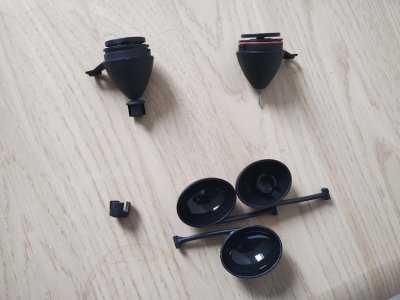
There is a shaft that comes out of the bottom of the bearing unit on which a small plastic fitting is threaded on. This is meant to be attached permanently. Into this fitting fit the cups and then a cap is push fitted in place to hold them in. The cups replacement kit contains the cups and the cap but not the threaded fitting. If when you look at your MHU you see a plain threaded shaft you are shafted. That fitting is not available on its own and you need a whole new bearing unit as well as the cups/cap. I had a bearing unit lose its cups when the shaft end fitting came off.

pro-cQwAt5zB.jpeg

Top left: bearing unit with shaft fitting
Top right: bearing unit with missing shaft fitting
Bottom left: cups retaining cap
Bottom right: cups
 
Last edited:
There is a post here describing the Raymarine smart wind sensor.


I am very pleased with mine, the previous one would alter wind direction in light winds and waves, but the smart one is rock steady. Expensive but it does what it claims very well.
Interesting thread about the smart Raymarine transducer: there are two aspects to the use of wind instruments: one measurement of wind speed to inform sail choice but the other is using the autopilot wind mode, would Raymarine be best for that?
 
Interesting thread about the smart Raymarine transducer: there are two aspects to the use of wind instruments: one measurement of wind speed to inform sail choice but the other is using the autopilot wind mode, would Raymarine be best for that?
Any wind transducer will do as long as it has a rapid enough update rate. The Nasa wireless doesn't specify the rate but the wired one does at 10 times per second, so I expect the wireless is the same. Anything faster than once per second will be fine. If you are then going through a converter from NMEA0183 to SeatalkNG there will be an additional delay but it will be in the order of milliseconds.
 
Interesting thread about the smart Raymarine transducer: there are two aspects to the use of wind instruments: one measurement of wind speed to inform sail choice but the other is using the autopilot wind mode, would Raymarine be best for that?

As @AngusMcDoon says, pretty much any wind sensor will be able to run an autopilot in wind vane mode, the difference I have found is that this particular wind sensor delivers a true wind direction well below the wind speeds where my last system (also Raymarine) gave up and produced random directions and speeds - particularly in a swell ... so it is useful in this specific use-case.

The autopilot was able to sail the boat well in wind vane mode in about 6 knots of true wind and kept a steady course, regardless of power-boat wakes etc. - mast movement does not affect the values of true wind direction or speed until the wind speed is so low that it isn't strong enough to move the speed sensor or return the direction sensor to the true wind position - but at that point the boat wouldn't sail well anyway.

Question is whether this is worth the price differential to you. Where I sail there are often days of very light winds, so I was often resorting to motoring - I am happy to sail slowly in very light winds, but when the sails collapse or thrash about due to waves I give up. The combination of Code-Zero and autopilot on wind-vane mode is therefore important to me.
 
The CV7 looks interesting and their website says tested on trawlers working in all weather's! I am surprised they are not more widespread unless a French company not widely marketed in the UK?
They are pretty widespread already. Seen more and more.
 
What do long distance cruisers use?
I am a bit of a fan of Furuno kit- my Furuno wind speed unit has lasted 12 years and around about 25,000 n miles, including ocean crossings and plenty of strong winds, so has proved itself robust. Don't know about it interfacing with the sea talk system that Raymarine uses. But there again I quite like independent systems for my instrumentation,
 
Top