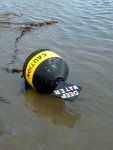
Alerting other sailors to our lifting keel, shallow draught!

Sailsalot

Member
Joined
9 Aug 2014
Messages
33
Location
Poole, Dorset
Visit site
Last year we bought a Parker 275 which has a lifting keel, it also has a rather nifty 2nd plank style drop down rudder from the rudder stock, which in combination with the keel lifted and large rudder pulled up allows us to get in and out of quite shallow water, roughly half a metre.
So far this year when anchored in shallow water we have watched at least 3 other yachts and even a large 2 masted schooner approach and then attempt to follow us into the shallows……they have all had much longer stopovers than they probably expected and we have then left, trying not to look at them stuck fast at odd angles.
Yesterday we saw a small cruiser of a similar size to us sailing back and forth looking in our direction, we were sitting happily eating a very late lunch at one of our favourite spots in Poole Harbour. Even with our shallow water sailing set up, we were keeping a close eye on the depth gauge and knew we would have to head into deeper water fairly soon after lunch, the tide was falling fast.
Anyway….. the other yacht approached and I tried to think of some way of alerting them to the shallow depth, but waving at them wouldn’t have had the desired effect, would have probably encouraged them closer and I couldn't tell whether they in fact also have a lifting keel. With a spring tide they were going to be stuck for 4 hours at least, not a bad place to be stranded, hope they had beer onboard.
Any suggestions of how to alert others to our shallow draught? I feel like making a large banner to hang along the guard rails KEEP AWAY, WE HAVE A LIFTING KEEL.
 
On the other hand, it is very useful when racing. Several smaller boats have tried going up the inside of me, with race ending consequences for them.
Pilotage is the responsibility of all boat owners, and you can't help some people anyway.
 
Personally in your position I wouldn't feel any great responsibility to warn people; it's up to each skipper to ensure he has sufficient depth for his boat. But if you want to do so, why not just hail them and say it? Sound travels quite a long way over water.

Pete
 
Flag U Uniform - you are standing into danger, together with a morse signal .._.


No problem. That's one of the benefits and purposes of the International Code of Signals.


It is also immense fun.
 
Apart from possibly having a floodlit sliding depth gauge fixed to the side of your boat, I think you should leave it to newcomers to ascertain the depth of water by a method of their choosing.
 
There's no particular IC flag I know of for ' watch out, this is a lift keel boat ' so if the berk approaching in a deep keel schooner / tanker or something doesn't have the brains to know shallow draught boats, OR LOOK AT HIS CHARTS - it's his problem !
 
Last edited:
Having a 28ft lift keeler that draws a little over 2 feet and mooring in the upper reaches of Portchester creek near Port Solent we frequently get a similar problem.
An hour or so either side of high tide we are able to make a course from Portchester, across a couple of mud flats, straight to North Corner jetty in the Dockyard rather than following the bends of the creek. Despite the red and green piles that mark the channel we are frequently followed out of the channel by boats leaving Port Solent that are obviously not watching the piles but following blindly. The vast majority notice the drop in depth, slow down dramatically and do a U-turn back to the channel. On a spring tide high you can get a 2 metre draft boat across there and a few succeed. There have been a few who spent upwards of eight hours careening to scrub their hulls.
We used to try to warn them but, over the years, have given it up as a lost cause.
 
When I started sailing, a thread like this taught me not to trust bigger boats to draw more than Jissel. I then quickly learned to recognise Southerlies, Parkers and the like so I could explain to the Admiral why we couldn't follow that boat!

At least having twin keels means that if we do stop then drop the anchor, it's easier to look as if we meant it...:)
 
There is a story of an Anderson 22 in a club race, when it got to a tight shallow bit the following boat thought ' they must draw at least 4' ' so went inside.

They had a happy few hours scrubbing the bottom hoping for the next flood tide.

It always pays to know boat types !
 
Perhaps a sign "Shallow water" with an arrow pointing downwards. My swing mooring is near a shallow rock reef that an be about .5 metre deep. People often assume that if a keel boat is moored there there must be enough water and get stuck. olewill
 
You could shout "Just taking the duck for a walk!" I'm with the others, it's not a problem for you - we've all gone aground and don't blame anyone else for it.

Rob.
 
Any suggestions of how to alert others to our shallow draught? I feel like making a large banner to hang along the guard rails KEEP AWAY, WE HAVE A LIFTING KEEL.

A big sign saying "LET US TELL YOU THE GOOD NEWS ABOUT JESUS" should keep other boats miles away. If it doesn't they can walk across the water for a chat with you.
 
I love all those replies, I think I like the morse code suggestion, or the U flag best, but I won’t be using them, even so :)
I’m glad others with bilge/lifting keels have had the same thing happen to them. It is quite surprising that in Poole harbour which is notoriously shallow in places, some sailors still rely on looking where other boats are anchored and follow them there without a glance at tide tables/charts first……...maybe they only do that once though!

All a learning curve and I would love to say that we never make a mistake, hmmm last week I got left on the pontoon when leaving with the boat being blown off in a stiff breeze, so our leaving procedure in that situation has been revised!
 
Just enjoy the fact that others should know better than to try floating on wet grass.

I really used to appreciate our lift keeler especially when entering Pwllheli harbour at times when fixed keelboats should have known better.
So many followed us assuming a tall rig would mean a deep keel.
It was a picture to see the panic set in just behind us when we lifted the dagger blade in the stock and reduced our draft to 18inches. I usually put a call on the Radio if they were following in on the ebb and told them the water depth as we negotiated the shallowest part of the channel.
Didn't bother on the flood as a boat aground for a while was most effective at slowing the speed boats down to no wake speed!

Port Sauzon on Belle Isle. I had the Capitainerie shouting not possible in French as a I entered whilst most of the bilge keelers were still well aground!

Really beginning to miss the fun now!
 
Years ago on lift-keel Sonatas, we found ostentatious use of a lead line got the idea across.

There is always the possibility that the other guy actually knows the way through the channel, it is embarrassing to run hard aground in 15 inches of water as a Contessa 32 sails past 20ft away.

Maybe a Plimsoll line on the transom?
 
An apocryphal tale from years back, a lost sailor decided to follow a barge going roughly his way, they both ran aground simultaneously. The barge skipper came out of his wheelhouse, removed the pipe from his mouth and said "I've come here for gravel, what you here for?"
 
It's not just lift-keel boats that can lead people astray. My grandad notoriously once ran aground trying to follow an Isle of Wight ferry.

(I don't know where this happened, and I assume the current vessels are deeper than they were back then.)

Pete
 
Top