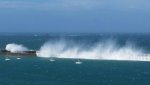
Alderney Breakwater. Wish you were here?

I sat out a gale in Braye in August 2016. It wasn't from the northeast, the direction when Braye can quickly become untenable), but rather from the west. But it was still very bouncy in the harbour. Water was coming over the top of the breakwater, several times the height of the wall itself.

I wasn't going anywhere near the breakwater to take a photo - far too dangerous - but I took this from Fort Albert, the headland overlooking the harbour to the east.


Alderney in a gale(small).jpg
 
I sat out a gale in Braye in August 2016. It wasn't from the northeast, the direction when Braye can quickly become untenable), but rather from the west. But it was still very bouncy in the harbour. Water was coming over the top of the breakwater, several times the height of the wall itself.

I wasn't going anywhere near the breakwater to take a photo - far too dangerous - but I took this from Fort Albert, the headland overlooking the harbour to the east.


View attachment 69676

Pretty impressive
 
Wouldn't they be better off biting the bullet and building a new barbour on the other side? that way theu could get a marina in there as well.
 
Rode out a gale from the NE there in about 94. Invicta 26.
Left Sark on a good forecast but shortly afterward got a NE F8 imminent.

Didn't fancy the race so went round the Casquets and just missed the tide for the Cap de la Hague.
Chewed through serveral lines to the buoy.
Needed full harnesses to go forward.

Wind went round to the NW and had a wild and fast trip back to Portsmouth.
 
Had a simular experience in 2005, 5 days chained to a mooring Bouy with the occasional wave landing on the coach roof.
Flat batteries and Omelette, no eggs.
 
in the mid 80's I was a alongside a boat in St Peter Port, it turned out the lady aboard's dad had been an army surveyor in the 60's -70's tasked with finding out why voids kept appearing in the Alderney Braye breakwater; simple answer, the Nazi's used slave labour, whenever some poor sod keeled over they went into the concrete mix, hence gaps appearing after a while.

I thought the breakwater was built in the 1850s. So where did the bodies come from? :)
 
From my reading Braye Harbour breakwater was actually much longer when it was first built by the British Government.
The end part was then broken away by a storm, sometime after WWII. Recently Alderney has asked the UK to finance reconstruction but this was declined. The breakwater is made of large stone blocks with large rocks on the seaward side.
I have not heard or seen any evidence of concrete used in its construction.
 
I wish I'd been wrong

http://www.jtrails.org.uk/trails/alderney-holocaust-and-slave-labour-trail/places-of-interest

28. The Harbour and Breakwater St Anne's - Braye Harbour
The breakwater and harbour was one of the major area of activity on Alderney and a major location for slave work. Slave workers were constantly engaged in loading and unloading boats and there are surviving photographs of SS prisoners their striped pyjama uniforms also at work in the harbour. Many of the workers were Russians and they were frequently beaten and ill-treated and hit with clubs. One of the port commanders frequently said of the Russian OT workers, 'kick them in the arse when they come' and 'these are not humans but animals'. Moreover, the extension of the breakwater itself was a major construction project using slave labour. The original harbour and jetty were very small and crowded; utterly ill-suited to the volume of shipping needed to fulfil the construction projects on Alderney and according slave labour was used to extend the jetty and also the breakwater.

Jews were also working at the harbour and may well in the prisoners seen in the photographs, 'here we came in contact with the Jews for the first time. They were involved in up-loading boats, and had reached such a degree of starvation that it was a pastime for the Germans to throw them pieces of carrot and see the pitiful wrecks fight for it ... Cases of cannibalism were mentioned to me by an elderly Rumanian Jew, who gave all sorts of hair-raising details ... I had no reason to doubt these reports.'

The harbour was the site of the OT transport office ('Schiffsleitstelle') and the point of embarkation and disembarkation for prisoner transports. Prisoners were transported off the island to go to other labour projects, where their labour was needed, occasionally for onward medical treatment and often for onward transportation for extermination at other camps or facilities and finally for evacuation towards the end of the war.

It appears that in December 1942, 68 Russian patients were sent for medical treatment in Cherbourg, though the informant was at a loss to understand why he had not been sent away to be killed instead. Also, in May or June 1943, a large transport of Russian prisoners was send for medical treatment in Cherbourg, or reassignment to lighter duties, as the result of a medical commission into the mistreatment of prisoners.

In November 1943, a contingent of French Jewish prisoners from Alderney (Auigny) were transferred to Dannes in the Nord Pas de Calais and the same happened on 7 May, 1944, when 650 Jewish prisoners were evacuated from Alderney by boat to Cherbourg and 500 of that group were sent to Dannes with the older men being sent to Camp Brauneck in Boulogne.

One group of Russians were transported to Kortemark in July - August, 1944, to work on the VI sites there. They were confined to sealed railway waggons for 3 weeks and suffered horrific privation, abuse, torture and murder, during the journey and the conditions led to prisoners attempting to escape. On the Kortemark journey, 19 prisoners were killed and 28 injured in a goods truck near Verdun, by SS-mann, Peter Bittenrinder.

In January 1943 some 300 Russians were due to be transported to Cherbourg by the s/s 'Xaver Dosch'. The Russians kept for three days packed below decks in terrible conditions and 8-10 Russians died while in the hold. Then, as the prisoners continued to be held without food or water for 14 days, there was a great storm from 13-14 January and the ship was wrecked in the port killing many of the Russians locked in the holds. The remainder were then taken off to France in the 'Francke'.

Evidence shows that the end of the harbour breakwater was, in the earlier phase of the German occupation of Alderney, the major point of disposal for the dead slave workers from the camps. V.I. Rosslova stated, 'A lorry loaded with corpses would go to the end of the breakwater which stuck out 500 meters into the bay, dumped its horrible load and came back.' John Dalmau dived in a diving helmet near the end of Braye Harbour breakwater, to repair an anti-submarine net and saw 'among the rocks and seaweed there were skeletons all over the place. Crabs and Lobster were having a feast on the bodies that remained intact... horribly fascinated I watched the blown up bodies [i.e. with gases of decomposition] moving with the tide like a dance macabre''. Some have cast doubt on these witness statements as evidence of human remains were not seen shortly after the war, though marine archaeology shows that human remains, for example in ship-wreck war-grave sites, do not persist for long periods and the activity of scavenging sea-life and powerful currents around the break-water may also be pertinent factors.
 
At which end?

I understood it was never completed anyway, hence the incomplete foundations at the outer end, because of criticism from Gladstone. Do you have any photographs of the WWII work?


The breakwater we see today was finished but not to the original plans. Within 10 years the outer end had been damaged and abandoned to it's fate. It was originally over one third longer.

The overall plan was massive and the extensive E and SE arms were never started, beyond minor works.

PS,
Interesting to note,
It was the same overall design as that at St Catherines and given the very different conditions there was doubt at the time, and even more now, that it could ever be sustained without constant expensive maintenance.

http://www.bbc.co.uk/news/world-europe-guernsey-35409542
 
Last edited:
Research it yourself, it's pretty clear; see my post #33 above.

I'm not casting doubts on there being slave labour or Nazi attrocities during WWII. I'm casting lots of doubt on your claims that the Victorian breakwater was not only built by the Germans with concrete but also contained buried corpses of slave labourers. Your post #33 simply refers to bodies being dumped off the end of the breakwater.
 
The Germans extended it inc buried slaves.

Have a look at the gun emplacement on shore for special mix German concrete...there was no reason for the person who related the story to fabricate it, she was the wife and daughter of Army officers on a Spinner boat, I can't remember her or the boat's name but could maybe find a witness who also heard the story.

This is exactly the sort of thing the Nazi's did - look at their aircraft manufacturing tunnels - why are you apparently apologising for them ?
 
The Germans extended it inc buried slaves.

Have a look at the gun emplacement on shore for special mix German concrete...there was no reason for the person who related the story to fabricate it, she was the wife and daughter of Army officers on a Spinner boat, I can't remember her or the boat's name but could maybe find a witness who also heard the story.

This is exactly the sort of thing the Nazi's did - look at their aircraft manufacturing tunnels - why are you apparently apologising for them ?

Tell you what Seajet. You take a photograph of the concrete Nazi Victorian breakwater next time you're over there. Remember, anything other than the main breakwater doesn't count - your claims were about the main breakwater itself. Gun emplacements and aircraft tunnels don't count.
 
Top