Ajy network geeks on here? What does your setup look like?

Karlsenkystfiske

Well-Known Member
Joined
27 Dec 2022
Messages
146
Visit site
Have you gone full triple starlink yet, or do you have a forest of 4G antennas in the mast?

I have just this humble Poynting puck antenna mounted inside the wheelhouse. Connected to a Rut X12. Looking to upgrade with a good 4g/5g antenna in the mast one of these days.
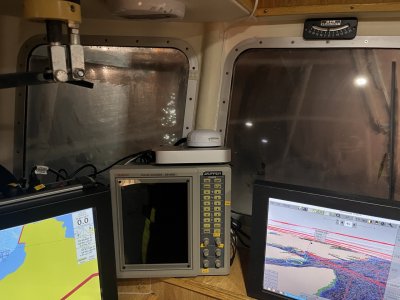
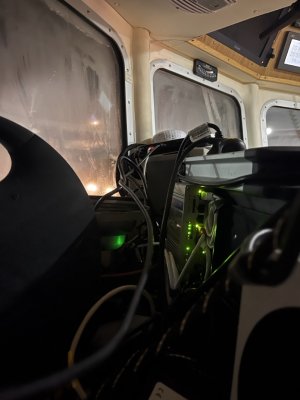
IMG_1249 – stort.jpegIMG_1250 – stort.jpeg
 
I have the smallest of all Teltonika routers (RUT240) on board, works fine with internal antenna but generally I do have signal where I go about.

Bought a RUTX50 for home (in a 150k ppl city but on a spot with not many customers for the telecom companies who have promised and not delivered cable for 3yrs now). currently running with internal antennas, not v.happy as accessible towers are 6km away.
Discussed with a guy, v.experienced who installs RUTX50 on ships and he says the best he's ever used was this:

Nedis ANOR5G40ME
omnidirectional, 2X2 SMA connectors straight to the RUT, 7m long (pref to keep to that size and not get extensions apparently)

So probably going to go for one of them, or since RUTX50 supports 4X4, I may go for
AO5G4-G QuOmni 5G/LTE Global MIMO 4x4, 5m
not in a great hurry though, probably getting one in late Jan.

V
 
Good on you for getting the X50! I have seen youtube reviews, and the speeds it is achieving is stunning!
As for the Nedis antenna, it seems to only be available in the UK? And it has a higher price tag than the 4x4, so I would be lead to believe the 4x4 would ba a better choice?
 
Does a masthead 4G antenna need to have special properties?

A masthead VHF antenna on yacht is different from a rooftop VHF on a motorboat as the yacht can be healed up to 30° whereas the motorboat needs to be angling it's signal better ...

4G must be used to people holding phones at funny angles but I assume that's handled by the phone not the cell tower...
 
I dont imagine heeling or rolling would matter much as long as the antenna is omnidirectional. The signal is not a thin laser-like thing, its more like a wide wave coming from the cell tower.
 
Does a masthead 4G antenna need to have special properties?

A masthead VHF antenna on yacht is different from a rooftop VHF on a motorboat as the yacht can be healed up to 30° whereas the motorboat needs to be angling it's signal better ...

4G must be used to people holding phones at funny angles but I assume that's handled by the phone not the cell tower...
It won't work unless your mast is 5m or less. Unacceptable losses in coax ..

Wi-Fi hotspot with remote antenna
 
I dont imagine heeling or rolling would matter much as long as the antenna is omnidirectional. The signal is not a thin laser-like thing, its more like a wide wave coming from the cell tower.
If I was designing an antenna for a RUX type device (designed for busses, trains etc) I would have made my Antenna signal Jam Doughnut shaped (so omnidirectional around the circumference of the antenna, but not a lot of value in sending signal towards the moon. But roll a boat 30° and you are sending most of the signal into the sea... ...if you roll a train 30° you have a lot more to worry about than your WiFi!

All more pronounced on top a 5m stick
 
Are you saying that cable length can be max 5m? That is not correct.
I didn't say the max was 5m but unacceptable losses will occur above those lengths negating the advantage of a higher mounted antenna. You will notice many 4G antennas come with 5m of cable as standard. It's for a reason.

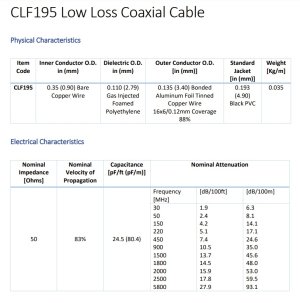
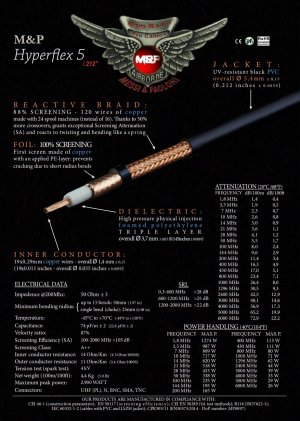
Typical cable losses CLF195 typically used for SMA connections & really good quality RG58. Approx 6db worse for 900MHz vs VHF 150MHz, ie 3/4 of your signal lost comparing VHF to 4G for any given cable length ....

cf195.jpg

hyper.jpg
 
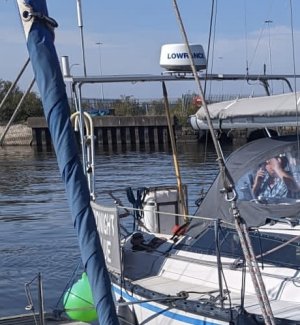
I'm looking at fitting an external wifi antenna but the base would be at the same height as the radar unit. Maybe a stupid question but would this not interfere with operation of the radar, ie blank out part of the radars 'sight'?
 
imho a 10-20mm dia antenna in front of the radar wont affect it. After all radar is transmitting from the whole width of the thing so v.unlikely to affect it.
I have added a circa 30mm dia NAVTEX antenna in front of my 24in garmin radar, nothing changed when I installed it tbh.
 
imho a 10-20mm dia antenna in front of the radar wont affect it. After all radar is transmitting from the whole width of the thing so v.unlikely to affect it.
I have added a circa 30mm dia NAVTEX antenna in front of my 24in garmin radar, nothing changed when I installed it tbh.
Thanks Vas, the Nedis antenna mentioned above is 70mm dia. and would be mounted at the same height as the radar head, fingers crossed 🤞
 
We have both the Stubby 4g and echomax on the solar/ radar arch, never had any issue with radar shadow
 

Attachments

  • 01e29785-21b1-4bfd-aa0e-4190655871bc.jpeg
    01e29785-21b1-4bfd-aa0e-4190655871bc.jpeg
    109 KB · Views: 8
@wonkywinch This is most interesting. Would like to learn more about this matter. I have wondered why the cables that come with such antennas are so short. So you are saying that anything above 5 meters of cable length, signal quality would start do deteriorate so that any advantage with placing it higher up would be lost?
Is there any workaround? I have one outdoor antenna that uses POE, and so it has no antenna cable at all. Just an ethernet cable straight all the way to my router!
 
@wonkywinch This is most interesting. Would like to learn more about this matter. I have wondered why the cables that come with such antennas are so short. So you are saying that anything above 5 meters of cable length, signal quality would start do deteriorate so that any advantage with placing it higher up would be lost?
Is there any workaround? I have one outdoor antenna that uses POE, and so it has no antenna cable at all. Just an ethernet cable straight all the way to my router!
Nothing magic happens at 5m, the signal loss is linear per metre along the whole length of cable and the benefit of placing the antenna far away (ie up high with longer cable) is lost.

As signal strength is lost, it doesn't taper down to zero, it reduces into the background noise floor (sounds like hiss on a receiver) so there is a point where the signal to noise ratio makes decoding the signal difficult.

The solution is to put the electronics, ie amplifier, within the antenna so higher power is being sent back down the cable. Like you, I have distant wireless access points fed by POE (power over ethernet down the network cable).

The maths for cable losses are completely different as the network cable is a bunch of twisted pair cables handling data (on/off clicks) rather than the 4G antenna which is 900MHz linear RF signal (radio frequency) trying to listen to minute strength signals out of the ether.
 
Last edited:
  • Like
Reactions: vas
@wonkywinch This is most interesting. Would like to learn more about this matter. I have wondered why the cables that come with such antennas are so short. So you are saying that anything above 5 meters of cable length, signal quality would start do deteriorate so that any advantage with placing it higher up would be lost?
Is there any workaround? I have one outdoor antenna that uses POE, and so it has no antenna cable at all. Just an ethernet cable straight all the way to my router!
It’s not quite that simple, it db loss in coax is about cable length, cable type and frequency. The smaller the diameter is mostly the worse in simple terms, goid quality high performing coax is very expensive and not normally the one supplied with our equiment.

you can get a good comparison looking at RG coax cable specs on Radio Ham suppliers web sites
 
Last edited:
It’s not quite that simple, it db loss in coax is about cable length, cable type and frequency. The smaller the diameter is mostly the worse in simple terms, goid quality high performing coax is very expensive and not normally the one supplied with our equiment.

you can get a wood comparison looking at RG coax cable specs on Radio Ham suppliers web sites
I agree but given the freq is (near enough) constant, once the cable is chosen for the job, the only variable is length as I mentioned. I also showed comparative cables with #2 being a high quality (M&P) RG58 from a radio amateur supplier. Anything thicker is going to pose installation difficulties. I can use 13mm M&P for my HF and VHF amateur base station but it will be a pain routing it around a boat and terminating it with SMAs

I too wanted to resolve this masthead issue and spoke to a friend who has decades of experience in mobile phone network and transmission systems. He too warned against long cable lengths so you'll see those puck antennas on top of 4g and 5g distribution boxes rather than up a pole.

When 5g becomes more widespread, the issue of reception over leisure boat type ship to shore distances and through thick plastic hulls will become more of a problem so expect more coachroof mounted puck antennas in future.
 
When 5g becomes more widespread, the issue of reception over leisure boat type ship to shore distances and through thick plastic hulls will become more of a problem so expect more coachroof mounted puck antennas in future.
Why bother with 5g?
Its range is far less than 4g. And 4g is plenty fast enough to watch a movie in HD 4K.
 
Top