AIS transmitter range

Having talked to Car Ferry OOW / Helm and a friend who's on a cruise liner bridge, most commercial traffic relies on Radar and eyeballs, not AIS. They don't have the time for it and only transmit because they are obliged to. Bridge crew training is still heavily biased towards radar I was told. So it's main value is for small craft to see big stuff charging towards them in poor but not perhaps zero vis. Don't assume they can see you on AIS?
 
How do you get to 5-6 miles and are you taking into account the format of an AIS transmission? I think you’ll find it is in practice a much longer distance than that from a masthead antenna to a ship.
You are quite right, but in the case of class B transmissions it is not the straight line distance between aerials that is the limiting factor, but the comparatively low power of 2 Watts. I’ve found this to be true in practice with class B’s vanishing off the plotter screen at around 6 miles but the class A’s still visible at more than 20 miles.
 
Oh dear! Does that mean I’ve wasted my money going from pushpit to masthead - in terms of transmitter distance- if as you say the limiting factor is not aerial height but power?

You are quite right, but in the case of class B transmissions it is not the straight line distance between aerials that is the limiting factor, but the comparatively low power of 2 Watts. I’ve found this to be true in practice with class B’s vanishing off the plotter screen at around 6 miles but the class A’s still visible at more than 20 miles.
 
Whilst it is true that the power output limits transmission range on class B (deliberately, to avoid clutter), you still need to have the best antenna arrangement - high up, clear of obstructions, correct cable - to get the maximum range from the lower power output of class B transmissions.
 
Oh dear! Does that mean I’ve wasted my money going from pushpit to masthead - in terms of transmitter distance- if as you say the limiting factor is not aerial height but power?

Definitely not. I have a Class B with active splitter and see class B targets out to 20 - 25 miles and Class A out to double that, disregarding times when it is much longer for different reasons. :)

Richard
 
Whilst it is true that the power output limits transmission range on class B (deliberately, to avoid clutter), you still need to have the best antenna arrangement - high up, clear of obstructions, correct cable - to get the maximum range from the lower power output of class B transmissions.

FWIW and mindful of all of the other threads around re bad suppliers, I purchased a little Metz antenna for the pushpit, plus the coax and other mounting bits and pieces - all as advised by Salty John on the phone.

Kit is important here, as I understand that AIS signals - even at 2W - are good for 20m+ subject to the equipment. An electronics whizzo might be so kind as to explain why the combination of GMSK modulation and HDLC protocols limits power loss and helps propagation, or something like that :confused:

Anyhow, I pieced together the various antenna bits and bobs, connected them to an SWR meter and can report that the kit was all excellent and remains so today.

So well done Salty John :encouragement:
 
Last edited:
Yes but the range limitation that others have mentioned due to class B power restriction relates to transmission not receiving I think?

I guess the problem is that without formal testing (eg by one of the yachting mags) it’s difficult to know your own transmit range.

Definitely not. I have a Class B with active splitter and see class B targets out to 20 - 25 miles and Class A out to double that, disregarding times when it is much longer for different reasons. :)

Richard
 
Apolgies, I didn’t read your post correctly - you addressed this fully!

Yes but the range limitation that others have mentioned due to class B power restriction relates to transmission not receiving I think?

I guess the problem is that without formal testing (eg by one of the yachting mags) it’s difficult to know your own transmit range.
 
An analysis of AIS range for various places to site the antenna and for Class A and class B transmitters was done by the CA and is on its website in the RATS section. A summary was published in the March edition of 'Cruising' (which is on good quality paper, is extremely well produced, has few adverts, and has authoritative articles - highly recommended).

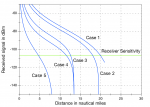
Of course ranges achieved on one particular day can vary considerably with propagation conditions as the radio signal is more or less likely to refract around the earth's curvature but the analysis was done of the range one should expect reliably. I reproduce (with permission) one of the graphs here:
AIS_Range.png

The sensitivity also varies between receivers, what's shown is typical of the lower performance devices, about 5dB better is entirely possible, which of course would improve reception ranges. The blue curves are the signal strength as a function of distance between the transmitter and receiver - so of course go down with increasing range. They take into account the curvature of the earth and also the reduction of signal with range even without that curvature. When the signal falls below the sensitivity the signal is no longer decoded reliably.

Case 1 is ship - ship
Case 2 is ship - yacht, antenna at masthead
Case 3 is ship - yacht, antenna on comms post
Case 4 is yacht - ship
Case 5 is yacht to yacht, bot antennas on comms posts.

Lots of other cases for VHF voice comms in the same article.

Connection alert /puff for joining the CA follows: lots of good stuff you know, does loads on your behalf (Greek tax, red diesel in Belgium and Lobster pots campaign but a small part), representatives all round the world, lots of useful discounts as well. . You know it makes sense...
 
Last edited:
I reproduce (with permission) one of the graphs here:
View attachment 70297

The sensitivity also varies between receivers, what's shown is typical of the lower performance devices, about 5dB better is entirely possible, which of course would improve reception ranges. The blue curves are the signal strength as a function of distance between the transmitter and receiver - so of course go down with increasing range. They take into account the curvature of the earth and also the reduction of signal with range even without that curvature. When the signal falls below the sensitivity the signal is no longer decoded reliably.

Case 1 is ship - ship
Case 2 is ship - yacht, antenna at masthead
Case 3 is ship - yacht, antenna on comms post
Case 4 is yacht - ship
Case 4 is yacht to yacht, bot antennas on comms posts.

Excellent study :encouragement:
 
Totally off topic, but interesting

When I picked up the new boat it had AIS and mid Casquets TSS, I was scratching my head why I could only see "targets" at a maximum of 3NM! Arrived in Alderney and followed the wire from the the AIS to "dangling in mid air"; not plugged into the splitter. So the unit with 0.5m of coaxial was receiving the "test targets" that I checked it with back on the Exe and had a very limited horizon, no idea if they could see me. Once I plugged the wire in the correct hole a whole fleet lit up the screen.
 
Fantastic!

So I think at the masthead, AIS range roughly 10nm transmit and 20nm receive..

Agreed, the labeling of Case 4 & 5 is a bit out, but I'd read the graph as circa 12nm TX, 16-18nm RX.
 
Last edited:
Top