AIS - essential kit these days for channel crossing?

You only have to worry about shipping when crossing the various TSS and they are relavively narrow.

I disagree entirely. In a shipping lane you know where they are. You know what route they are taking. I know from experience that, further west in the Channel for instance, ships seem to "scatter" and can come at one unannounced & from a wide variety of angles. Ferries cross shipping lanes & in the Irish sea they seem to have scant regard for yachts, shipping lane, or otherwise.
Fishing boats can be a pain as well as they can be fishing almost anywhere & not all of them turn their AIS on. Presumably to avoid detection by others.
 
What does the panel think of the ICOM AIS kit & display ?
Quite satisfied with mine.
It feeds its data to the chartplotter under the sprayhood, so we have all we need to know right there in the cockpit.
The ICOM itself is mounted at the chart table and the display set to the list of closest targets, not the 360° radar-like screen.
As my old VHF is starting to be unreliable, I’m replacing it with a new ICOM VHF, with the extra benefit that it will be possible to call any AIS-target direct.

I have to echo all the others:I coped perfectly without an AIS for many years, but since I installed one I have enormously enjoyed having all the info and I would not be without it. I started out with a receiver, but seeing how useful it was, I made the switch to a transceiver.
 
I’m going to change the subject slightly as it appears we have a very different style of sailing to many people on here. Our radar, VHF Chart Plotter etc are all at the chart table. When on passage, we are invariably on autopilot, whether we’re sailing or motoring. We don’t often have the luxury of two people being on watch together and so the on watch person spends most of their time standing and peering over the spray hood (it’s substantial so you can lean on it) or sitting in the shelter of the spray hood looking all round every few minutes but either war with some of the time below making a cup of tea or at the chart table pointing the plotter cursor at ‘targets of interest’. (Invariably finding that their CPA is over a mile and who cares)

I find it quite interesting that so many people want all the information at the helm or in sight of the helm.

The only sop to this is that we have a ST60 graphics display which gives us a rolling road or distance to waypoint etc.

Perhaps I should start another thread.

We had the same set-up on our previous boat, and it worked, as that was what we were used to. We were glad we had the GPS position that we could transfer to the chart. There was the slight niggle that in some circumstances you had to be at two places simultaneously, but you learned to cope with that.
The current , more recent and bigger boat came with a plotter that can be mounted at the chart table and under the sprayhood and VHF and autopilot remote control both just inside the companionway but within easy reach. That has shifted the control centre to the bridgedeck. When on passage we are like you, alone on watch most of the time and using the autopilot. In poor conditions we stay in the shelter of the sprayhood most of the time and still have full control of boat and navigation.
I find I use the chart table mainly for planning purposes, checking the paper charts or the pilot books and keeping the logbook. All the rest is done from the cockpit/bridge deck.
I do not feel the need to have the plotter at the helm. When I’m helming it is either enjoying a daysail in home waters, or in pilotage conditions and in that case we most often split the roles of helmsperson and navigator, in our case a navigator who remains in the cockpit and has full situational awareness.
 
I've been crossing the Channel for the best part of 40 years and have been using AIS for the last 3 of them. I'd put it down as a "nice to have", especially when visibility is poor. In good visibility I don't really use it, but that's maybe out of habit. I usually just sit in the cockpit, line up for example a stanchion against a boat that looks a danger and continually check it. In fog I have the radar going as well as AIS and refer to both.
 
I find it quite interesting that so many people want all the information at the helm or in sight of the helm.

Clearly a shorthanded boat *can* operate with two-thirds of the collision-avoidance sources hidden away from the watchkeeping position. And if one has inherited this arrangement, then perhaps it's not worth the effort of changing it. But I notice that your post doesn't state any actual advantage to putting half the "bridge" in the saloon, while nevertheless the tone implies that having all available information (visual, charting, AIS, and radar) in one place is inferior.

I sit or stand pretty much where you describe - the front of the binnacle makes a good bum-rest with my chin just over the sprayhood. But I also have all my navigational tools and information, except for the paper chart and the Navtex, a tilt of the head away.

Pete
 
The position of the plotter/AIS is partly a matter of what one is used to and partly what boat one has. My boat is tiller-steered, so a plotter by the companionway would be barely readable and I have settled for the screen by the chart table. If I had a wheel, I might prefer it at the binnacle, but then I would want a duplicate inside as I would want to avoid having to do what I often see, which is the skipper going out in the cold and wet to check the screen and plan the next day's trip.
 
I would want a duplicate inside as I would want to avoid having to do what I often see, which is the skipper going out in the cold and wet to check the screen and plan the next day's trip.

That makes sense. I do my planning with dividers on a paper chart, so the issue doesn't arise :p

Pete
 
Clearly a shorthanded boat *can* operate with two-thirds of the collision-avoidance sources hidden away from the watchkeeping position. And if one has inherited this arrangement, then perhaps it's not worth the effort of changing it. But I notice that your post doesn't state any actual advantage to putting half the "bridge" in the saloon, while nevertheless the tone implies that having all available information (visual, charting, AIS, and radar) in one place is inferior.

I sit or stand pretty much where you describe - the front of the binnacle makes a good bum-rest with my chin just over the sprayhood. But I also have all my navigational tools and information, except for the paper chart and the Navtex, a tilt of the head away.

Pete

+1
 
As many good DSC radios have AIS receive capability at about £250 there seems little need for a separate AIS receiver or display. And though no one likes going out in predicted fog on longer passages it can come about quite quickly. If by channel crossing the OP means Dover - Calais the risk is minor as passages can be contained in daylight and visibly clear weather. If channel crossing means Sothampton to Guernsey or even Plymouth to Normandy/Brittany passages are more than 14 hours long and up to 34 then night time will beckon and AIS is a great comfort
 
I have my radar, plotter, fishfinder and AIS ( also hand bearing compass, spare winch handles, knives and torch ) on a swing out panel visible in the cockpit - if I'm suitably frightened I can put the washboards in and see the lot from below :)
 
The position of the plotter/AIS is partly a matter of what one is used to and partly what boat one has. My boat is tiller-steered, so a plotter by the companionway would be barely readable and I have settled for the screen by the chart table. If I had a wheel, I might prefer it at the binnacle, but then I would want a duplicate inside as I would want to avoid having to do what I often see, which is the skipper going out in the cold and wet to check the screen and plan the next day's trip.
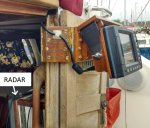
Mine is wheel steered but spends 99% of the time underway on Autohelm. AIS is an engine so displays on the Chart Plotter. At night and in wet weather I keep watch from inside (Pilot House) so I opted to put the Plotter on a swinging arm (RADAR is also on a swinging arm).

CP and Radar.jpg
 
If by channel crossing the OP means Dover - Calais the risk is minor as passages can be contained in daylight and visibly clear weather. If channel crossing means Sothampton to Guernsey or even Plymouth to Normandy/Brittany passages are more than 14 hours long and up to 34 then night time will beckon and AIS is a great comfort
No, you are wrong there. The Dover Strait is a hotspot for fog and it can certainly catch you out. The density of traffic also makes AIS worth having, although it is not as horrendous as some would have you think, with ships spaced a mile or more apart, so only a few are in sight at any time.
 
. If by channel crossing the OP means Dover - Calais the risk is minor as passages can be contained in daylight and visibly clear weather.

You obviously have very little sea-time in that area if you are not aware of the prevalence of fog and the rapidity with which it can develop.
 
I have my radar, plotter, fishfinder and AIS ( also hand bearing compass, spare winch handles, knives and torch ) on a swing out panel visible in the cockpit - if I'm suitably frightened I can put the washboards in and see the lot from below :)

So many variations. All our instruments are above the companionway, the radar just inside and the chart plotter under the sprayhood, as is the autohelm remote. 99% of our sailing is on autohelm but I can see everything from behind the helm and reach everything from under the sprayhood. I've no intention of standing behind the helm just to see instruments and can't see the point of having them down below where they can't be seen and operated from above.
 
No, you are wrong there. The Dover Strait is a hotspot for fog and it can certainly catch you out. The density of traffic also makes AIS worth having, although it is not as horrendous as some would have you think, with ships spaced a mile or more apart, so only a few are in sight at any time.

I used to hang around Dover and there were clear days when fog could be thought unlikely in the next 6 hours, but compared to the west country it was much drier and less and foggy. The Bristol Channel and Severn Estuary is foggy many Autumn and Spring mornings so its all relative.

Traffic density is of course worse near Dover but in good visibility you can see them coming and we all used to manage without AIS in the old days. I would automatically fit an AIS receiver to any of my craft but the OP was asking if we thought it actually essential
 
Traffic density is of course worse near Dover but in good visibility you can see them coming and we all used to manage without AIS in the old days.
:encouragement:
Usually ramsgate calais it was the forth ship you could see at first you'd go behind. Ais takes all tne stress out of it. Interesting, if they do make a tiny course adjustment to miss you, iy can often be to very close to 1nm cpa. Without an ais you'd never know that.
 
I've been crossing the Channel for the best part of 40 years and have been using AIS for the last 3 of them. I'd put it down as a "nice to have", especially when visibility is poor. In good visibility I don't really use it, but that's maybe out of habit. I usually just sit in the cockpit, line up for example a stanchion against a boat that looks a danger and continually check it. In fog I have the radar going as well as AIS and refer to both.

Pretty much what I do. Except my hand bearing compass is in its stowage just inside the companionway and within very easy reach so I usually end up taking bearings. (Actually I usually get the crew to do it as I think its a good habit for them to get into.)

Clearly a shorthanded boat *can* operate with two-thirds of the collision-avoidance sources hidden away from the watchkeeping position. And if one has inherited this arrangement, then perhaps it's not worth the effort of changing it. But I notice that your post doesn't state any actual advantage to putting half the "bridge" in the saloon, while nevertheless the tone implies that having all available information (visual, charting, AIS, and radar) in one place is inferior.

I sit or stand pretty much where you describe - the front of the binnacle makes a good bum-rest with my chin just over the sprayhood. But I also have all my navigational tools and information, except for the paper chart and the Navtex, a tilt of the head away.

Pete

I'm not going to criticise your arrangements as they work perfectly well for you. But I admit that I like walking around while on watch. If I start leaning on the spray hood for too long I find my eyelids can start to get heavy... time for a cup of something hot. (And with the radar on standby, I can make a cup of tea/coffree/soup[ with the radar on and telling me that there's nothing in the immediate vicinity to worry about. A look round from standing on the companionway steps confirms this...)

I sail a 31 ft tiller steered yacht single handed for 95% of the time. The Raymarine AV100 tiller autopilot is a useless bit of kit (dangerous in fact) so I have to stay at the helm in rough weather, unless using my Aeries.

My cockpit is split by a mainsheet traveler at seat level. That makes moving about the cockpit difficult.
I have injured my back a couple of times trying to get below in rough weather because I get slung about so much. So I avoid doing so like the plague. Last week I crossed the Dover Straits in the bottom end of F8 and had to helm the whole way. No way could I have even considered going below.

The distance from tiller to the instruments on the hatch top is such that I have difficulty reading the smaller displays. At night I have to use a torch to see them due to the silly red lights in them.

As a result I have (well not for the last 18 months because it went U/S but I bought a new one last week) a plotter mounted just aft of the tiller, where I can work it whilst helming.

Anything below deck that needs operation in rough weather, for me would be a waste of time. Just changing the chart in my Yeoman makes me seriously seasick. In August I went to Ostend & between Longsand Head & Ostend I chucked up 9 times. Another reason not to go below

Therefore, I do not have radar etc. For VHF under way I use a hand held VHF listening to the main radio for anyone calling me up on 16

Being an east coast sailor the two instruments I definitely need on deck is the echosounder & the compass ( that sits under the tiller). Navigated for years with nothing else.

I regularly do legs of 100 miles plus SH so I do get about OK

I sail in awe of your steely resolve and amazing exploits. I admit to being a complete wuss who despite having sailed across oceans several times and many thousands of miles, still sail for the pleasure of other people's company (except during the night watches) and not for being thrown around like the inside of a washing machine. Been there and done that. And if my Autopilot can't cope with all but the severest of conditions, I'd be looking for another autopilot. I HATE steering all the time when on passage. If I'm in a race, or if it's an interesting bit of coast, then steering is fine,. but steering across an open sea is a complete chore for me. I'd rather be reading the pilot book or splicing a rope or putting whippings on lines. I've even been known clean and polish while on passage.
 
:encouragement:
Usually ramsgate calais it was the forth ship you could see at first you'd go behind. Ais takes all tne stress out of it. Interesting, if they do make a tiny course adjustment to miss you, iy can often be to very close to 1nm cpa. Without an ais you'd never know that.

Oh how true this is. And I wonder how many yachtsmen have been altering course mistakenly thinking that the ship they saw was going to run them down when in fact it was going to do no such thing and had already seen them and taken avoiding action. (The problem is that the avoiding action doesn't quite comply with IRPCS but is more in line with 'make the alteration small' to comply with the owners wish to save fuel...)
 
Oh how true this is. And I wonder how many yachtsmen have been altering course mistakenly thinking that the ship they saw was going to run them down when in fact it was going to do no such thing and had already seen them and taken avoiding action. (The problem is that the avoiding action doesn't quite comply with IRPCS but is more in line with 'make the alteration small' to comply with the owners wish to save fuel...)

A couple of times over the years I have got amongst shipping having forgotten to switch on my Echomax X-band RTE.
Switch it on and two minutes later, most vessels in sight have visibly altered a bit and I can almost cross them off the list of concerns..
Yes they all *might* have been just about to alter anyway, but the same thing has happened repeatedly..
(My boat is low in the water and wooden, as bad as it gets for natural radar visibility.)
Yes they still get monitored anyway.
I deliberately tried this, twice, when beating out of the Skagerrak this July, and it instantly got clear results. It's a great feeling touching a button on a little plastic gadget and causing hundreds of thousands of tons of steel to move, almost at your beck and call :encouragement:
If it's a choice between that and AIS I'll take the RTE, all day long..

Afterthought..on YM courses etc, in discussing collision avoidance, a clear and visible course alteration is rightly encouraged, with a suggested minimum of 30 degrees so everyone can see your aspect unambiguously change.
Ships will rarely perform these antics, nervous yachts resort to 'might is right, give them a wide berth however you do it' behaviour, and acronyms starting 'Wind Assisted F..' are coined!
 
Last edited:
Top