AIS DSC MOB - confused

jonathanhsm

Well-Known Member
Joined
8 Jan 2007
Messages
211
Location
Lymington
Visit site
I’m buying an AIS DSC personal beacon to supplement my old McMurdo PLB. I intend doing a lot of winter sailing – often solo – and thought with the amount of AIS plots in my area it would be the quickest way for a MOB to get rescued.

I’ve waded through the blurb and am looking at a SMRT alert beacon. My reasoning is that it’s up to date Class M – it activates automatically when immersed, and it looks like you could hang it around your neck or put it in a pocket rather than attach it to a lifejacket…as other brands do. As I understand it the lifejacket would have to be opened to arm the device every time of use – and that’s a faff….especially with lifejackets that ‘burst the zip

I don’t need COSPAS-SARSAT – cos I’ve already got that.

But I have a number of questions which vendors have so far been unable to answer.


1 It puts out a DSC and AIS alert. The DSC continues until you are notified that someone ‘accepts the signal’. What does this mean … presumably this is the coastguard ?– but what if someone else (like me) goes into a button pressing frenzy to stop the alarm and accidentally ‘accepts’ the signal

2. It also shows an AIS MOB plot to boats in the area. But you are expected to register your boat’s MMSI on the device via an app Does that mean it transmits to your boat first before widening the signal to others ? (Not much point if you’re solo) on a closed loop – or does it broadcast immediately to everyone receiving.

3 And on that note what happens if you fall off someone else’s boat – does it think you’ve fallen off your own boat

Also any ideas on where to put it – I could hang it round my neck and presumably still have access between the inflated lungs of lifejacket?

Any thoughts ?
 
1 It puts out a DSC and AIS alert. The DSC continues until you are notified that someone ‘accepts the signal’. What does this mean … presumably this is the coastguard ?– but what if someone else (like me) goes into a button pressing frenzy to stop the alarm and accidentally ‘accepts’ the signal
Leisure sailing dsc vhf are class D, they cannot acknowledge distress messages, pushing "Accept" or similarly named buttons does not send any reply, it simply silences the buzzer (and maybe switches channel). DSC Acknowledgments have a well defined legal effect, they are usually sent only by coastal stations, or maybe nearby ships while in the high seas.
 
Please be aware these are primarily designed for your own crew to know you're overboard and for them to rescue you.

We've been out all year and heard these used on at least three occasions I can remember. In all instances, the coastguard were NOT launching a rescue based solely on the beacon as they do with EPIRB. They spent a considerable time on the radio finding more information, and calling around, but it was a very different response to EPIRB/PLB.

Anecdotally, I don't think other boats will respond either. It's just another alarm and since modern EPIRBS include an alert in their test most now simply dismiss the alert. My EPIRB sends two AIS alerts during a test which are indistinguishable from the real thing. I test in the first 5 minutes of the hour, and monitor 16 in case someone notices. I also usually inform the CG of the test.
 
I suppose the best thi
What about the antenna position? A beacon hanging on the neck with the antenna in the water would have a range of a few meters at most (at least those we tried a few years ago).
A lot of these devices are designed to fit into the lifejacket ... so they wouldn't be very high above the sea either. I suppose the best thing would be to get the device as high as possible as you would with a PLB and its springy aerial. Obvs if you're unconscious thats not going to work!
 
Please be aware these are primarily designed for your own crew to know you're overboard and for them to rescue you.

We've been out all year and heard these used on at least three occasions I can remember. In all instances, the coastguard were NOT launching a rescue based solely on the beacon as they do with EPIRB. They spent a considerable time on the radio finding more information, and calling around, but it was a very different response to EPIRB/PLB.

Anecdotally, I don't think other boats will respond either. It's just another alarm and since modern EPIRBS include an alert in their test most now simply dismiss the alert. My EPIRB sends two AIS alerts during a test which are indistinguishable from the real thing. I test in the first 5 minutes of the hour, and monitor 16 in case someone notices. I also usually inform the CG of the test.
Thats not very encouraging. I would have thought a blaring DSC alert accompanied by a coloured AIS plot saying 'MOB' would spur coastguard (or nearby vessels) into action. As I understand it the response to an EPIRB/PLB alert can take a long time - perhaps too long?
 
Although the range at surface may not appear much, as long as it's not submerged, then it'll be the height of the receiving antenna that will give you range.

A yacht with an antenna 15m above sea level will have a (listening) range of around 9 miles. A coastal AIS receiver at 200 feet up will have a range of 18 miles.

A fishing vessel or mobo with antenna 4m up will only "see" 4-5 miles.

All still fairly useful.
 
Thats not very encouraging. I would have thought a blaring DSC alert accompanied by a coloured AIS plot saying 'MOB' would spur coastguard (or nearby vessels) into action. As I understand it the response to an EPIRB/PLB alert can take a long time - perhaps too long?
A DSC alert maybe, but AIS alerts are almost always false alarms and in any case designed for your own crew to respond to.

PLB is acted on immediately, there’s a delay in satellite comms but that’s been addressed with the latest generation EPIRBs and is now very quick.

As a solo sailor a PLB is your best bet. The AIS might help, but I wouldn’t expect it to and personally wouldn’t consider it worth the extra weight on my lifejacket. It’s personal choice though and I know others disagree with that. Just don’t make the LJ so heavy that you ever choose not to wear it.
 
I have a MOB-1 AIS/DSC device

It is mounted in my PFD. I never turn it off, and the battery is still good going on nearly 5 years.

If you aren't testing it all the time, the battery will last.

I am required to have it for the races I do, and under those requirements, after 5 years, I have to either get a new one or send it off to have the battery replaced. So, as far as I am concerned, there is no reason to open the PFD to turn it off.

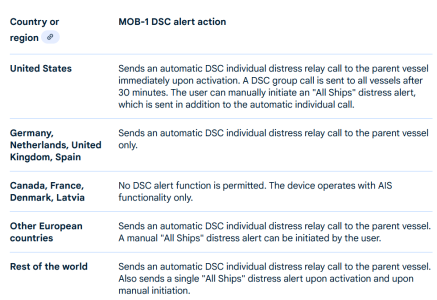
The DSC call function is highly confusing; Individual call, vs Relay Call, vs All Ships Call. It varies by the country in which you purchase the device, and if this is important to you, you should research it yourself. It is (apparently) not even consistent within the EU. The behaviour can also vary depending on whether the call is activated manually or automatically.

It's true that there are so many DSC emergency calls that many people ignore them.

However, when I see an AIS MOB activation, I always watch them to see if they keep moving with the boat. If they do, I generally assume it has gone off accidentally. Usually though I hail the boat on VHF.

I think the range is commonly given a 1nm - it's 0.5 watt. obviously, it depends on the sea state, and how high the device is. But if you mount it according to the directions, it is on top of the PFD bladder, and should be clear of the water. I kind of doubt that in a real MOB situation, a person could on average hold it much higher out of the water by hand for an extended time, because if there are any waves, you will be using your arms to manage your buoyancy. In any case, it's easy to disconnect if you want to try to hold it up.

I like having it mounted in the PFD I just wish that the PFD designers and the MOB device makers would get together and design a better mounting system.
 
My reasoning is that it’s up to date Class M
I'm happy to be corrected on this but Class M is pretty pointless in the UK at the moment. It basically means the device has a DSC receiver (rather than just a transmitter). This means that it can receive an 'acknowledgement' and stop spamming the alert to everyone's DSC radio in the vincinity.

However, in the UK you are not allowed to use this type of device to make an all stations emergency DSC call (only an individual call to an mmsi), so the feature is a bit pointless.

1 It puts out a DSC and AIS alert. The DSC continues until you are notified that someone ‘accepts the signal’. What does this mean … presumably this is the coastguard ?–
In the UK these devices are not allowed to put out a DSC alert. It can only make an individual call to your boat.
Therefore there is no one to 'accept' the alert (because your radio doesn't even have that facility - only shore based stations can do it).

but what if someone else (like me) goes into a button pressing frenzy to stop the alarm and accidentally ‘accepts’ the signal
that's impossible because on your radio that button only silences the alarm locally, it doesn't actually send out an acknowledgement to the alerting radio (which makes it stop transmitting the alert).

Class M basically mandates that the beacon must have a receiver to receive these acknowledgements. The non class M ones would just transmit essentially forever spamming the airwaves with no way to acknowledge / stop them.

2. It also shows an AIS MOB plot to boats in the area. But you are expected to register your boat’s MMSI on the device via an app Does that mean it transmits to your boat first before widening the signal to others ? (Not much point if you’re solo) on a closed loop – or does it broadcast immediately to everyone receiving.
There is a difference between a DSC alert and an AIS position.

The DSC alert is like a mayday call that contains your position at the time the alert was transmitted. In the UK this is sent only to your DSC radio on your boat, and the VHF should then send it to the plotter to display.
In some other countries, this alert would be sent out to all ships in the area and make their radios go mad.

The AIS position just gets transmitted to everyone in the area. There is no prioritisation, it's a broadcast signal.

3 And on that note what happens if you fall off someone else’s boat – does it think you’ve fallen off your own boat
The DSC alert would get transmitted to your own boat's radio. The AIS position would be visible on everyone's plotter.
 
This may have been a bad idea, but a couple of years ago (4-5?), when I installed my MOB1 in my lifejacket, I programmed the DSC MMSI to be Solent Coast Guard. I race solo, predominantly around the south coast, and concluded that having it send a msg to my own VHF would be a little pointless.
I went for the AIS/DSC back then as I concluded that my best chance of being saved was by the other racers around me - back then, the consensus was that the response time to a PLB was too long. However, it sounds from #8 that the response time may have improved, and so I may reconsider when I replace it next year.
 
This may have been a bad idea, but a couple of years ago (4-5?), when I installed my MOB1 in my lifejacket, I programmed the DSC MMSI to be Solent Coast Guard. I race solo, predominantly around the south coast, and concluded that having it send a msg to my own VHF would be a little pointless.
I went for the AIS/DSC back then as I concluded that my best chance of being saved was by the other racers around me - back then, the consensus was that the response time to a PLB was too long. However, it sounds from #8 that the response time may have improved, and so I may reconsider when I replace it next year.

I think you may find you have a very angry coastguard if you were ever to accidentally activate it as they would have literally no way of silencing the call.

Not sure I would admit that on a public forum…
 
Last edited:
This may have been a bad idea, but a couple of years ago (4-5?), when I installed my MOB1 in my lifejacket, I programmed the DSC MMSI to be Solent Coast Guard. I race solo, predominantly around the south coast, and concluded that having it send a msg to my own VHF would be a little pointless.
I went for the AIS/DSC back then as I concluded that my best chance of being saved was by the other racers around me -
I don t know where the CG has its antennas, but it could be difficult to receive an individual DSC beacon message at more than a few miles (being very optimistic), I once posted an example I received an AIS distress signal (from an onboard beacon, not even from a MOB) and had to relay to the CG, they were at just a few miles and did not receive anything. AIS seems a better bet if you sail among other people all similarly equipped with AIS.
FWIW, when alone in coastal waters I keep a DSC VHF, ok it's not automatic but the distress signal is All Ship, VHF radios are a lot more common than AIS receivers, DSC alarms on vhf sets are quite loud (whereas a lot of AIS alerts are barely distinguishable on many receivers), one can confirm by voice the distress and possibly say ''there s my boat with orange canvas going straight under pilot with no one onboard'' :D
 
I think you may find you have a very angry coastguard if you were ever to accidentally activate it as they would have literally no way of silencing the call.

Not sure I would admit that on a public forum…
That's a fair point.
As I say, it's up for renewal very soon and I'm considering a PLB for the AZAB anyway
 
Quoting jakew000
'The DSC alert is like a mayday call that contains your position at the time the alert was transmitted. In the UK this is sent only to your DSC radio on your boat, and the VHF should then send it to the plotter to display.
In some other countries, this alert would be sent out to all ships in the area and make their radios go mad.'


I dont think this can be right - it may be the case with some of smaller devices for crewed boats but the sMRT blurb clearly says that in the UK the alert is sent out to everyone in range -
  • VHF DSC
    Nearby vessels are automatically alerted about the man-overboard situation via DSC technology.
    If I press the DSC on the fixed VHF radio on my own boat I hope it does the same thing ...and makes 'everyone's radio go mad' including the Coastguard who would then acknowledge it?

 
Quoting jakew000
'The DSC alert is like a mayday call that contains your position at the time the alert was transmitted. In the UK this is sent only to your DSC radio on your boat, and the VHF should then send it to the plotter to display.
In some other countries, this alert would be sent out to all ships in the area and make their radios go mad.'


I dont think this can be right - it may be the case with some of smaller devices for crewed boats but the sMRT blurb clearly says that in the UK the alert is sent out to everyone in range -
  • VHF DSC
    Nearby vessels are automatically alerted about the man-overboard situation via DSC technology.
    If I press the DSC on the fixed VHF radio on my own boat I hope it does the same thing ...and makes 'everyone's radio go mad' including the Coastguard who would then acknowledge it?


like i said above - this whole subject is very unclear, and even manufacturers information may not be correct

I am attaching a screen shot of a search result on this topic - not because I think the result is correct.., i will bet you can find differing information somewhere else...

i am only trying to demonstrate that it it is not a simple question.

also, the EU has new rules that came into force Jan 1 of this year, that may or may not be reflected in this result. My understanding is that not all EU countries have adopted the new rules yet: A new European regulation comes into force: which AIS MOB devices will survive after January 1, 2025?. GMDSS Radio Survey Blog

Screenshot 2025-10-09 081956.png
 
Quoting jakew000
'The DSC alert is like a mayday call that contains your position at the time the alert was transmitted. In the UK this is sent only to your DSC radio on your boat, and the VHF should then send it to the plotter to display.
In some other countries, this alert would be sent out to all ships in the area and make their radios go mad.'


I dont think this can be right - it may be the case with some of smaller devices for crewed boats but the sMRT blurb clearly says that in the UK the alert is sent out to everyone in range -
  • VHF DSC
    Nearby vessels are automatically alerted about the man-overboard situation via DSC technology.
    If I press the DSC on the fixed VHF radio on my own boat I hope it does the same thing ...and makes 'everyone's radio go mad' including the Coastguard who would then acknowledge it?
If you look at the Ocean Signal AIS MOB beacon for example (the former one, I do not know the more recent models), there are four or five different configuration softwares depending upon where you buy it and the type of Radio authority you sail under, OfCom, ANFr, etc. In some places the allowed DSC distress is ''All Stations'', in other countries it is ''Individual'' and one has to configure with the one allowed receiving MMSI (possibly your own boat)
like i said above - this whole subject is very unclear, and even manufacturers information may not be correct

I am attaching a screen shot of a search result on this topic - not because I think the result is correct.., i will bet you can find differing information somewhere else...

i am only trying to demonstrate that it it is not a simple question.

also, the EU has new rules that came into force Jan 1 of this year, that may or may not be reflected in this result. My understanding is that not all EU countries have adopted the new rules yet: A new European regulation comes into force: which AIS MOB devices will survive after January 1, 2025?. GMDSS Radio Survey Blog

View attachment 200508
For example, the previous Ocean Signal Mob beacon had about four different configuration softwares, they made available only the one relevant to the regulations of the Country of use (then of course all the others could be found somewhere in the internet). I understand regulations are quickly evolving and still under study by the various national authorities.
 
Quoting jakew000
'The DSC alert is like a mayday call that contains your position at the time the alert was transmitted. In the UK this is sent only to your DSC radio on your boat, and the VHF should then send it to the plotter to display.
In some other countries, this alert would be sent out to all ships in the area and make their radios go mad.'


I dont think this can be right - it may be the case with some of smaller devices for crewed boats but the sMRT blurb clearly says that in the UK the alert is sent out to everyone in range -
  • VHF DSC
    Nearby vessels are automatically alerted about the man-overboard situation via DSC technology.
    If I press the DSC on the fixed VHF radio on my own boat I hope it does the same thing ...and makes 'everyone's radio go mad' including the Coastguard who would then acknowledge it?

I agree it's really confusing having just read through the manual.

Maybe the Class M ones can now make DSC all ships calls?

If the manufacturer cannot tell you what it will do I'd find a different device...
 
Last edited:
Top