AIS crossing Shipping Lanes

Nothing to do with processing power, it is just substandard product design and perhaps substandard consumers.

The CPU effort to produce a bearing at time of CPA is trivial.

Totally correct. The maths needed in the processor is trivial compared to everything else going on.

Perhaps you two need to read the thread a bit more closely ..... and being rude to your fellow forumites is never a winning strategy. :rolleyes:

I would have thought that it was absolutely clear when I said "You need a cleverer algorithm in the display processor to tell you exactly where you will both be at that moment of closest approach." that I'm not using the words "processing power" in the literal sense but in the metaphorical sense as in the colloquial "brain power" i.e. intelligence. :)

Richard
 
My Raymarine AIS info is shown on a Raymarine C120 plotter. I have configerred my display to show my projected track and the projected track of AIS targets. The length of these tracks is variable, I usually use 12 minute vectors, but from memory these can be extended in the menu to 30minutes or more. It is then obvious if the projected CPA is ahead or astern of my boat position.
 
Consider....

AIS says CPA is 0.25 nm. You wish to cross the shipping lane with a bigger margin of safety, say 0.5 nm. So you next need to know if you're going to pass in front or behind the ship, to know whether to increase or decrease your speed (which may be easier than changing course).


.........Grateful for advice.


The only solution I have found is to get into close combat with the target when the change in bearing becomes obvious.

Inside a mile, I make the working assumption that he either has not seen me or is happy with his course. You can then either speed up or slow down to reduce the time in the corridor of uncertainty. Your main worry at this stage is that some dozy bugger is going to wake up on the bridge and do summut daft.

I have just fitted a Vesper which has the prediction facility built in, don't know if it works at sea but looking forward to it.
 
Nothing to do with processing power, it is just substandard product design and perhaps substandard consumers.

The CPU effort to produce a bearing at time of CPA is trivial.

True, but then again it is a number which makes little sense in the absence of its associated uncertainty level; it could even be dangerous in isolation. For this reason tech companies like FLIR (Raymarine's owner) tend to desist from providing this parameter in isolation. Raymarine's preferred approach is therefore to display a collision risk intercept zone where its size encompasses something like a 2 std confidence region under whatever base parameters they are using. This can either be a rectangular box somewhere along the target's heading vector with the risk target clearly ringed in red, or simply a shaded ring (I think) if it cannot. The user can in turn configure this alarm feature to alert for a user defined CPA/TPCAs, which all in all is pretty good. It is arguably better than a bearing at CPA which starts to suddenly swing all over the place at the last minute in the event of a close encounter? Finally, as others point out some AIS systems are happy to pump out this parameter accompanied by a suitable health warning.

Edit: here's a quick link from PBO which explains it well:
http://www.pbo.co.uk/gear/collision-avoidance-software-38277
 
Last edited:
Perhaps you two need to read the thread a bit more closely ..... and being rude to your fellow forumites is never a winning strategy. :rolleyes:

I would have thought that it was absolutely clear when I said "You need a cleverer algorithm in the display processor to tell you exactly where you will both be at that moment of closest approach." that I'm not using the words "processing power" in the literal sense but in the metaphorical sense as in the colloquial "brain power" i.e. intelligence. :)

Richard

What the 2 [joke]nerds[/joke] above arent saying is that in the calculation for CPA, there is a step where it would be less than trivial to produce any/all of time, location, vector at that point.
 
Perhaps you two need to read the thread a bit more closely ..... and being rude to your fellow forumites is never a winning strategy. :rolleyes:

I would have thought that it was absolutely clear when I said "You need a cleverer algorithm in the display processor to tell you exactly where you will both be at that moment of closest approach." that I'm not using the words "processing power" in the literal sense but in the metaphorical sense as in the colloquial "brain power" i.e. intelligence. :)
When did pointing out factual error become offensive behaviour on YBW?

Once CPA has been calculated sufficient info is available to derive bearing at time of CPA.

And you need to stop digging yourself into a deeper hole by stirring the world "intelligence" into your claims. There is nothing intelligent about cartesian maths and trigonometry, it pre dates Newton and Calculus.

We are indeed beginning to see intelligence in AIS software as demonstrated by Raymarine's 2016 software update which shows red and green zones. The software then provides guidance on where to steer in a multiple ship crossing scenario.
 
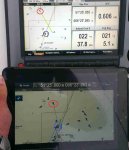
This is an example of the different AIS vectors in Raymarine older software and the newer Lighthouse software, albeit the first with AIS improvements in 2015 (slightly improved since then)
I have added red circles round the ship and blue round the boat position - the E90W shows the (actual track) vector ahead whereas the newer e7 (copied to the iPad via RayControl) shows the more useful relative track crossing through our position.

Not exactly the same situation as the OP's, as in this case the CPA would be zero - but if the CPA had been 0.5miles the relative vector on the e7 would show whether crossing ahead or behind. But lots of room for confusion when different versions, and different Raymarine plotters running latest available software, show very different things.

I think I may have posted on here a similar question asking how to determine whether CPA was ahead or behind, as also surprised at this apparent major but easily addressed omission.

PS One other big improvement in the recent Raymarine Lighthouse software is the different AIS ship icons. In the situation shown there were a host of targets with close CPA's, but mostly very slow moving fishing boats over the Celtic Deep. Fortunately I wondered if any of the many targets was different, and having been through each sure enough on of the many CPA's hiding at the back was a biggie doing 20 knots directly towards me rather than a little one doing 2 knots. With 2016 software update he might have a bigger ship icon (IF the AIS static data is accurately updated)
 

Attachments

  • IMAG2533 AIS vector differences 2015c.jpg
    IMAG2533 AIS vector differences 2015c.jpg
    83 KB · Views: 1
When did pointing out factual error become offensive behaviour on YBW?

Once CPA has been calculated sufficient info is available to derive bearing at time of CPA.

And you need to stop digging yourself into a deeper hole by stirring the world "intelligence" into your claims. There is nothing intelligent about cartesian maths and trigonometry, it pre dates Newton and Calculus.

Lol .... I have no problem digging any hole you like .... but you won't last long on here if you continue to refer to the forumites who buy into AIS as "substandard consumers". :)

However, I do formally retract my previous allegation that you haven't read my posts correctly as it's now clear that you haven't even read your own! :encouragement:

Richard
 
My Raymarine AIS info is shown on a Raymarine C120 plotter. I have configerred my display to show my projected track and the projected track of AIS targets. The length of these tracks is variable, I usually use 12 minute vectors, but from memory these can be extended in the menu to 30minutes or more. It is then obvious if the projected CPA is ahead or astern of my boat position.
Further to the above, I can then make speed or heading adjustments to ensure my required Distance to CPA is maintained.
 
In the absence of a built-in system indicating whether a crossing will be ahead or astern, it helps to get back to basics: monitor the change of bearing indicated in the target info, just as you'd do with a hand-bearing compass. The bearing's trend will tell you how you'll cross and the only algorithm required is already in your head. (If it isn't, perhaps you shouldn't be at sea;))

Granted there might be a bit of overload on a busy day in The Solent, but for crossing shipping lanes, it's fine.

(Apologies if this was already suggested: I lost interest in the squabble.)
 
Another way would be to plot an intercept course and once you have the bearing to intercept you can workout what course you need to stear to either pass ahead of astern of the target vessel.
 
I think I may have posted on here a similar question asking how to determine whether CPA was ahead or behind, as also surprised at this apparent major but easily addressed omission.

Agree that software is catching up fast, not that surprising given the relative newness of AIS to the mass leisure market.

That said, the fact that a gaggle of big US/Japanese tech company cannot sort a "major but easily addressed omission" contains a clue to a different explanation. For the aforementioned reasons it turns out that this is an explicit choice on their behalf made for both legal and safety reasons. Raymarine has recently come up with something much more useful and significantly more complex solution in that it attempts to depict the implicit error terms around the vector crossover points. Others will surely follow (perhaps they have?) in implementing more secure solutions than the deceptive attraction of a simple bearing at CPA angle.
 
Not yet having the benefit of AIS (Vespermarine unit purchased at SIBS, but not yet installed), I'm surprised that this problem exists.

If I lock onto targets on RADAR using MARPA, and then hover over the target with the pointer, it draws the relative vector of the vessel to its CPA, and adds a line perpendicular from that points back to my boat (with annotations in the display giving CPA and TTCPA). As per Dunedin's earlier explanation, it is then immediately apparent whether I am passing ahead or behind the other vessel depending on where the relative vector line is drawn.

This is easy enough for them to do with RADAR (on a Raymarine E series from 2005, with software last updated around 2012). Why would it be any different for AIS?
 
Not yet having the benefit of AIS (Vespermarine unit purchased at SIBS, but not yet installed), I'm surprised that this problem exists.

It doesn't! In fact you'll love the new AIS functionality with the only caveat that you may have to update the software to Lighthouse II version and this may in turn stress the CPU on an E Series. The Raymarine tech guys in Fareham and will I'm sure be able and happy to advise.

Failing that the Vesper app is excellent in itself and you cld always run it off an iPad or something as an alternative platform?
 
Not yet having the benefit of AIS (Vespermarine unit purchased at SIBS, but not yet installed), I'm surprised that this problem exists.

If I lock onto targets on RADAR using MARPA, and then hover over the target with the pointer, it draws the relative vector of the vessel to its CPA, and adds a line perpendicular from that points back to my boat (with annotations in the display giving CPA and TTCPA). As per Dunedin's earlier explanation, it is then immediately apparent whether I am passing ahead or behind the other vessel depending on where the relative vector line is drawn.

This is easy enough for them to do with RADAR (on a Raymarine E series from 2005, with software last updated around 2012). Why would it be any different for AIS?
The reason is reference frame.
With radar your boat is the reference and other vessels tracks are displayed relative to you, so pass in front/behind is blatantly obvious. With AIS, however, it is the ground that is the reference and the relative visualisation goes out the window.
Another factor, and I'll take me hat off to the software publishers, Is the accuracy and age of AIS information. With radar then what you get is a per few seconds absolute update. AIS is no so timely and relies absolutely on the transmitter's accuracy. What if their GPS is up the swaney? what if their paddle wheel log is covered in weed?
Thats not to say that theres any excuse for the delay from the concept of alerting CPA to the currently emerging displays. Beta testing would have shown the problem with indication vector at CPA, but TCPA is less prone to problems, and your position and target position (plus a blob) at TCPA should have been an intuitive step.
That would have been quickly followed with "what do we do with a display full of confetti" when in a busy situation, answer is simple: show the first to happen!
 
I'm struggling to make the connection between AIS and the paddlewheel.
There is not, he just wants to sound like an expert but is not.

In addition his claim that because radar sees the other it becomes obvious whether the other ship is passing ahead or behind is just as fanciful.
 
Top