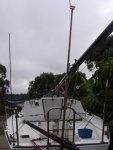
AIS antenna - what type and where best to locate

picardy

Well-Known Member
Joined
31 Mar 2005
Messages
266
Visit site
I want to fit an AIS system this year and have been thinking where best to fit the antenna.

If I go on the spreaders I get great height but its a pain to fit. If I go on the pushpit its easy to fit but lower down. Also do I go for a rubber stub, stainless whip or fibreglass?

Thanks
 
Pushpit is OK, but if you have a transponder it transmits, and you need it to be well above head height. There are safe distance recommendations for VHF transmitting aerials, and you certainly don't want one at head height close to where you stand at the helm. Mounting the aerial on a pole so that its base is well above head height is probably a good idea.
 
Hi

Line of sight is your starting point and then you may not want it so high as to give too many readings from targets not likely to cause you any trouble.

We fitted a "stubby" and keep it inside the boat as high as cabin allows giving plenty of range for us. We have it on a long cable. Thinking we could rig it, say, on spreaders if a longer range was required.

A
 
Pushpit is OK, but if you have a transponder it transmits, and you need it to be well above head height. There are safe distance recommendations for VHF transmitting aerials, and you certainly don't want one at head height close to where you stand at the helm. Mounting the aerial on a pole so that its base is well above head height is probably a good idea.

I think a class B AIS is not too much of a power risk, but pushpit mounting is prone to damage from mooring lines, usually other peoples.
Also the biggest danger of damage to people from transmitters is statistically poking the aerial in your eye, so having the tip well above eye level (even when standing on the seats) is a good idea.

Mounting it below is just gross, you never know if it will work significant less well when there is a lot of spray on the deck etc, which is when we most need our electronics to work.
 
Pushpit is OK, but if you have a transponder it transmits, and you need it to be well above head height. There are safe distance recommendations for VHF transmitting aerials, and you certainly don't want one at head height close to where you stand at the helm. Mounting the aerial on a pole so that its base is well above head height is probably a good idea.

AIS transponders are limited to 2 watts output power. In comparison your hand held VHF is limited to 5 watts. I would not worry too much about safe distances.
 
I have also been looking at this in the last few weeks and at this moment in time I am minded to go for the spreaders even though it is going to be harder to install. I will trial it first as a 'loose' fixed installation before drilling any holes.
 
Mine is on the pushpit for two reasons, range is good at 10-15 mile and if the mast comes down, it'll still be there and able to act as a VHF antenna. It's a wee stub one from Cactus.
 
To answer the OP's question - it depends on your boat and how you use it. If you already have a masthead VHF antenna (with cable) you might use that with a splitter. If you don't have a masthead VHF and don't want long range you may get by with one lower down (eg pushpit, spreader (what about mast shadow?) etc.
I have a Vesper set up and am really happy (definitely no connection). Some points:
- if you are in the open ocean 100 Nm IS of interest - if not you can select the range of targets to alarm and display (in coastal mode I’m happy with 25 Nm which is about 1 hour’s notice, in harbour 5 Nm is better);
- the splitter does not introduce losses – in fact it amplifies both the VHF and AIS signals (it is 12V powered);
- the splitter supports AM/FM, VHF and AIS;
- a normal VHF antenna is not strictly optimum for both VHF and AIS but probably adequate. You can get an antenna that serves both well (I had to replace mine, bl##dy Cockatoos, so I got the dual one - magic);
- I carry my spare VHF antenna below in case my mast falls and takes out my targa with solar panels, wind generator and GPS antennae;
- give some thought to how you will display and use the AIS information – my little Vesper screen is OK but the information is even better overlain on a chartplotter or PC (eg OpenCPN);
- I'd suggest contacting your proposed supplier and asking . . .
Cheers, Andrew
 
Pushpit is OK, but if you have a transponder it transmits, and you need it to be well above head height. There are safe distance recommendations for VHF transmitting aerials, and you certainly don't want one at head height close to where you stand at the helm. Mounting the aerial on a pole so that its base is well above head height is probably a good idea.

Nonsense. If that were true then they wouldnt make vhf handhelds. MF and other frequency ranges should be away from brains.
 
On the pushpit salty John on the forum sells the kit you also have a backup for your VHF. No connection other than as a satisfied customer
 
The range of a VHF signal is proportional to the height of the antenna. If you want to see and be seen at longer ranges then mount your antenna as high as possible. If you prefer not to see or be seen then mount your antenna as low as possible or leave it at home.
 
100_6759scaled.jpgI have a VHF antenna home made consisting of a stainless steel pole which is part of the stern rail but extends up another .5 metre. This is the ground plane. The antenn itself is a piece of SS wire rod 4mm diameter and 17 inches long. I flattened out the bottom end of the rod and drilled a hole for a small screw onto a ring AMP lug onto the coax centre. This fits into a piece of plastic conduit that goes into the post. A slot in this plastic allows the outer braid to pass through to another AMP lug screwed througha hole in the post.
Another peice of plastic tube goes into the first plastic tube to fill the gap between the post and the antenna. The whole of this area filled with epoxy to keep water out and hold it in place. The coax feed goes down the post. So tip of the antenna is about 2 metres above the water and about 1.5 metres above the cockpit seat. It works a treat as a com antenna and of course is good if mast comes down. I would recommend this type as an AIS antenna and emergency com antenna. I would not suggest a splitter from com antenna. (too much complexity and no redundancy) In my case the post also doubles as a hand hold for when climbing out of the water but it could be an additional post clamped to the side of an existing stern rail. In the picture you cna just see the VHF antenna on the far right. The long antenna on the left was a 27mhz mrine which has now gone out of fashion in west oz. good luck olewill
 
Thanks for all the comments. I get mixed reports about VHF splitters. The plus is obviosuly that you don't need a second antenna but what's the downside as they seem quite expensive.

Thanks
 
I bought a Digital Yacht AIS and they recommended their AIS optimised aerial rather than a splitter although they offer both. It's quite stubby and mounted on the pushpit, from my mooring in Gosport I receive returns from the larger ships moored in Southampton docks and from way down into the Nab anchorages, which I find more than satisfactory.
 
Top