Air drift height

Couldn't agree more, its one thing I miss not being able to access the river above Oxford but you have to compromise if you want a sea going cruiser as well. It wouldn't be worth buying a boat that can just get under Folly bridge but not Osney as well, a lot more choice if you use 12'5" as your max and accept Folly bridge is the limit.
thank you
 
Couldn't agree more, its one thing I miss not being able to access the river above Oxford but you have to compromise if you want a sea going cruiser as well. It wouldn't be worth buying a boat that can just get under Folly bridge but not Osney as well, a lot more choice if you use 12'5" as your max and accept Folly bridge is the limit.
My boat is a blue water ocean going motor cruiser which can also go to Lechlade.

It doesn't have a flybridge though which some people might see as a problem.
 
Outinthedinghy.
Please what class of boat do you have? I would love a boat that could do the length of the Thames and also be seaworthy.
 
Outinthedinghy.
Please what class of boat do you have? I would love a boat that could do the length of the Thames and also be seaworthy.

My boat is a one off home build (not built by me!) So it doesn't have a "class" as such but in boat design terms I suppose it would be described as a scaled down outrigger trawler built as a twin screw motor yacht.

Slightly deep for up the top end at 3ft6 but she got there.

I have yet to do any salty work as only got the boat last year and wanted to put hours in on the tame Thames before doing anything else. And now Emma Smith bridge is shut...
 
Between Teddington and Oxford the minimum bridge clearance is 12ft 5ins - Culham lock cut and 12ft 6ins at Cookham.
Also the air draught of boats advertised is not always the minimum attainable with masts etc folded.
Plenty of boats like the ones you mention are on the upper Thames.
Be aware that all bridge clearances are if the headwater of the Lock below is at Headwater (0”). Cookham is very rarely kept at this level And is normally between +2” and +4”, but can be as high as +6” (meaning a clearance of 12’0”.). Add to that the lock cut constantly bobbing up and down three inches either side of the average reading. Therefore a constant variance of six inches between the peak and trough.
 
Be aware that all bridge clearances are if the headwater of the Lock below is at Headwater (0”). Cookham is very rarely kept at this level And is normally between +2” and +4”, but can be as high as +6” (meaning a clearance of 12’0”.). Add to that the lock cut constantly bobbing up and down three inches either side of the average reading. Therefore a constant variance of six inches between the peak and trough.

If air draft clearance is a concern, just ask the duty keeper what the headwater is as you pass through the lock (assuming you can find him/her). No HWs are kept at zero, all are between +2" to +8" as the norm.
 
If air draft clearance is a concern, just ask the duty keeper what the headwater is as you pass through the lock (assuming you can find him/her). No HWs are kept at zero, all are between +2" to +8" as the norm.

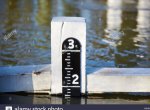
I should add that, in the absence of a duty keeper, you can check the headwater gauge yourself, a cast iron bar with graduations in inches that will be found attached to a pile near the head gates on on the bull noses of the chamber.
 
These things

Screenshot_2020-09-27-14-34-42-077_com.android.chrome.jpg

But I think, to be pedantic, they may be cast aluminium rather than cast iron. Some of the old TC lock name plates (prior to the tin enamel ones) were aluminium where you might expect iron.
 
Last edited:
Be aware that all bridge clearances are if the headwater of the Lock below is at Headwater (0”). Cookham is very rarely kept at this level And is normally between +2” and +4”, but can be as high as +6” (meaning a clearance of 12’0”.). Add to that the lock cut constantly bobbing up and down three inches either side of the average reading. Therefore a constant variance of six inches between the peak and trough.
thank you for the info very helpfull.
 
Another way of doing it is by googling "River level Cookham" and opening the page. Google seems to display slightly out of date data for this on its own page.

Cookham currently 0.07m which is about 3 inches.
 
Top