Aftermarket Bellows Kits....a warning

The rubber ones where the ram goes over the pins.

Those rigid plastic bushes are pretty thick, I wouldn't have thought that any copper tube insert would have given any contact with the drive. The screwed on bonding cables on the DPH sound a better solution. I did have some very minor corrosion on the DPS drives. Some on the shaf where it passed through the drivet, some pitting due I presume to crevice corrosion as they were sealed from oxygen and on on the ends of the rams, where the bosses were up against the well greased bushes. Very minor though.
 
Last edited:
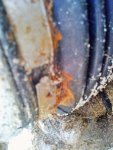
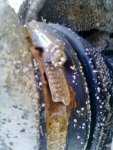
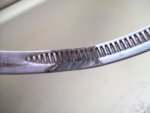
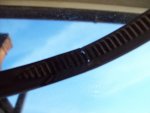
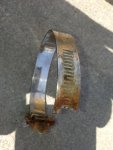
I have just one clip with me and there seems to be rust around the worm drive part and also an area of corrosion on the underside, so potentially two separate problems. The only numbers under the rust are W5 120-140. I'll post some photos when I get a mo.

The retailer's site mentions the use of marine stainless steel for their clips (otherwise known as 316) But The Australian Stainless Steel Development Society report that 316 grade is prone to pitting and crevice corrosion and they say 316 is unsuitable for use in sea water where crevices exist and the temperature is 10-15C. Maybe this is why VP use a special alloy (perhaps S31803) and the aftermarket jobs are in fact lower grade stainless steel.

WP_001883.jpgWP_001884 (1).jpgboat corrosion 002.jpgboat corrosion 003.jpg
 
Last edited:
This was ths clip taken off the water intake hose on our friends new boat.
As I say the worm / screw was made of mild steel. As are most of the cheap stainless clips.
 

Attachments

  • IMG_0190.jpg
    IMG_0190.jpg
    68.8 KB · Views: 5
That's shocking after just 4 months. I did change my water intake hoses when I changed the bellows. These came from a different supplier but I'm certainly removing all the aftermarket stuff when I next visit!
 
That's shocking after just 4 months. I did change my water intake hoses when I changed the bellows. These came from a different supplier but I'm certainly removing all the aftermarket stuff when I next visit!

Strangely on the SX/ DPS Volvo Penta do not fit a bonding wire to the water inlet hose clamp; maybe the clamp on that hose is not judged critical

As I mentioned earlier, the original VP exhaust bellows clamp on my boat was virtually as new after 9 seasons use in salt water.
 
Last edited:
electrolysis can't happen without an electrical supply and these clips are totally insulated from metal and any potential power supply either from the boat or ashore.
That is absolutely not correct. All you need is 2 different metals touching each other and immersed in seawater and you'll create an electric current

In this case if the components within the construction of the clip are different metals you could get electrolysis, and of course you could get crevice corrosion as you say. It's a pity the clips are not made from plastic. I'm glad you spotted it before it was too late!
 
I replaced the bellows on our SX drive last year, I got the aftermarket kit from repower marine and didnt think the clips were stainless so used the old ones which were fitted with bonding wires.
 
I replaced the bellows on our SX drive last year, I got the aftermarket kit from repower marine and didnt think the clips were stainless so used the old ones which were fitted with bonding wires.

I did that a few years ago ! The bellows looked fine, but the clips that came with it didn't look "right". Stainless for sure, but different compared to the VP one, not in a good way.
 
That is absolutely not correct. All you need is 2 different metals touching each other and immersed in seawater and you'll create an electric current

In this case if the components within the construction of the clip are different metals you could get electrolysis, and of course you could get crevice corrosion as you say. It's a pity the clips are not made from plastic. I'm glad you spotted it before it was too late!

I think you'll find that my statement was absolutely correct, 3 things are required for electrolysis to occur, an electrolyte, dc current and two electrodes.

I believe the process you refer to within the clip with two metals in contact is Galvanic corrosion.

I think these clips from repower marine suffered from both crevice corrosion and galvanic corrosion,
 
Sure, if we are using scientific precision then yes you're right that electrolysis requires a potential to "drive" the current whereas galvanic just need 2 metals of different nobility in an electrolyte, with no external battery or similar.

It's just that in non scientific conversation and in boating circles the term electrolysis is widely used to cover what is strictly galvanic activity. That is what I did (and do often) and in your OP you did the same: you wrote "the clips are insulated from any metal so electrolysis can't occur", from which most readers would deduce you were thinking of galvanic. No worries though :D

I think these clips from repower marine suffered from both crevice corrosion and galvanic corrosion,
Agreed!
 
Top