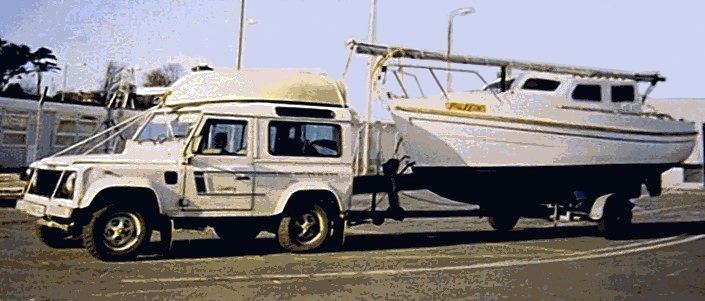
Advice on trailer-sailer launch please.

I always treat the "never submerged" claims with a pinch of salt.

Recovey with guide arms is a doddle, I wouldn't struggle without them.

Jacking up the trailer with the boat on is very little different to doing it without so I do my bearings after each trip.

I jack mine up and take the wheels off so it's less nickable when it's on the drive.

The brake cables don't run in an outer either, it's a rod back to a splitter than a cable to each side, nothing to get stuck.
P1000537.jpg
 
30 odd foot tides if he is launching from the Wirral if on the Mersey side the tidal currents would probably not be kind to the trailor the Dee side if I recall it can be done that way, just remember to buoy the trailer as others might use the beach to....

I was thinking more of a long rope on the nose of the trailer and just pull it out of the water as soon as the boat floats off rather than leaving it to the next low water.
 
As said you really need a ramp or steep beach to roll the boat off. As said I don't think you can avoid getting the bearings and brakes wet. Also as said put the lights on a board so they can be removed.
For recovery you can push the trailer out deep enough to float or winch the boat on then recover on the end of a rope to the car.

As Vic says you can set up ropes and pulleys so that the pulling on winch can be used to pull the boat off. ie a rope from the winch down to a pulley on the back of the trailer, forward around the bow then back to a fixture on the other side back of the trailer. Attach the winch wire to the rope so that you pull the bow towards the back of the trailer.
Or better fit a pulley at each back corner of the trailer with 2 ropes on end of each attached to the other around the bow. The other 2 ends to the winch wire. Tricky to get enough movement of the ropes. The first option has rope slipping across the bow (like a puley 2 purchase) the second no slipping no purchase.

However there are some things you can do to the trailer. (major surgery). I had to replace the draw bar on my trailer early on. Box section rusted through) I fitted the draw bar so that the trailer has more tilt back down. This effect could be achieved by raising the car tow ball. Hence the boat has a better slope to roll down.

In the photo of brakes above you will see that the springs hang from under the axle. Make sure yours is like that. If springs are above you will have the boat a lot higher than necessary. You may be able to move them to lower boat. Check of course for clearances. If it is under you may be able to fit a spacer to lower boat even further.
You should not be afraid to wet the trailer. Indeed you may need to disconnect from the car and push the trailer out deeper then retrieve on a rope. (need a decent jockey wheel) You may even need an anchor or mooring out deeper to use to pull the trailer out further.
These things may help but really you need a decent steep ramp. Hang in there you will get used to it with experience. olewill
 
1.5 tons is a lot for trailer sailing, and on a beach will almost certainly sink in as you have found. The standard rubber rollers fitted to most trailers are unlikely to run freely with that load on them anyway, making it even more difficult to shift it.

One solution would be to have the boat on a trolley which can be dunked, and then winched back on to the trailer. There are a range of trailers available designed to do it this way, though not cheap! It might be possible to make it up for yourself and modify your existing trailer.. There is also the breakback system where the boat sits on a frame that slides down to the back of the trailer to allow you to launch it without dunking the wheels.

I doubt very much though that you will be able easily to slide the boat on and off without modifying it quite radically.

It shoudl not take all day to rig your boat. The last trailer sailor I had was a 20 footer, and I could get her rigged from road running position in around 20 minutes.
 
As others have said, the hubs need to go in and you need to live with brake and bearing maintenance. Two tips learned the hard way.

If you have inner and outer brake cables, run oil down the inner cable (from new is best!) and then fill the 'cup' at the hub end with marine grease.

As others have said, brakes are more of an issue than bearings, especially if you use bearing savers. A major problem for me was salt water getting under the brake linings, causing the shoe to rust which expands and pushes the linings off the shoe. I now seal the junction of the shoe and liner with Hammerite or similar.
 
Thanks Oldharry. I had completely forgotten about "break back trailer" . The ones around here and they are very common has an overlapping join in the draw bar with a pivot bolt about 3 metres back from the tow ball. With the boat gone back some distance on the trailer the back "breaks" raising the front of the frame of the trailer and dropping the back of the trailer to the sand. The boat then slides off so much more easily. On retrieval the bow when being winched onto the back roller pushes the back of the trailer down "breaking " the draw bar of the trailer. You tend then to be winching the boat up a steeper slope of the trailer bed but as the boat reaches the balance point the draw bar unbreaks and the trailer becomes level for the final pull into position.
So it happens automatically. There is a pin that is fitted when not broken to hold the draw bar rigid. OP might find it worth investing in an electric winch for the trailer. Talk to a boat trailer expert about break back. good luck olewill
see also http://www.ybw.com/forums/showthread.php?129200-How-to-best-use-my-break-back-trailer
 
Sympathies. It's a toss up between time available, technology/ engineering and cash for the right equipment or mechanic. Our boat is 1.5 T. We launch and recover from a reasonably firm sand beach. The trailer usually sinks. The answer was to launch elsewhere or to buy a piggy back, launch trolley on a road trailer. Rd trailer doesn't go near the sea. Boat on launch trolley goes on beach, rig, cuppa, buoy trolley and anchor out, cuppa , float off and moor. Rtn for cuppa, cuppa, cuppa. Tide goes out and recover/ hose down trolley and forget until end of season. Worked a treat for 4 years so far. Good trolley system, choose your day and plan to take your time...
 
I had a Jaguar 22 towing with a Citroen CX. I was able to alaunch and recover single handed unless there was a cross wind.

I would keep the car on the level and chocked, belaying the trailor into the water with a rope around the tow ball. I had nightmares about it getting away from me but it was never an issue. For recovery again I kept the car on the level letting the trailor into the water. When the boat was back on I would use the rope to pull it up to the level section by driving the car forward.

I fitted arms to the trailor to guide the boat back on after a year which made things easier esp if there was a cross wind.
 
Thanks for all the good ideas. I managed to get a friendly tractor owner to assist - the result was a large trench in the beach from tractor wheelspin and a 22mm doubled line parting with a bang. Gave in and immersed trailer and have been studying YouTube on hub maintenance ever since. Will consider trolley & cranage options for the future and possibly fitting unmarked wheels to my trailer. Thanks again.
Andy
 
Top