Advice on this crack please

Poey50

Well-Known Member
Joined
26 Apr 2016
Messages
2,319
Location
Chichester
Visit site
20190111_113329.jpeg

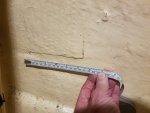
This is near the waterline in the port forepeak of a Sadler 32. The hull had extensive work done on it in 2012 because of a leak in the deck to hull join. There were good professional repairs done but none in this area. I've seen a photo of the gelcoat stripped back on the outside to this crack and there is no crack or damage showing. Could it be an artefact of the way it was laid up? What are the options for treating it?
 
Am I right in thinking Sadlers have a sandwich construction with foam in between? If so, there's no danger of the boat sinking and you can do it afloat quite happily.

I'd grind it out, tapering the edges, and repair with as many layers of glass cloth and epoxy as needed. Finish with flowcoat or, if it's not in plain view, Danboline or similar.

This article shows you how.

You can use polyester resin, but epoxy gives a stronger bond.
 
It’s a 32 so no Hull sandwich foam filled thingy, just a very heavy lay up as was common in those times. Is that the bulkhead just to the left?
That looks like a very uniform rectangular panel added at some point but the paint over it looks as though it was done at the same time as the rest so it’s unlikely to be a later repair. Could it be a void repair at point of manufacture?
At any rate, if you want to get to the bottom if the issue the only way is going to be to grind it back to see what’s happening and the repair as needed.
 
Am I right in thinking Sadlers have a sandwich construction with foam in between? If so, there's no danger of the boat sinking and you can do it afloat quite happily.

I'd grind it out, tapering the edges, and repair with as many layers of glass cloth and epoxy as needed. Finish with flowcoat or, if it's not in plain view, Danboline or similar.

This article shows you how.

You can use polyester resin, but epoxy gives a stronger bond.

Many thanks. The S32 deck has a foam core but the hull has a solid layup as below ..

hull.jpeg
 
Is that the bulkhead just to the left? .

That's right.

That looks like a very uniform rectangular panel added at some point but the paint over it looks as though it was done at the same time as the rest so it’s unlikely to be a later repair. Could it be a void repair at point of manufacture?
At any rate, if you want to get to the bottom if the issue the only way is going to be to grind it back to see what’s happening and the repair as needed.

Thanks - I'll do that. I'll wait 'till the boat is out of the water just in case.
 
Yes it does like an added patch of some kind.
Will it lift up if you push a scre driver in it?
If I was determined to investigate further I would try to see if that bit pulls off in order to determine just what has gone on. This before grinding back as the grinding may make it harder to see what has been done.
Then of course grind out/rough up and repair as normal.
 
Yes it does like an added patch of some kind.
Will it lift up if you push a scre driver in it?
If I was determined to investigate further I would try to see if that bit pulls off in order to determine just what has gone on. This before grinding back as the grinding may make it harder to see what has been done.
Then of course grind out/rough up and repair as normal.

The patch has certainly lifted at the bottom, at some point, by about one millimetre but it resists lifting up any further with moderate leverage.

An earlier comment that the patch was put on before the original painting looks correct. What might be the reasons that this is done? (Just for interest.)
 
The patch has certainly lifted at the bottom, at some point, by about one millimetre but it resists lifting up any further with moderate leverage.

An earlier comment that the patch was put on before the original painting looks correct. What might be the reasons that this is done? (Just for interest.)

As I said, the only reason I can think of is a void found at the lay up stage, a gap or air bubble in the GRP that perhaps became apparent on close inspection, was cut out and re filled. Nice tidy finish with a uniform margin.
 
... An earlier comment that the patch was put on before the original painting looks correct. ...

But how original was the painting? Our forepeak is carpeted, but it’s a Slack boat so I don’t know what was the original Sadler finish - which, if paint, might have been repainted anyway?
 
The patch has certainly lifted at the bottom, at some point, by about one millimetre but it resists lifting up any further with moderate leverage.

An earlier comment that the patch was put on before the original painting looks correct. What might be the reasons that this is done? (Just for interest.)

My guess, being unable to actually see it, is that it's part of the 'tabbing' which holds the bulkhead in place. It was never properly bonded to the main layup of the hull, and it's cracked away as a result of an impact or fender forces, maybe even yard propping forces, flexing the hull at that point.

Is the paint actually paint, or flowcoat?
 
When you enlarge the photo for more detail there appear to be a number of hairline cracks running vertically to the right of the patch. Looking closely at the obvious vertical crack you can discern a hairline crack rising from exactly that point. The hairline cracks could suggest some previous impact damage externally. Do you think the external gel oat is completely original and undamaged. If there are hairline cracks confirmed internally it is very likely there has been something externally that has caused them. Look closely for evidence of either previous external repairs or hairline cracks in the gel oat.
 
My guess, being unable to actually see it, is that it's part of the 'tabbing' which holds the bulkhead in place. It was never properly bonded to the main layup of the hull, and it's cracked away as a result of an impact or fender forces, maybe even yard propping forces, flexing the hull at that point.

Is the paint actually paint, or flowcoat?

This. Exactly. It's some extra tabbing done at original build - just not very well. Nothing to worry about. Grind away and re-do.
 
My guess, being unable to actually see it, is that it's part of the 'tabbing' which holds the bulkhead in place. It was never properly bonded to the main layup of the hull, and it's cracked away as a result of an impact or fender forces, maybe even yard propping forces, flexing the hull at that point.


Is the paint actually paint, or flowcoat?

It's flow coat and original judging by the rest of the boat.
 
Impact, definitely, see how the mat has been lifted by bulkhead. You would be amazed how much the hull can deform then pop back, leaving internal damage like that. Well, it's not really damage, just cosmetic.
 
Our 1985 Sadler 32, which we've owned from new, looks very similar but uncracked.

I'd agree it's as originally constructed but the hull has flexed at some time since, enough to create that crack along the edge of the top woving in the lay up.

It may be very little to worry about. If it's totally firm under the crack I'd be tempted to try a little filler first and see if it cracked again.
 
I was about to suggest looking for the tabbing in an area not flow-coated, to compare and confirm that that is what it is. On ours, the wet locker is not flow-coated but I was also going to suggest looking on the other side of the bulkhead to the crack (behind the toiletries cupboard?) - which might be a wise move anyway in the circumstances.
 
Thanks all for additional thoughts. As said, previously the outside seems fine but, as there is now a weakness in this area, I will grind back as most have suggested and fill as needed in the usual way. I'll report back if there is anything unusual.
 
Top