Advice on Blake seacocks please

Nickm72

New Member
Joined
7 Oct 2019
Messages
21
Visit site
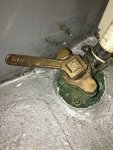
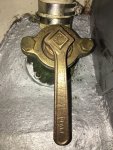
Hi, I've just bought a Super Seal 26 and hope to put her in the water next week, so have been servicing the seacocks. I have a few questions I hope someone can help me with please?

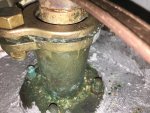
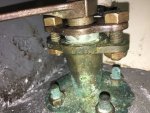
  1. The waste seacock seems to seat right down nicely but the water inlet doesn’t…there is a big gap between the clamping plate of the cone and the hull fitting. Looked on YT and this one seems to have the same gap
    . Is that normal? (please see my attached pictures)
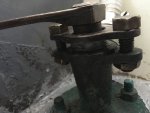
  2. How tight should the bolt at the top and the locking nut be?
  3. Does the locking nut go in-between the hull fitting and the clone clamp or under the hull fitting? Here, on a newer one, the nut goes in between
    . Which is right for my version?
  4. Is there any way to test these before I put her in the water?
Cheers, Nick.
 

Attachments

  • IMG_2749.jpg
    IMG_2749.jpg
    980.7 KB · Views: 24
  • IMG_2755.jpg
    IMG_2755.jpg
    703.7 KB · Views: 27
  • IMG_2752.jpg
    IMG_2752.jpg
    135.5 KB · Views: 27
  • IMG_2753.jpg
    IMG_2753.jpg
    431.6 KB · Views: 27
  • IMG_2754.jpg
    IMG_2754.jpg
    516.6 KB · Views: 22
  • IMG_2748.jpg
    IMG_2748.jpg
    121.4 KB · Views: 23
I have these on my Westerly. You should clamp down until the tap is stiffish but still movable. Then ideally lock off with nut behind the body. Oh and clean and grease tap cone and bore first.

If worn they may seep a bit but plentiful grease cures most of this. My cockpit drains re fine after 42 years as rarely moved, my heads need regular greasing and adjustment. Hard to test in situ. You could try pressuring from outside with hose - if they don't leak they are bomb proof but if they do leak you may just be giving too much pressure compared with 1 foot head of water in normal use
 
Hi, I've just bought a Super Seal 26 and hope to put her in the water next week, so have been servicing the seacocks. I have a few questions I hope someone can help me with please?

  1. The waste seacock seems to seat right down nicely but the water inlet doesn’t…there is a big gap between the clamping plate of the cone and the hull fitting. Looked on YT and this one seems to have the same gap]. Is that normal? (please see my attached pictures)
  2. How tight should the bolt at the top and the locking nut be?
  3. Does the locking nut go in-between the hull fitting and the clone clamp or under the hull fitting? Here, on a newer one, the nut goes in between Which is right for my version?
  4. Is there any way to test these before I put her in the water?
Cheers, Nick.

The gap between the body flange and the cone retaining plate is not critical , provided there is a decent gap.

The retaining plate screws should be tightened until the cone can barely be turned then backed off until the cone will turn reasonably easily, but obviously not to the point where it is loose.

The lock nut should be tightened sufficiently to prevent the screw from turning. They are "yellow metal" so be careful not to overtighten and damage the threads

I would put the locking nut below the flange, as in your third photo, but I notice that the images on Blakes & Taylors website show it below retaining plate

If you had modern seacocks with grease nipples I would say be careful not to damage the grease nipple with the spanner if the lock nuts are below the flange

About the only way to test would be top apply some water pressure and check that they don,t leak
 
Good advice given already.
Just to emphasise that the size of the gap isn’t critical. It’s the fit of the cone and the fact that’s it’s greased is what keeps the thing working and watertight.
Traditionally you ground the cone in with grinding paste if they started to leak. I’ve done it but getting the fit right and greasing properly always seemed to sort things out in practice.
 
I found that, when I had a boat with Blakes-type seacocks. that if a liberal amount of grease was applied, and the flange tightened down only until some of the grease was being squeezed out and then the locknuts tightened, that it would not leak and the handle could easily be turned. Periodic examinations were then required and the flange tightened down incrementally if seepage occurred. This could be carried on until the end of the season, by which time the valve progressively required more force to open and close. It was necesary to service the valve fairly soon after lift-out so that it did not seize up over winter
 
I found that, when I had a boat with Blakes-type seacocks. that if a liberal amount of grease was applied, and the flange tightened down only until some of the grease was being squeezed out and then the locknuts tightened, that it would not leak and the handle could easily be turned. Periodic examinations were then required and the flange tightened down incrementally if seepage occurred. This could be carried on until the end of the season, by which time the valve progressively required more force to open and close. It was necesary to service the valve fairly soon after lift-out so that it did not seize up over winter

Thanks for taking the time to comment.
I think based on what you and the others have said and from what I've read elsewhere, I'll remove the water inlet cone, clean it and the outlet in white spirit (as I only wiped it down after using grinding paste) and then re-pack it with a bit more grease. I'll then follow what you've said above. Thanks.
 
Hi, I've just bought a Super Seal 26 and hope to put her in the water next week, so have been servicing the seacocks. I have a few questions I hope someone can help me with please?

  1. The waste seacock seems to seat right down nicely but the water inlet doesn’t…there is a big gap between the clamping plate of the cone and the hull fitting. Looked on YT and this one seems to have the same gap
    . Is that normal? (please see my attached pictures)
  2. How tight should the bolt at the top and the locking nut be?
  3. Does the locking nut go in-between the hull fitting and the clone clamp or under the hull fitting? Here, on a newer one, the nut goes in between
    . Which is right for my version?
  4. Is there any way to test these before I put her in the water?
Cheers, Nick.
These sea cocks should last a life time . Remove the securing screws and take out the cone and inspect it . It should have evidence of contact with the body over its full surface and the body should be similar. If there is dark shadowing from the port either to the seaward end or to the handle end then there is the risk of leakage. This is not a problem as usually the cock can be restored to serviceable condition by grinding . I use grinding paste as sold to enthusiasts for grinding inlet and exhaust valves on engines. When reassembling these cocks I liberally coat the cone with a Copperslip type grease which both lubricates and helps seal. The clamp screws should be tightened evenly to the point where it is difficult to operate with a single extended finger. I have not had to grind mine for about 4 years and they still turn easily .
 
These sea cocks should last a life time . Remove the securing screws and take out the cone and inspect it . It should have evidence of contact with the body over its full surface and the body should be similar. If there is dark shadowing from the port either to the seaward end or to the handle end then there is the risk of leakage. This is not a problem as usually the cock can be restored to serviceable condition by grinding . I use grinding paste as sold to enthusiasts for grinding inlet and exhaust valves on engines. When reassembling these cocks I liberally coat the cone with a Copperslip type grease which both lubricates and helps seal. The clamp screws should be tightened evenly to the point where it is difficult to operate with a single extended finger. I have not had to grind mine for about 4 years and they still turn easily .
Great, thanks for your advice.
 
Just to say that it is well worth using the proper Blakes grease - it seems to provide the ideal combination of stickyness and slipperyness, and will be less likely to leak.
 
Just to say that it is well worth using the proper Blakes grease - it seems to provide the ideal combination of stickyness and slipperyness, and will be less likely to leak.

It can be easier to get the copper filled at Halfords which is also good for exhaust manifold studs etc
 
Top