Advanced battery charging for beginners

Babylon

Well-Known Member
Joined
7 Jan 2008
Messages
4,397
Location
Solent
Visit site
My new Beta 25 alternator warranty is voided by fitting an alternator booster, such as those by Sterling, etc.

The original installation was a Bukh DV20 with a Paris Rhone 60amp alternator and an old Sterling 4-step booster fitted. I have 2 independent battery banks: 1 x 60Ah engine starter battery, 2 x 110Ah sealed domestics. No electric pumps, limited electronic navigation aids, and no power-hungry TVs etc.

The new Beta comes with a 40amp alternator as standard, although there's a 70amp one as an optional extra.

Basic alternator charging questions:

1. If I got rid of the old alternator booster (or just disconnected it until the 3-yr warranty had expired), what difference would it make to charging efficiency or battery longevity?

2. Presumably an alternator booster is just wired for the domestic bank (else how could it 'judge' the state of charge of two independent banks with different battery types and different total capacities)?

3. What does a 70amp alternator do which a 40amp one doesn't? Does it charge the two battery-banks faster, or is there a limit to how fast batteries like to be charged?

4. With two independent banks, does a basic alternator setup just charge everything until they've reached capacity, or is the starter battery 'prioritised' until its fully charged, then the domestics get a go?

Babylon
 
The 70A alternator is capable of generating a current of 70amps to recharge the batteries, the 40A only 40amps, providing that your batteries can accept this level of charge than this will lead to faster charging times.

Advanced regulators should recharge batteries around 30% faster from what I've read, standard regulators are more suited to cars when the engine is ran constantly and there is no real battery drain apart from starting.
The sterling regulator will not prioritise any batteries, I don't know what the switching sytem is aboard your boat, but if its fitted with charge split diodes or a voltage sensing relay it should charge both banks.

From what I understand everytime you start the engine the Sterling regulator plans its charging cycle, but if there are two batteries linked together for charging then it will only be optimal for one of them.

An alternative which won't void your alternator warranty is the sterling Alternator to Battery Charger. This is powered by your Alternator, you simply wire it into it, but then smart charges the batteries, you can get some with two outputs to charge two different battery banks.
 
Your old alternator "booster" is presumably what Mr sterling prefers to call an "advanced alternator regulator" ie one that gives proper regulated multi-step charging like a modern automatic battery charger would with the facility to elect settings for different battery types. A simple booster would simply increase the alternator output volts and could lead to over-charging.

Presumably because the above does not provide two separate outputs for two battery banks you also have a diode splitter.

1. If you get rid of the old Sterling unit you will obviously loose the benefits of the advanced charging regime and also then suffer from the volts drop across the diode splitter which the Sterling unit compensated for.
having an alternator modified to battery sensing would over come this but probably invalidate the warranty unless you can specify or connect for battery sensing in the first place. ( look at the wiring diagrams for the Beta engines I seem to remember one or other of the alternators can easily be connected for battery sensing)

2. No it controls the alternator output so both batteries are ( unnecessarily) charged in the same way

3. The 70 amp alternator is capable of delivering more amps than a 40 amp one. the battery may not accept the full output current though except when deeply discharged. It gives the potential for faster charging perhaps.

4 With a diode splitter both banks are charged simultaneously, the more deeply discharged will take the lion's share of the output however. A VSR used in place of a diode splitter enables the charging to be prioritised. In the Uk priority to the starter battery is favourite. In the US they prefer to prioritise the domestic bank and treat the starter battery as a reserve

Sterling's Alternator -Battery charger may be an attractive proposition as it requires no tampering with the alternator internals but it delivers enhanced charging of the house bank at the same time as bog standard charging of the starter battery without the use of a diode splitter or VSR. Sterling say its use will not invalidate the alternator guarantee

Your needs seem minimal.
Basic charging utilising a VSR may well be adequate. I would not like to predict if there will be any significant benefit in having the 70 amp alternator but if it is not stupidly more expensive it might be the better choice ... you'd have it if you need it!
 
My new Beta 25 alternator warranty is voided by fitting an alternator booster, such as those by Sterling, etc.

Are you quite sure about this? I'm far from sure, but have a dim memory from when I bought my Beta six years ago that they offered the Sterling regulator as an optional extra. If so, it would be surprising if they didn't endorse its fitment. I've just checked the Beta website and sadly it offers no information on this. Maybe it's worth checking directly with Beta, but perhaps you've done that already.

Either way, your batteries aren't going to thank you if you rely on just the standard alternator regulator for the next three years. And how are Beta to know what extra kit you've fitted? (Oh, yes, the little wire you have to solder on to the alternator...well, if the alternator packs in, maybe you can discreetly unsolder it again.)
 
It says in my handbook for the Beta 722 (20hp) that the 40A standard alternator is actually battery sensed, while the optional 70A alternator is not. If this is still the case (better check, my engine is from 2006), then it might not be a big disadvantage to charge through a diode splitter. Perhaps the voltage drop is compensated for? Beta should be able to tell.

For my installation I chose the 70A alternator and an Adverc regulator/controller. I'm not familiar with the Sterling booster, so would not comment on that. But to answer your question no 3: I'm quite certain that a more powerful alternator will give a faster charge during the first part of the charging cycle. After a certain time the output will sink and when it is below 40 A there will obviously no longer be any benefit of the bigger alternator. At that stage the charging time is determined by what the batteries will accept.
 
My new Beta 25 alternator warranty is voided by fitting an alternator booster, such as those by Sterling, etc.

Frankly, I wouldn't worry about that. Alternator failure is extremely rare, especially during the warranty period, and repair or replacement isn't a second mortgage job. So go ahead and fit your Sterling booster to your new alternator. The benefits greatly outweigh any small risk.

With only 2 domestic batteries, you'd be unlikely to see huge charging currents. However, it would still be worth specifying the 70A alternator for 2 reasons. Firstly, it will be capable of a higher output at most engine speeds. Secondly, it will probably run cooler than a hard-working 40A unit, and hence be more reliable long-term.
 
This may be controversial view, but I understand that with a modern alternator which probably charges at 14.2 to 14.4 volts an alternator regulator will probably not do much to decrease charging times. It will prevent over charging (as it will switch to a float mode when the batteries are full) but unless you do an awful lot of motoring and even then unless you have sealed batteries the overcharging can largely be dealt with by topping up the batteries. If you have gel or AGM batteries, then a regulator is more important as these batteries are much more sensitive to overcharging and, particularly in the case of gel, charge voltages. A regulator will also go some way to overcoming the volt drop caused by split charge diodes, but using a VSR as recommended above will avoid that problem anyway.

The prevailing view seems to be that most yachts batteries are damaged by undercharging rather than overcharging, but that will of course depend on the regime.

If you are using non-sealed wet cells I suggest you leave forget about a regulator for now and see how it goes. If you think you're not getting the charging performance you got with the old system, you could either fit an alternator to battery charger (which probably won't void the warranty, but is quite expensive) or wait for the warranty to expire and refit the regulator you have.

Given your larger domestic bank, you will probably see the benefit of a 70A alternator - I think wet cells accept charge current of around 25% of capacity when discharged to 50% or so so you could put charge into your bank at around 60A. Whether it's worth getting the bigger alternator depends on price/budget (obviously) and how much motoring you do. If you motor a lot anyway then the 40A alternator may be sufficient, but if not it could lead to undercharging.
 
This may be controversial view, but I understand that with a modern alternator which probably charges at 14.2 to 14.4 volts an alternator regulator will probably not do much to decrease charging times. It will prevent over charging (as it will switch to a float mode when the batteries are full) ...

That's a common mistake. Add-on alternator regulators such as the Sterling and Adverc cannot reduce the alternator voltage to a float level; they can only increase the alternator voltage.

The only "smart" regulators which can achieve a float voltage are the ones which are true external regulators and which replace the alternator's own internal regulator, eg Balmar, etc.
 
That's a common mistake. Add-on alternator regulators such as the Sterling and Adverc cannot reduce the alternator voltage to a float level; they can only increase the alternator voltage.

The only "smart" regulators which can achieve a float voltage are the ones which are true external regulators and which replace the alternator's own internal regulator, eg Balmar, etc.

Can you explain please? From engine start my Sterling provides anything up to 55 Amps, gradually reducing to something like 8 amps, by which time the indicated voltage on my meter is 14.4 or somewhere near. The Sterling then goes into float mode and voltage drops to something like 13.5, I forget the exact figure. Why is this not 'float level'?
 
Can you explain please? From engine start my Sterling provides anything up to 55 Amps, gradually reducing to something like 8 amps, by which time the indicated voltage on my meter is 14.4 or somewhere near. The Sterling then goes into float mode and voltage drops to something like 13.5, I forget the exact figure. Why is this not 'float level'?

Certainly. Add-on alternator regulators such as the Sterling and Adverc work by increasing the alternator's voltage. They operate in parallel with the alternator's internal regulator (indeed this is promoted as a "fail safe" feature). As such, the lowest voltage the alternator will produce is whatever the internal regulator is set to.

If your alternator's regulator is set to say 14.0V, that's the lowest it will produce. If you have a diode splitter in the circuit, the lowest voltage measured at the battery would then be less, say around 13.5V.
 
Certainly. Add-on alternator regulators such as the Sterling and Adverc work by increasing the alternator's voltage. They operate in parallel with the alternator's internal regulator (indeed this is promoted as a "fail safe" feature). As such, the lowest voltage the alternator will produce is whatever the internal regulator is set to.

If your alternator's regulator is set to say 14.0V, that's the lowest it will produce. If you have a diode splitter in the circuit, the lowest voltage measured at the battery would then be less, say around 13.5V.

This certainly applies to my Driftgate "Skipper" regulator. Boost gives 14.8v. which drops to ~14.2v. as set by the alternator regulator when the boost mode cuts out. The system never operates below 14.2v.
AFAIK, all that the Skipper does is to pump more amps into the alternator field winding as required by its control circuit.
 
Certainly. Add-on alternator regulators such as the Sterling and Adverc work by increasing the alternator's voltage. They operate in parallel with the alternator's internal regulator (indeed this is promoted as a "fail safe" feature). As such, the lowest voltage the alternator will produce is whatever the internal regulator is set to.

If your alternator's regulator is set to say 14.0V, that's the lowest it will produce. If you have a diode splitter in the circuit, the lowest voltage measured at the battery would then be less, say around 13.5V.

There are several things fail to understand about the operation of these regulators.

I understand the reasoning that ( because they are in parallel with the internal regulator) they cannot lower the alternator output volts below the internal regulator setting
BUT Sterling refers to a float stage in the charging and gives voltages of between 13.5 and 13.8 for different battery types. How does it lower the volts to those figures ?

he also mentions "soft start". Does that mean soft only from the internal regulator setting upwards? Hardly a soft start if it does. If it is a true soft start how does it do that if it cannot control the volts below the internal regulator setting?

Also puzzled by the reference to constant current charging. I do not see how it monitors the current in order to achieve that.
 
I understand the reasoning that ( because they are in parallel with the internal regulator) they cannot lower the alternator output volts below the internal regulator setting BUT Sterling refers to a float stage in the charging and gives voltages of between 13.5 and 13.8 for different battery types. How does it lower the volts to those figures ?

he also mentions "soft start". Does that mean soft only from the internal regulator setting upwards? Hardly a soft start if it does. If it is a true soft start how does it do that if it cannot control the volts below the internal regulator setting?

Also puzzled by the reference to constant current charging. I do not see how it monitors the current in order to achieve that.

I think that some of what Mr Sterling says isn't necessarily the way most people might view it. Perhaps he assumes that the standard alternator voltage is very low. In his 2011 catalogue, he uses an example of charge improvement based on an alternator with a standard voltage of 13.83V - rather less than we might usually assume. In previous catalogues, he's used the graph shown below, which shows a float voltage of 14.0V for alternator boosters.

sterlinggraph.jpg


As for the "soft start", that's just a time delay before boosting starts. Adverc does the same, waiting until the battery voltage has risen to a set point before applying boost.
 
Battery charging

There is a common misconception or is just the wrong words used regarding battery charging. You don't so much pump current into a battery as let it flow in. It is not so much battery charging as offering to the battery a voltage on the terminals and the battery takes what it wants.
So a standard regulator might produce 14v which is connected to the battery terminals. The current that the battery takes depends on the inherent voltage of the battery (specifically the difference in voltage between the battery inherent voltage and the alternator.) and also depends on the battery size. So two batteries in parallel will together take twice as much current from the alternator. Likewise a battery of twice capacity.
The current taken by a battery for charging is generally not that much after the initial surge of current. It takes a long time to fully charge the batteries. Hence the Stirling and other advance regulators increase the voltage to induce the batteries to take more current so getting more total charge for a limited engine run time. With large batteries and an advanced regulator a small alternator may sometimes approach max rating.
The max current rating of the alternator is just that a max current. Only ever approached with very low batteries and or large electrical load. The voltage of the alternator output will fall as load increases to near the rated max. So because voltage is not so high battery charging current will fall until the batteries begin to take less current, voltage and current will stabiilise at a current less than alternator rating. A larger alternator will make the overload less likely.
Yes a larger alternator might be more reliable or run cooler.
An analogy is the top speed of your car which you might think about when in a traffic jamb. ie not usually much value. good luck olewill
 
Last edited:
The max current rating of the alternator is just that a max current. Only ever approached with very low batteries and or large electrical load.

And, of course, only ever approached at max revs! At cruising revs, the alternator's output can be significantly lower.
 
And, of course, only ever approached at max revs! At cruising revs, the alternator's output can be significantly lower.


You need to look closely at your alternators rating and your pulley ratio. I have installed a LOT of alternators that are developing near max rating at 1000 to 1200 engine RPM.


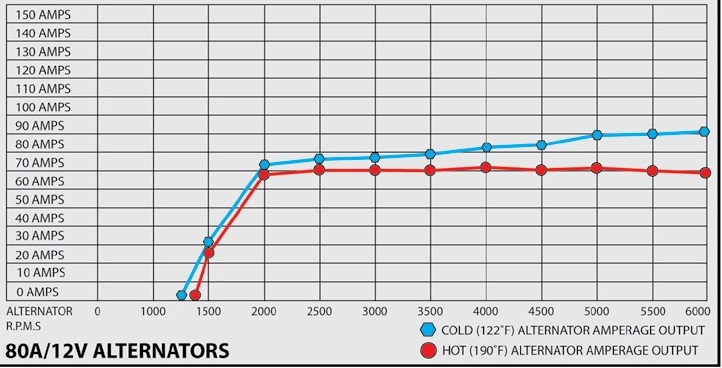
The alt below, I have installed quite a few, can achieve a full COLD rated output of 80 amps at 2000 ENGINE RPM if you have a 3:1 ratio. Cold ratings don't last for long though so the HOT rating is what you want to use and look at. HOT rated is a flat graph from 2000 ALTERNATOR RPM to 6000....


That means this alternator is at MAX hot rated output at 2000 ALTERNATOR RPM. That is 666 ENGINE RPM at a 3:1 ratio and only 800 ENGINE RPM at a 2.5:1 ratio. Hardly anywhere near full throttle.

You need to look at the alts hot rating, your pulley ratio and the alts output curve. There are LOTS of alts that are capable if supplying the max hot rated capacity at idle or just slightly above. Most current alternators, supplied by most engine makers, will be hitting well over their maximum hot rating at well below cruise RPM. Many after market alternators can hit their max rating at or slightly above idle speed with a 2.5:1 or 3:1 ratio which are fairly common pulley ratios..

This is a common US made aftermarket alternator by Balmar. (notice this is ALTERNATOR RPM not engine)
126748884.jpg


Even stock alternators like the Yanmar/Hitachi 60A alternator on the YM series is achieving its rated output at 5000 ALTERNATOR RPM. With a 3:1 pulley ratio you are developing the full rated output by 1666 engien RPM. Even at a 2.5:1 ratio you are hitting full output at just 2000 RPM which is well within cruise RPM range for that engine which has an upper limit of about 3000 RPM cruise and 3600 max.

At just 3100 ALTERNATOR RPM the curve crosses the 50A mark. This is just 1033 ENGINE RPM @ 3:1, basically just a touch above idle speed, for nearly 84% of its rated output for a basic stock alternator..
 
Last edited:
That means this alternator is at MAX hot rated output at 2000 ALTERNATOR RPM. That is 666 ENGINE RPM at a 3:1 ratio and only 800 ENGINE RPM at a 2.5:1 ratio.

As you'll obviously know, alternator output curves vary and not all have such a flat curve as the one you've chosen to show. If you'd used the 110A Balmar instead, the curve looks rather different...

balmar1.jpg


My boat uses a Prestolite Leece-Neville 90A unit, and the curve is rather steeper for that alternator, with max output being approached at 4000-5000 alternator revs (like the 110A Balmar above), as shown here...

prestolite8MR2069TA.jpg


The Balmar alternator you mentioned uses a 2.7" pulley. Many small boat diesels have quite small crankshaft pulleys - the one on my Volvo Penta is only about 5.2" diameter, so a 2:1 ratio is about the best achievable. Using a smaller alternator pulley to try to get 3:1 pulley ratio can be problematical with higher output alternators due to insufficient belt wrap distance.
 
Last edited:
As you'll obviously know, alternator output curves vary and not all have such a flat curve as the one you've chosen to show. If you'd used the 110A Balmar instead, the curve looks rather different...

balmar1.jpg


My boat uses a Prestolite Leece-Neville 90A unit, and the curve is rather steeper for that alternator, with max output being approached at 4000-5000 alternator revs (like the 110A Balmar above), as shown here...

prestolite8MR2069TA.jpg


Achieving a 3:1 pulley ratio with higher output alternators can be problematical due to insufficient belt wrap distance.

And that 110 Balmar is within about 5 amps of it's max hot rating of just 90A at about 1600 engine RPM using a 2.5:1 pulley ratio. A 3:1, as many engines have, you are at 1333 RPM. At 2:1 your at 2000 engine RPM. I still don't see "significantly lower" than its max hot rating and we're nowhere near "max revs". For many alts you can comfortably get the vast majority of the hot rated amps out of them at or below cruise RPM.

I have installed a boat load of those those 8MR series alts, great units, and also convert them often to external regulation of use with AGM or gel batteries. Leece-Neville builds Balmar's alternators. Most of these installations have been on 2.1:1 - 3:1 pulley ratios and never once had a problem even on AGM's which can really load up the alt. Many of these boats also turn a water pump with the alt belt which also minimizes belt wrap. I don't like it but it is what it is and they usually perform fine provided they are properly aligned and a decent quality belt is used. I have owned three 8MR's on my own boats using either the 90 or 105 amp units. Two of these were with external regulation and one with the stock adjustable regulator. I use a 2.5" pulley on the 8MR alts and our current boat has a stock 2.8:1 ratio.

Even at a 2.5:1 these alts are pumping out darn close to full rated capacity at just over 1600 engine RPM, this is a ways off of full max RPM for the engine to see the vast majority of the rating. Even if you use 5000 alt RPM and 2.5:1 you are at just 2000 engine RPM which is well within cruise range for many small aux engines...

These alts are easy to convert to external regulation too. I wrote this a while ago:

Converting an 8MR series to External Regulation
 
Last edited:
Top