Adding reefing lines for an additional 3rd mainsail reef

eebygum

Well-Known Member
Joined
6 Nov 2002
Messages
566
Location
Manchester
Visit site
I’m looking to get a third reef (with spectacles in the luff crinkle) added to my SHE32C as there were a couple of times I thought I could have benefited from it this summer on my sail up to Orkney. Plus I think it would help me balance the windvane better.

My boom only has space for two reefing lines so I’m trying to understand the best way to bring down the third reef to the boom.

All the reefing and main halyards are controlled at the mast, which I’m very happy and don’t wish to change.

Any ideas, descriptions or photo’s of you setup greatly appreciated.

Cheers
 
I was thinking that if you had a cheek block you could have a short reef pendant with an eye in the running end and attach a hauling line to it leading to the mast when you required it; which hopefully wouldn't be that often. The fixed end is just tied round the boom since you have a loose footed sail.

Then you wouldn't have a line permanently hanging under the boom.

If you attach a block with a soft shackle you could try it out and maybe go for the cheek block later on.
 
A lot of designers seem to think you should use the lines from the first reef when you put the second one in. Not sure I want to be clambering around the boom in two reef weather.

Assuming your current reefing lines run inside the boom, I'd just run reef 3 along the outside. I had two reefs on Jissel, both on the outside and they worked well. A block by the ramshorns and another on the boom, up through the cringle to a bowline round the boom. A third reef isn't going to be a huge amount of string, so you may not need it, but I had bits of line attached loosely under the boom to keep the reefing line under control when not in use.

Alternatively, if loads are low enough, a bowline, a turning block and a cleat on the boom might be enough.
 
If your boom has three internal lines, two for reefing and one for the outhaul, you could use the cheek block for a new, external, outhaul and lead the third reef through the vacant internal slot. Has the advantage of having all reefs in the same place, operating in the same way. I did this on a similar boat, works ok.
I do sometimes wonder about the use of a second reef on a shorthanded cruising boat though.
 
If your boom has three internal lines, two for reefing and one for the outhaul, you could use the cheek block for a new, external, outhaul and lead the third reef through the vacant internal slot. Has the advantage of having all reefs in the same place, operating in the same way. I did this on a similar boat, works ok.
I do sometimes wonder about the use of a second reef on a shorthanded cruising boat though.
Some boats seem to have very small first reef?
Probably good for racing.
For cruising, I would think a decent sized first and second reef would cover the same range as 3 reefs on a racing boat?
The boat I'm hoping to get has a fairly typical single line system, which doesn't seem to work vey well.
I'm thinking the first thing to do is get the second reef working really well.
If there's enough wind to need a reef, I'll get from A to B with two.
 
Some boats seem to have very small first reef?
Probably good for racing.
For cruising, I would think a decent sized first and second reef would cover the same range as 3 reefs on a racing boat?
The boat I'm hoping to get has a fairly typical single line system, which doesn't seem to work vey well.
I'm thinking the first thing to do is get the second reef working really well.
If there's enough wind to need a reef, I'll get from A to B with two.
Always the subject of argument but I took the advice of Kemp's and settled for two reefs, which has proved ideal for our kind of sailing. This is what it looked like, though the sail has now been replaced by a similar set-up from another maker.
shifta 002.jpg
 
I don't know your reefing arrangement. You don't mention whether its single line reefing, you don't mention if most of your sailing is single handed

I'd swap reef one to be reef 2 and reef 2 to be used for reef 3. You now don't have a first reef - or your first reef is now reef 2.

I'd be twitchy about putting in the 3rd reef at the mast and would suggest you finding a way to do this in the cockpit. When you get to 3rd reef weather you might not want to be prancing about the deck and reefing at the mast. Have a look at your deck organiser and see if you could swap (say outhaul) for reef 3 - then reef 3 is in the cockpit but you need to go to the mast for the outhaul - this would not work if you are racing - but fine if you don't mind the slight inconvenience.

I find I'm always a bit late in deciding when to reef - and commonly miss the first reef and go straight to the second. Our 3rd reef cuts the main down to 25% of area.

Take care, stay safe

Jonathan
 
You could see how it sets using the 2nd reef line, it might be good enough?
Thanks, I thought of that as an option which would probably work if setting up from anchor/marina but if reefing at sea I think that might involve too much dancing on deck (I sail a lot single handed); something I can quickly fix to the boom might be my better option.
 
Some boats seem to have very small first reef?
Probably good for racing.
For cruising, I would think a decent sized first and second reef would cover the same range as 3 reefs on a racing boat?
The boat I'm hoping to get has a fairly typical single line system, which doesn't seem to work vey well.
I'm thinking the first thing to do is get the second reef working really well.
If there's enough wind to need a reef, I'll get from A to B with two.


Yes, that's the gist of it. I think many are reluctant to specify a two reef mainsail because of wanting to keep a boat in class. Plus, racers always need to extract every once of drive from the rig.

When cruising, short or singlehanded, ease of use is often more important. Going down to a third reef when windspeed gets towards 25kts can save grief later if the wind gets up. It also suggests you can hold onto a full or lightly furled genoa longer, always a good thought. I have never felt a lack of drive operating like this, some boats may become unhandy, I guess you have to try it and see.

Neeves has suggested another approach which has a lot to commend it.

.
 
I have noticed this tendency over time for sailmakers and sailors to have only two reefs in the main - and frankly it is a trend that I can't understand. Ok two reefs might be fine for some but are we not supposed to go out sailing when the wind is strong? and what happens when you find yourself in strong winds rather unexpectedly sometimes the forecasters have it wrong or you might be on passage. I would be unhappy and nervous sailing a boat with only two reefs fitted in the main. Many times I have used the third reef in my main.
Like eeybygum says I am also happy with taking in reefs at the mast, I believe it the simplest system and sometimes you might need to be at the mast to haul down the main anyway. I cannot understand the reluctance to go on deck to the foot of the mast. With the exercise of care it needn't be dangerous.
The old advice of taking in a reef early is still relevant today.
 
Always the subject of argument but I took the advice of Kemp's and settled for two reefs, which has proved ideal for our kind of sailing. This is what it looked like, though the sail has now been replaced by a similar set-up from another maker.
View attachment 124781
So the second reef looks like it loses about 35% of the luff length, so maybe cuts the main area to 55%?
What wind do you think full sail is OK for and what would be too windy for two reefs?

I would think that for sailing close to the coat, with tides , shallows, headlands etc, the sea state is going to be the limit of what the boat can cope with rather than the absolute wind speed.
Sailing a Laser in 20mph winds, it's much easier further out than in the bay where the shallower water steepens the waves.
 
So the second reef looks like it loses about 35% of the luff length, so maybe cuts the main area to 55%?
What wind do you think full sail is OK for and what would be too windy for two reefs?

I would think that for sailing close to the coat, with tides , shallows, headlands etc, the sea state is going to be the limit of what the boat can cope with rather than the absolute wind speed.
Sailing a Laser in 20mph winds, it's much easier further out than in the bay where the shallower water steepens the waves.
I normally take in the first reef when I get about 24kn apparent when sailing to windward, a bit less in open water. This means that the second reef comes in at around 28-30kn. The boat, with 110% jib sails very well in 20kn when many boats will be reefed. My cruising grounds have included the Channel and southern North Sea, including a number of 24hr+ trips, but I can’t conceive of a situation where I would need even less sail, given modern forecasts. Those willing to set off into the Channel with a F7 or more in the forecast may well have different needs, and of course those going further afield. I don’t think that I have needed the second reef for a downwind or free sail in open water, though there was one occasion when we did a 2hr passage in the Scheldt in a steady F8 when I probably had two reefs.
 
Copy of my article in PBO
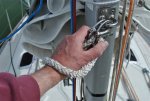
When I am sailing I have a short strop permanently fitted to the spinnaker ring on the mast. When visiting crew ask what it is for I tell them that it is for an emergency hand hold when at the mast in case a large wave causes the boat to roll unexpectedly & catches them out Picture A

That is until we are out of sight of land. Then I tell them the real reason I have it!!

As most of my sailing is on my own I try to go on deck as little as possible: hence I have single line reefing. Now I do not wish to get into the debate about this system – it works for me!!. The problem is that whilst it is great for the first & second reefs it needs lines permanently rigged up the leech & the luff of the sail. These have to be gathered in every time the sail is dropped. I can deal with the first two sets of reef lines OK, but they would be so long for the third reef that they would be a serious hassle. Furthermore, I only have to go down to third reef, at the most, once a year, but I hoist & drop the sail dozens of times.

Single line reefing is good but I wanted a bullet proof method of applying the third reef, plus a backup if a reef line were to break. Some single line systems have an array of blocks inside the boom & if these ever failed at sea the chances of repair would be limited.

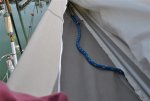
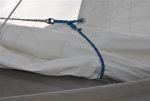
My solution was to have a separate line rigged through the boom to the blue line shown in picture C which just sits in the lazy cover until required. This blue line goes under the boom & the end not hooked to the red & white line has a large knot. This is to stop it slipping out through the slot in the cover. If one does not have enough pullies in the boom for the extra line one can always swop to the clew outhaul provided it has a snap shackle & is long enough to lead back to a winch on the deck where a strong pull needs to be applied

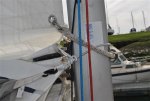
To reef I drop the boom, I head into wind (start the engine for a few minutes if needs be) I release the topping lift & halyard (I know from experience how much to let off) I go forward & hook the strop to the sail spectacles & under the spinnaker ring as in picture B. This keeps the sail down enough to prevent not to crush the sliders below & stops the luff pulling aft away from the mast. Letting the topping lift off allows the boom to drop into the cockpit so I can safely rig the blue strop as shown in pictures D & E. In the picture it is not very tight but when the sail flogs a little overcoming friction. It will tighten a lot more pulling the clew out & down to give a nice flat sail or I can leave a fuller shape if I so wish. (It was just done lightly in a marina for the pictures.)

I then hoist the halyard, bear away & stop the engine.

An improvement would be a lighter leech strop with a plastic stopper instead of the clumsy looking knot & the strop at the mast could be a little shorter, but I have had this for years & it has always worked, so it remains on the “to do” list
No A (600 x 402).jpg


No B (600 x 402).jpg
No C (600 x 402).jpg
No D (600 x 402).jpg
No E (600 x 402).jpg
 
I’ve just got twin line reefing to three reefs on sail. Works well, no hidden blocks in boom and can be done with ease from cockpit. The important thing is to mark your halyard at reef points - makes the whole process much quicker: release halyard to chosen reef, wind in relevant lines. Job done.
 
If there is only room to have two reefing lines in the boom why not make them for the second and third reefs or the first and third depending which of the first two you use most? You could always put reefing pennants on for the first one, its what reef knots are for.
I had only two reefs but both were deep ones with the first being a bit higher than a normal first reef and the second could best be described as a 2 and a half. If conditions were too strong for the second reef it was probably time to drop the sail and motor, but for coastal sailing that was a rare occurence.
 
You could always put reefing pennants on for the first one, its what reef knots are for.
Not exactly correct
Reef pennants cannot be used with sail bags attached to lazy jacks. Reef pennants do not tension the clew & gooseneck, only stow the loose foot in to the boom. You need an outhaul to the clew & a firm fixing such as horns etc for the luff. Simply tying light pennants round the sail does not meet those requirements
 
Top