Add a Battery Blue Sea Wiring

CraigandHan

Well-Known Member
Joined
20 Jun 2020
Messages
70
Visit site
Evening Chaps,

I have a question for a friend and now I have thought about it I’m trying to get my head back on track.
Anyways my friend has got an Add a Battery from Blue sea with the ACT automatic split relay.

All the wiring we understand however, we are just not sure where the starter and alternator wires go now, he used to have two isolators for both battery’s and is now consolidating them.

do the starter and alternator wires now go to 2 (see link) now or does just the starter and the alternator wire go straight to the battery??

http://assets.bluesea.com/files/resources/instructions/990310020.pdf

thanks for your help in advance.
 
Evening Chaps,
I have a question for a friend and now I have thought about it I’m trying to get my head back on track.
Anyways my friend has got an Add a Battery from Blue sea with the ACT automatic split relay.
All the wiring we understand however, we are just not sure where the starter and alternator wires go now, he used to have two isolators for both battery’s and is now consolidating them.

do the starter and alternator wires now go to 2 (see link) now or does just the starter and the alternator wire go straight to the battery??

http://assets.bluesea.com/files/resources/instructions/990310020.pdf

thanks for your help in advance.
The Dual circuit switch is two switches in one lump operated by just one knob.
IIRC the one in the "Add a battery" kit incorporates emergency battery paralleling

Yes
Connect the wires at present on the existing engine battery isolating switch to "2"( That's the connection to the engine start battery and the connection to the engine starter solenoid and alternator)

Connect the wires at present on the existing house battery switch to "1" ( that the connection to the house battery and the connection to the dist panel etc )

Personally Id have kept the separate isolator switches just addad a VSR and an emergency cross-over switch between the switched sides of the isolators.
 
ViC,

thanks for your input, so basically alternator and starter wires will be double jointed on 2?

I get what your saying about serperatly isolated and I thinkwe may keep the starter “key” as a safety so this can be isolated all together.

it was just a very rudimentary old fashioned way of doing it with wires everywhere so we wanted to try and “modernise” it and neaten it up, currently there was no split charger or anything on boated it was just used by turning batteries off and on via the isolator.
 
ViC,

thanks for your input, so basically alternator and starter wires will be double jointed on 2?

I get what your saying about serperatly isolated and I thinkwe may keep the starter “key” as a safety so this can be isolated all together.

it was just a very rudimentary old fashioned way of doing it with wires everywhere so we wanted to try and “modernise” it and neaten it up, currently there was no split charger or anything on boated it was just used by turning batteries off and on via the isolator.

Transfer the wiring from the existing isolators to the new dual circuit switch ... ie from the engine battery isolator to "2" and from the domestic service battery isolator to "1" The Dual Circuit swich combines the two switches into one " lump" but there is no electrical connection between the two .

I'd expect to find that the alternator output is connected to the main battery cable at the starter solenoid with a single heavy cable running from there to the existing isolator. If its not like this how is the alternator output connected?

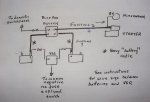
Here's a diagram I did recently but it is basically the same as shown in the Blue Sea instructions

Dual circuit switch wiring.jpg
 
This is awesome mate thank you,

I will get my mate to check the wiring but I can work of those thanks!

Fitting this switch is a backward step. It would (as Vic has already said) be better to keep the two separate switches. The Blue Sea switch does not allow one system to be switched off, it's both or nothing. Say you need to work on the engine and want the power off to the engine circuits, you can only do that if you turn the domestic circuits off too. But what if it's dark and you need the cabin lights on ? What if the problem happens at night, at sea, you need your nav/anchor lights on ?

You have a problem with the domestic system, smoke is coming from somewhere, you have to turn the switch off, now you can't start the engine.

A domestic battery has failed, you need to turn the switch off, no power for anything.

All of the above problems do not happen with two separate switches and a third switch that parallels the two circuits for emergencies. If there is a problem with one system you switch it off, the other continues to work, if you need to use the isolated system you can (generally only if it's a battery issue) switch on the emergency switch and run both systems from one battery/bank.

No reason why you cannot keep the existing two switches, tidy the wiring up and fit a VSR and the third switch. If your mate has purchased the Blue Sea switch already, perhaps he can return it in exchange for a VSR and extra switch ?
 
The reason why he got this kit was for the automatic charging relay as the batteries didn’t have anything split charging them before.

I get the idea of not isolating but could the standard key switch for the engine not be kept so you can isolate the battery? Or in an instance keep what’s there now, and always keep them on, then use the blue sea with the charging... then if anything is wrong use the old “key” isolators??
Thanks for the wiring help though I’ll send this all onto him
 
The reason why he got this kit was for the automatic charging relay as the batteries didn’t have anything split charging them before.

I get the idea of not isolating but could the standard key switch for the engine not be kept so you can isolate the battery? Or in an instance keep what’s there now, and always keep them on, then use the blue sea with the charging... then if anything is wrong use the old “key” isolators??
Thanks for the wiring help though I’ll send this all onto him

The key does not isolate the battery, it simply turns off the power to the instruments etc.

You could keep the existing isolators, left wired to the batteries as they are now, running new cables from them to the two input terminals on the Blue Sea switch, then connect the starter cable and domestic circuit cable to the two outputs. Leave them on under normal conditions (as you say) and use the Blue Sea switch for day to day use.

Seems unnecessarily complicated though, it would work just as well if the existing switches were left in place and a VSR added, along with the 3rd switch. Either method will function OK though.
 
The reason why he got this kit was for the automatic charging relay as the batteries didn’t have anything split charging them before.

I get the idea of not isolating but could the standard key switch for the engine not be kept so you can isolate the battery? Or in an instance keep what’s there now, and always keep them on, then use the blue sea with the charging... then if anything is wrong use the old “key” isolators??
Thanks for the wiring help though I’ll send this all onto him

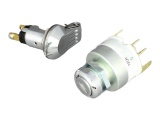
When you say "standard key switch" are you referring to an "ignition key switch " like you have in your car.

Ignition_&_alarm_switches.jpg


or are you referring to a battery isolating switch with a removable key like this :

Car-and-boat-battery_isolator_switch-with-removable-key_1.jpg


Keep the former, presumably on an engine control panel .

Keep the latter if you feel you must but if you do you might as well keep the domestic battery isolator as well , forget the dual circuit switch but fit a VSR
 
I got round the what if scenarios by fitting battery terminal switches on each of the neg terminals of the batteries. I like the dual switch for it's simplicity. If I ever see smoke one switch isolates everything. Once the fire is out I can trouble shoot at leisure.
 
Sorry Paul and VIC I meant key isolators, as in the second picture what ViC is,

although complicated I think I’ll advise to do what I suggested, keep the keys, run new wires to Blue Sea so it works under normal operation then IF there is a problem and need to isolate an individual one then he can with the old key.

there are lots of reason why it’s annoying, the key isolators are under separate boards etc etc and are a pain, so a nice easy one switch like the Blue Sea is compact and can be mounted easily in a nice box with the ACR.
Thanks for the help once again!
 
Sorry Paul and VIC I meant key isolators, as in the second picture what ViC is,

although complicated I think I’ll advise to do what I suggested, keep the keys, run new wires to Blue Sea so it works under normal operation then IF there is a problem and need to isolate an individual one then he can with the old key.

there are lots of reason why it’s annoying, the key isolators are under separate boards etc etc and are a pain, so a nice easy one switch like the Blue Sea is compact and can be mounted easily in a nice box with the ACR.
Thanks for the help once again!

That all sounds acceptable (y)
 
My pleasure :)
Paul, wondering if you can help.

for me, I’m currently having a problem with wiring, there seems to be a massive voltage drop on my B and G chart plotter (showing 11.9v with fully charged batteries, anyways I have re done connectors and insulated and re run 17.9 amp twin core to the battery just to see about the drop, it’s a good 4/5 meters or wiring maybe more. The battery power has come up to 12.4 but not showing the battery voltage , I have a lot going into the B and G all NMEA 0183 and a miniplexer.

is the twin core dropping the voltage that much.. and if so what wire do I need?

I have read chartplotters are a bit off on voltage measuring but just worrying it’s so low..

thanks in advance
 
Paul, wondering if you can help.

for me, I’m currently having a problem with wiring, there seems to be a massive voltage drop on my B and G chart plotter (showing 11.9v with fully charged batteries, anyways I have re done connectors and insulated and re run 17.9 amp twin core to the battery just to see about the drop, it’s a good 4/5 meters or wiring maybe more. The battery power has come up to 12.4 but not showing the battery voltage , I have a lot going into the B and G all NMEA 0183 and a miniplexer.

is the twin core dropping the voltage that much.. and if so what wire do I need?

I have read chartplotters are a bit off on voltage measuring but just worrying it’s so low..

thanks in advance

Exactly what cable are you using, do you have a link to it ?

Can you measure voltage at the plotter with a multimeter ?
 
I can’t measure it at the chart plotter I have tried but not sure how I can, the connectors I use are crimped and insulated so I can’t get in

the wire is twin core B11410 30m roll 17.50amp

that’s what I re wired it to, however I’m back on the old wiring (to the fuse socket and the chart plotter only registers 12.0 amps again
 
I can’t measure it at the chart plotter I have tried but not sure how I can, the connectors I use are crimped and insulated so I can’t get in

the wire is twin core B11410 30m roll 17.50amp

that’s what I re wired it to, however I’m back on the old wiring (to the fuse socket and the chart plotter only registers 12.0 amps again

That cable comes up as 2mm in a Google search here 2 Core Cable (Black) 30M, 17.50amp

It's best to provide a link so we know we're talking about the same stuff. 2mm 2-core is usually 25a, so i don't know why they quote 17.5 It looks like it isn't very flexible and doesn't have many strands.

You will need to accurately measure the voltage at the battery, at the plotter with the plotter off and at the plotter with it turned on.

12.4v at the battery isn't a fully charged battery, that's only about 70% charged, assuming it's rested with no loads or charging going on.
 
That cable comes up as 2mm in a Google search here 2 Core Cable (Black) 30M, 17.50amp

It's best to provide a link so we know we're talking about the same stuff. 2mm 2-core is usually 25a, so i don't know why they quote 17.5 It looks like it isn't very flexible and doesn't have many strands.

You will need to accurately measure the voltage at the battery, at the plotter with the plotter off and at the plotter with it turned on.

12.4v at the battery isn't a fully charged battery, that's only about 70% charged, assuming it's rested with no loads or charging going on.

Paul,
Sorry I messaged wrong, the battery is 12.8v, and the chart plotter was measuring 12.4.

many ideas how I accurately measure the voltage at the chart plotter??
Unfortunately I can’t provide a link because I got the wire from an auto shop but will see if I can see it.

it is pretty flexible cable to be fair
 
Top