ACR and Solar Panels

jbm1967

Well-Known Member
Joined
2 Feb 2019
Messages
70
Visit site
Hi, I would like to put in an ACR. From
What I understand once the Start Battery is fully charged the charge from the alternator will be sent to the house battery. Great! Will the same happen the other way? I.e. with engine off once the house battery is fully charged from the solar panels with the start battery be charged? Hope my questions make sense and any help would be much appreciated.
 
Hi, I would like to put in an ACR. From
What I understand once the Start Battery is fully charged the charge from the alternator will be sent to the house battery. Great! Will the same happen the other way? I.e. with engine off once the house battery is fully charged from the solar panels with the start battery be charged? Hope my questions make sense and any help would be much appreciated.
I only know ACR as a brand name for one make of VSRs, so my answer is in general for VSRs.
A Voltage Sensing Relay will put two banks of batteries in parallel when the voltage of one of the banks is at or above a predetermined voltage. But you have to choose which one and that is conventionally the engine start bank.
So if you wanted it to work the other way round you’d need two VSRs and another pair of wires to connect the positives of both banks together at the relay. All easily doable but I’m not sure why you would bother as the engine bank will always be near fully charged anyway.
 
I only know ACR as a brand name for one make of VSRs, so my answer is in general for VSRs.
A Voltage Sensing Relay will put two banks of batteries in parallel when the voltage of one of the banks is at or above a predetermined voltage. But you have to choose which one and that is conventionally the engine start bank.
So if you wanted it to work the other way round you’d need two VSRs and another pair of wires to connect the positives of both banks together at the relay. All easily doable but I’m not sure why you would bother as the engine bank will always be near fully charged anyway.
Makes sense. Thanks
 
My cheap ebay VSR works in both directions. The house battery is connected to solar and the relay joins the batteries when the sun is out. They also get joined when the engine is running.
 
My cheap ebay VSR works in both directions. The house battery is connected to solar and the relay joins the batteries when the sun is out. They also get joined when the engine is running.
Interesting - which voltage is it set to sense? How is it wired? I may have missed something really obvious in my thinking.
 
I’ve a standard VSR between both starter and house battery, solar and battery charger on house and alternator on starter, all charge either way switches 13.3 on and 12.8 off.

worked perfectly for the last 5 years
 
Most modern VSRs are dual sensing. This means that when either of the banks reaches the set point to close, the relay closes and parallels the two banks. There is no preferential battery/bank.

There is also a misconception (perpetrated by some VSR manufacturers) that the engine battery gets fully charged before the relay closes and charges the domestic bank. This is a load of old cobblers. For one thing, consider the dual sensing, how could the engine battery be charged first from the solar panels that are connected to the domestic bank ? I can hear someone saying "in that case the domestic bank will be fully charged first, then the VSR will close and charge the engine battery, but sorry, that's still wrong.

**Putting aside for a moment the fact that a decent VSR will have various delays in opening and closing, rather than the "closes at xxV and opens at yyV, let's pretend that it does open and close at set points and nothing else. Let's take Daves 13.3V on from the above post. Daves engine battery is at a reasonable rested voltage of circa 12.6V and he starts his engine, his alternator starts charging at 14.2V. How can the VSR tell the difference between the 12.6V true battery voltage and the alternator output of 14.2V ? Simple answer is, it cannot, it is connected to the battery, the same as the alternator and all it can "see" is the alternator output, it will close immediately. If the battery is partially depleted it might take a few seconds for the terminal voltage to rise to 13.3V but it won't take long.

**Most decent VSRs will have delays in switching, or you'll get relay chatter. Say the relay closes when you start the engine and the domestic bank is fairly depleted, that could pull the terminal voltage of the engine battery below the set point for the relay to open. In no time at all the engine battery voltage will rise above the set point for the VSR to close and then the domestic bank will pull the voltage down again, ad infinitum. Hence the need for switching delays.

My VSR of choice is the Victron Cyrix range. These have varying set points for opening and closing, depending on battery voltages. Details can be found on the Victron site. But, they still close very soon after a charging source such as the alternator exists.

There is nothing wrong with the relay closing before the engine battery is fully charged. If it waited for that to happen it would be a rubbish solution. The engine battery isn't likely to accept much charge, other than for a short time, so you may as well be making use of the alternator by charging the domestic bank as soon as possible.
 
Thanks for all the input. I bought one of these befor all the replies 12V 140amp Durite 0-727-33 voltage sensitive/intelligent Split Charge Relay
No idea if it’s dual sensing but I hope it is
 
Most modern VSRs are dual sensing. This means that when either of the banks reaches the set point to close, the relay closes and parallels the two banks. There is no preferential battery/bank.

There is also a misconception (perpetrated by some VSR manufacturers) that the engine battery gets fully charged before the relay closes and charges the domestic bank. This is a load of old cobblers. For one thing, consider the dual sensing, how could the engine battery be charged first from the solar panels that are connected to the domestic bank ? I can hear someone saying "in that case the domestic bank will be fully charged first, then the VSR will close and charge the engine battery, but sorry, that's still wrong.

**Putting aside for a moment the fact that a decent VSR will have various delays in opening and closing, rather than the "closes at xxV and opens at yyV, let's pretend that it does open and close at set points and nothing else. Let's take Daves 13.3V on from the above post. Daves engine battery is at a reasonable rested voltage of circa 12.6V and he starts his engine, his alternator starts charging at 14.2V. How can the VSR tell the difference between the 12.6V true battery voltage and the alternator output of 14.2V ? Simple answer is, it cannot, it is connected to the battery, the same as the alternator and all it can "see" is the alternator output, it will close immediately. If the battery is partially depleted it might take a few seconds for the terminal voltage to rise to 13.3V but it won't take long.

**Most decent VSRs will have delays in switching, or you'll get relay chatter. Say the relay closes when you start the engine and the domestic bank is fairly depleted, that could pull the terminal voltage of the engine battery below the set point for the relay to open. In no time at all the engine battery voltage will rise above the set point for the VSR to close and then the domestic bank will pull the voltage down again, ad infinitum. Hence the need for switching delays.

My VSR of choice is the Victron Cyrix range. These have varying set points for opening and closing, depending on battery voltages. Details can be found on the Victron site. But, they still close very soon after a charging source such as the alternator exists.

There is nothing wrong with the relay closing before the engine battery is fully charged. If it waited for that to happen it would be a rubbish solution. The engine battery isn't likely to accept much charge, other than for a short time, so you may as well be making use of the alternator by charging the domestic bank as soon as possible.

Interesting essay.

Why do VSR's switch at 13.6 volt, well in the 1970's when I designed them alternators regulated at 13.6 volt, today they regulate at 14.2/14.4 so why use 13.6 volt still :unsure:

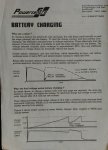
You cannot have duel sense VSR's with differnt operation cycles :unsure:, below is our handout for the 1985 SBS, explaing a VSR and multistage charging, what's happened with all these modern VSR's ?

Voltage adjustment, that has been available since the 80's, chatter, that's bad design and bad battery management, though for some time we have used both charge amps and volts to control switching, so no chatter.

The problem charging from solar or a mains charger using a VSR is engine start, coupled with timed drop out to avoid chatter. With solar charging engine and service battery are linked, starting the engine will pull a large current from service battery, will your cabling and contacts carry it ? Why do the modern advanced VSR's include an interface to drop out contacts before starter engagement ?

Modern systems tend to be marketing led, rather than what people need.

Have we moved on from 1985 ?

Brian


p4000.jpg
 
Interesting essay.

Why do VSR's switch at 13.6 volt, well in the 1970's when I designed them alternators regulated at 13.6 volt, today they regulate at 14.2/14.4 so why use 13.6 volt still :unsure:

You cannot have duel sense VSR's with differnt operation cycles :unsure:, below is our handout for the 1985 SBS, explaing a VSR and multistage charging, what's happened with all these modern VSR's ?

Do VSRs switch at 13.6V ? None of the ones mentioned above do so. The Victron ones i mentioned certainly don't either, they close between 13.0V and 13,8V with a greater delay at the lower voltages, varying between 10 mins and 4 secs.

Just because alternators now regulate at higher voltages doesn't mean we need the VSR to close at those voltages, we just want the VSR to close when one of the banks is on charge. Your own VSRs seem to close at 13.8V, so you must agree :)

The problem charging from solar or a mains charger using a VSR is engine start, coupled with timed drop out to avoid chatter. With solar charging engine and service battery are linked, starting the engine will pull a large current from service battery, will your cabling and contacts carry it ? Why do the modern advanced VSR's include an interface to drop out contacts before starter engagement ?

Why wouldn't they ? Fit a 120A VSR with cable rated at least 120A and protect it with a fuse, no greater than 120A. The Victron VSR even has a connection to close the relay if the engine battery is low, to enable some assistance from the domestic batteries, so Victron are obviously content that the VSR is up to some current flowing to help start the engine, obviously within the constrains of the relay rating.

Modern systems tend to be marketing led, rather than what people need.

Have we moved on from 1985 ?

We definitely have moved on. Back in the 80's options were limited and most boats would have had 1-2-B switches and/or split charge diodes. The VSR is only one possible solution to split charging and current, quality ones, fulfil the needs of many boats. They are simple, reliable and affordable. But we now have other options too, lower loss FET based splitters for simple alternator charge splitting and more sophisticated options such as A2B or B2B chargers.

We can have a high output alternator controlled by a digital, external, regulator, controlled by a BMS, charging and maintaining a bank of Lithium batteries, with a B2B to charge the engine battery using a totally different charging regime. Or we could have a large solar array charging a big bank of deep cycle batteries, with a B2B charging the engine battery, and a VSR between the engine battery and the bow thruster battery.

So yes, i think charging systems have most definitely moved on.
 
Last edited:
Top